
Chatuh Shloki Manusmriti: A Multidimensional View of the Dharmashastras
Everything we know in this world is through Vāk, the medium of the word and the corresponding idea; so, everything in this world can be objectified as Vāk. The Bhāratiya tradition, while explaining the development of verbal knowledge, propounds it in four stages, namely: 1. Para, 2. Pashyanti, 3. Madhyama, and 4. Vaikhari.
Para is the unchanging substratum that derives from the chaitanya shakti of ultimate reality, Brahman. Pashyanti is the formation of a slight desire – iccha shakti – to speak. Madhyama is the construction of more concrete content in one’s mind through jnāna shakti, while Vaikhari is the final sound that comes out of the mouth through kriya shakti. In essence, Vāk’s journey from Para to Vaikhari illustrates the process of creation itself – from the unmanifested to the manifested, from the subtle to the gross. When in the Bhagavad Gita, Lord Krishna tells Arjuna that he has already propounded this knowledge to Surya, which was later transmitted to Manu and the Saptarishis, Arjuna raises the question about the timeline of the shāstra as it was being explained to him. This discussion itself, from the fourth adhyāya of the Gita, generates the idea of shāstra being developed in different formats and being revealed in the mortal world as per the needs of the time, but being present in its Para form eternally.
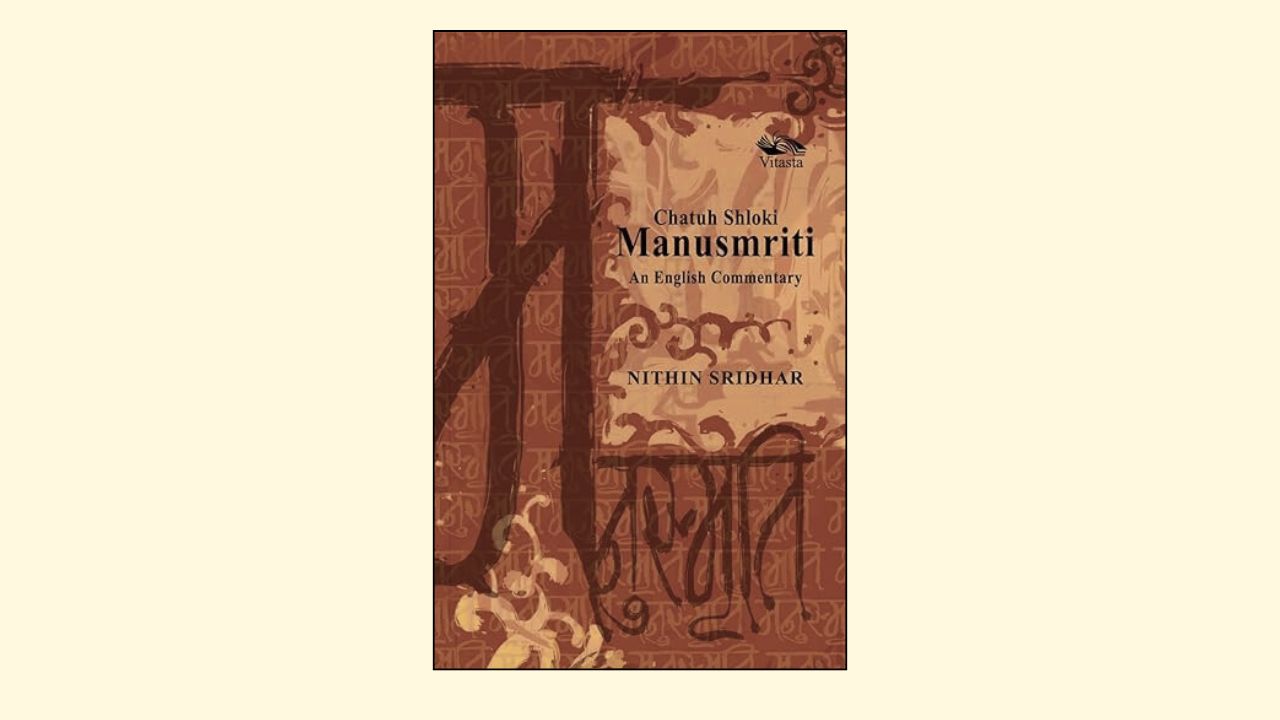
Nithin Sridhar, right in the first chapter of his book, Chatuh Shloki Manusmriti, develops the discussion on origination, transmission, and the authorship of Manusmriti, which develops this idea of shāstras being eternal, continuing the explanation of Dharma only in different modes, and keeping its essence homogenous between the Shruti and Smriti shāstras, thereby avoiding a divergence within the form of Dharma. Attributing the authorship of the Manusmriti either to Prajapati Brahma or Swayambhuva Manu has therefore not been debatable, as the knowledge originating in various modes of Vāk provides sufficient space for resolving this conflict, as shāstras develop through the jnāna shakti of Brahman, later on revealed by the rishis, thereby maintaining the Apaurusheyata of the shāstras. Even considering the modern theory of historically aligning the shāstras, Nithin Sridhar provides sufficient evidence from the Mahābhārata and various other Purānas, situating the placement of Manusmriti as Pramāna Shāstra.
As an apprentice of Vedānta, the appealing part of the book, to me, is to see someone filling the gap within Vedānta texts and Smriti Shāstras, which have been studied, dealing with two different aspects of Dharma for ages. Under the explanation of general transmission of Indic knowledge, the author provides sufficient evidence explaining the homogenous nature of purushārthas encompassing the Kāmasutra, Vedānta Shāstras, and Manusmriti by placing them on the same ground dealing with the formulation of Artha, Kāma, Dharma, and Moksha purushārthas.
The second chapter in the book provides at length a detailed discussion regarding the nature of Dharma, differentiating it from the modern explanation of Dharma as merely morals, ethics, and other mortal forms of actions. The author’s insight in aligning the Sutra Granthas, the Smriti Granthas, and traditional interpretations is commendable, as it strengthens the principle that all the Dharma Shāstras originate from the same source, hence collaboratively explaining the term Dharma, and therefore, without considering the approach of various shāstras, one cannot interpret Dharma. Manusmriti itself deals with Dharma as multi-dimensional, explaining various modes of Dharma, indicating that it cannot be merely translated as an ethical or moral practice, but rather carries the potential of Dharma being beyond the Bhautika world, transmitting and inheriting its role and idea in Ādhyātmika and Ādhidaivika modes.
The author’s later explanation of the function and purpose of smritis in Hindu society deals with the idea of designating a simplified technique of Dharma among various groups of society, carefully defending the Varna Vyavastha explained in Manusmriti, which has been challenged by the so-called progressive groups of modern society. While concluding the second chapter, he points out various issues faced by people following the shāstric tradition, which has created a clear gap between modern and traditional interpreters of the Dharmashāstras and the Manusmriti in particular.
As a resolution to the corrupted interpretation, in the third chapter of the book, the author offers a rigorous discussion on the definition of Dharma, the procedure for attaining the knowledge of Dharma through various Pramānas, and shraddha as the most primordial qualification for attaining knowledge along with various perspectives of Dharma and its role cosmologically, temporally, teleologically, functionally, and rationally. All these modes of Dharma, defended through the explanations in the Manusmriti, seem to be an appealing technique for shielding the methodology accepted by the Dharmashastras.
Finally, the second portion of the text justifies the title of the book, not merely as an allocative defense, but starting with a rather well-illustrated commentary on the first four verses of the Manusmriti.
In the Indian hermeneutical traditions, particularly the Mīmāṃsā and Vedānta schools, the ultimate meaning or purport (tātparya) of a shāstra (scriptural or scientific text) is determined using a set of six criteria known as the ṣaḍ-vidha-tātparya-liṅgāni (six-fold signs for ascertaining the purport). These six limbs are Upakrama (introduction/commencement), Upasaṃhāra (conclusion/culmination), Abhyāsa (repetition/recurrence), Apūrvatā (novelty/uniqueness), Arthavāda (eulogy/corroborative statements), and Yukti (reasoning/logic).
Among these, upakrama and upasamhāra are considered elements that prima facie incorporate the initial passages or chapters of the text, which are examined to determine the subject matter, along with the concluding passages or chapters, which are also analyzed to see what the author finally establishes or summarizes. The conclusion should align with the introduction. Through abhyāsa, one determines the frequency with which a particular idea, concept, or term is mentioned throughout the text, which indicates its importance to the central theme. The first two (Upakrama and Upasaṃhāra) are considered essential as they frame the entire discussion, and consistency between the beginning and the end is a strong indicator of the text’s intended meaning.
The traditional method of developing a shāstra incorporated the elements of conversations between the guru and shishya, focusing upon the same Upanishads through Shrauta Parampara – the procedure of listening to elaborate philosophical principles, developing this tradition of Samvāda. This tradition has remained dominant in shāstric teachings, as questions raised, either in the form of Samshaya (doubt/argument) or Jigyāsa (curiosity), have been evaluated on the grounds of Adhikārita/Yogyata – the eligibility of the listener and the speaker. Raised questions showcased the eligibility of the shishya/listener while the given explanation gradually develops the intensity of the subject based on the increasing values of Dharma within the shishya until the conclusion of the text.
All the ācharyas commenting on the Bhagavad Gita have therefore considered the first adhyāya of the Gita vital because it showcases the eligibility of Arjuna, who identifies himself as a shishya and surrenders at the feet of Bhagwān Sri Krishna for attaining the knowledge of his Dharma, despite it just being a representation of the frustration of Arjuna.
As the first four verses of the Manusmriti incorporate the questions raised by rishis for explaining the form of Dharma, these verses play the role of Para Vāk, which generates the originating form of thought, later developing into a lengthy explanation of Dharma propounded by Manu. Hence, this commentary plays a vital role in explaining those four verses with the crux of the Manusmriti itself.
Despite the author’s work being a fresh analysis, he carefully considers the previous commentaries of senior writers, offering respect and acknowledgement. Incorporation of meanings from different philosophical schools of Nyāya, Vaisheshika, and Yogamārgas, along with commentators from Vedānta schools, seems significant as various Vedānta schools of Adi Shankaracharya, Madhvāchārya, Rāmanujāchārya, and Vallabhāchārya have assimilated the ideas of other philosophical schools, aligning them with the shāstras, thereby providing a new perspective.
The most attractive element in this commentary by Nithin Sridhar is his ability to maintain the traditional method of writing the commentary, elaborating the shabdārtha (meaning of every word), thereby analyzing the meaning of the verse in accordance not just with the Sanskrit dictionary but also the commentaries of previous commentators on the Manusmriti.
Manusmriti has been alleged as a text that distorts the form of Vedic Dharma and as offering justifications for discrimination. Considering this proposition as the primary Purvapaksha against the Manusmriti, the author, in the appendix of the book, offers various perspectives about the arrangement of Varna Vyavastha, considering its explanation as found in the Purusha Sookta, the Bhagavad Gita, Smriti, Bhagavat Purāna, and opinions offered by various āchāryas, thereby offering an all-encompassing text for interested readers.
A person trained in Western education finds it convenient to criticize the shāstras, which has created a huge division among traditionally trained learners and modern experts. Thus, the approach taken by Nithin Sridhar offers avenues to Dharmic learners and researchers to undertake the writing of commentaries on the various Dharmashāstras, keeping in mind the allegations of modern researchers and offering authoritative refutations, thereby enabling a legitimate understanding of the form and intent of Dharma.
