
The Price of Silence: Did Our Complacency Cost Your Child Her Dream College Acceptance?
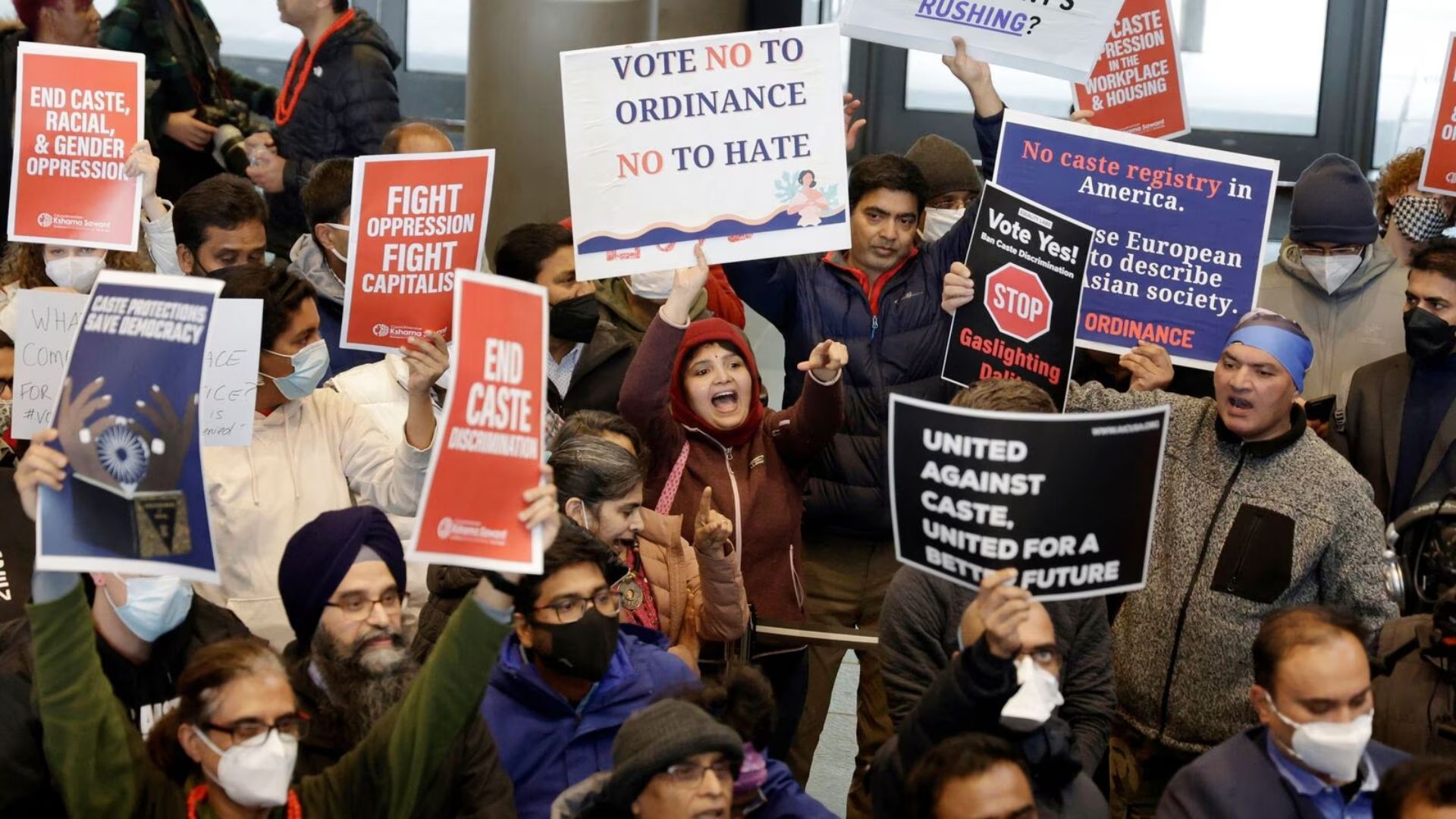
Image courtesy of Fair Observer
Introduction
It is the time of the year when students finalize their college choices, parents plan summer vacations, and families look forward to the future. Yet, beneath the surface, a heavy fog of frustration and disappointment lingers for many whose children were rejected by the dream universities they rightfully deserved. You may be torturing yourself with questions, wondering what mistakes you made or what more you could have done to secure that coveted acceptance letter. The painful truth, however, is that the system you supported may have been biased against them. This essay attempts to provide a research-based analysis of how the Hindu community’s own political complacency and blind acceptance of hostile ideologies might have directly compromised the academic futures of our children.
A 2024 academic study by the Network Contagion Research Institute (NCRI) and Rutgers University reveals a deeply troubling trend: mainstream anticaste narratives are fueling systemic prejudice against the entire Hindu community. After being exposed to “caste discrimination” material from Equality Labs, everyday participants shockingly endorsed actual quotes from Adolf Hitler where the word “Jew” had simply been replaced with “Brahmin.” When Diversity, Equity, and Inclusion (DEI) frameworks weaponize dehumanizing rhetoric—leading wellmeaning people to view a religious minority through the lens of “viruses,” “parasites,” and “the devil personified”—the system is fundamentally broken.
The study’s college admissions experiment exposed the real-world dangers of this institutionalized bias. When a Hindusounding admissions officer rejected a Hindusounding applicant, participants primed with anticaste rhetoric immediately fabricated a narrative of discrimination. Despite absolutely zero supporting evidence, they automatically assumed the officer was a biased “uppercaste” individual, deemed the decision unfair, and eagerly demanded that the officer be punished. By reducing an entire religious community to a monolith of inherent racism, current academic and corporate DEI frameworks are not preventing bias—they are actively codifying a new form of corporate and collegiate Hinduphobia.
As the proverb goes, the devil is always in the details. By passively accepting these flawed DEI caste narratives, the Hindu community is unwittingly compromising the future of their own children. Supporting genuine equality and social justice is essential, but it is equally paramount to ensure that these initiatives do not weaponize a new form of systemic discrimination against our own families. Whether through silent compliance or misplaced support of contemporary caste rhetoric, we are actively jeopardizing our children’s career prospects. Therefore, the time has come to arm ourselves with objective academic research, confront elected officials as the election season approaches, and demand that these antiHindu narratives be challenged, critiqued, and, if need be, the authors hauled to the courts for the sake of future generations.
This essay, therefore, attempts to bring critical data and analysis required to break the cycle of complacency. We can no longer afford to retreat into the comfort zones of professional success, weekend parties, and annual vacations while our community’s reputation is hollowed out. It is time to take control of the narrative against Hindus, Hinduism, and Hindu communities and secure the future that our children deserve.
The Research
A November 2024 study conducted by the NCRI and Rutgers University’s Social Perception Lab reveals a surprising paradox: certain diversity, equity, and inclusion (DEI) frameworks designed to combat prejudice may actually create more hostility [1]. Using a randomized controlled trial, researchers compared how people react to rigid “oppressor versus oppressed” framing versus neutral readings. The results showed that participants exposed to advocacyheavy materials were significantly more likely to assume malicious intent in a college admissions scenario. This reaction demonstrated a heightened hostile attribution bias—the psychological tendency to interpret neutral or unclear situations as intentionally hostile.
Designed by Dr. Lee Jussim, the study examined a nationally representative sample of 847 Americans to determine how casteawareness training shapes public perception. The experimental group read an essay that used the framework and language of Equality Labs—an advocacy group whose widely cited survey on American caste dynamics has been criticized by researchers as unscientific. Meanwhile, the control group read a neutral, academic overview of the caste system. The data showed a stark contrast: respondents exposed to the Equality Labs intervention perceived significantly higher levels of bias in the admissions process. Specifically, exposure to this framework led to a 32.5% increase in the perception of microaggressions, a 15.6% spike in perceived harm, and an 11% rise in assumptions of bias during interview processes compared to the control group [1].
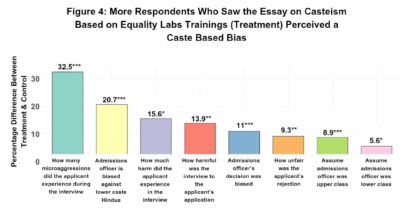
Source: NCRI Report, p. 14
Beyond everyday social scenarios, the study revealed a significant increase in participant agreement with extreme, demonizing language. The researchers adapted historical quotes from Adolf Hitler, replacing the word “Jew” with “Brahmin”—a group frequently depicted as oppressors in contemporary caste narratives. Participants who had been exposed to the advocacybased DEI content were markedly more likely to endorse these severe statements, showing increased agreement that Brahmins are “parasites” (+35.4%), “viruses” (+33.8%), and “the devil personified” (+27.1%). According to the researchers, these findings suggest that exposure to rigid antioppressive narratives can inadvertently make individuals more vulnerable to the types of scapegoating and demonization typically characteristic of authoritarianism [1].
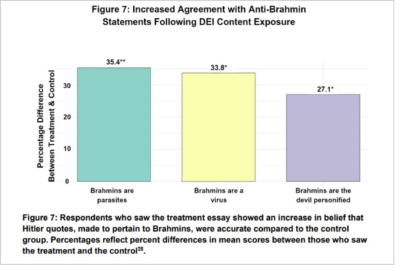
Source: NCRI Report, p. 17
Ultimately, the evidence highlights a notable psychological irony. While these antioppressive DEI frameworks explicitly set out to eliminate prejudice, certain narratives can instead trigger a deep, hostile attribution bias. By shifting how individuals process social interactions, these frameworks can inadvertently heighten interpersonal suspicion, foster prejudicial attitudes, encourage authoritarian policing behaviors, and drive support for punitive actions—even when there is no objective evidence that a transgression occurred.
The Impact
The realworld impact of the NCRI study can be evaluated through four distinct perspectives. The first is the weaponization of an information vacuum. A survey by CoHNA (Coalition of Hindus of North America), based on a YouGov national sample of 1,500 respondents, reveals that public awareness of the caste system in the United States remains low, with only 8% having personal experience with caste [2]. Proponents of antiHindu propaganda have leveraged this lack of public knowledge to advance hostile agendas, integrating unverified caste policies into university DEI frameworks. By adopting these narratives, institutions such as Harvard University, Brown University, and the California State University system have effectively codified systemic bias against Hindu applicants and staff under the guise of social justice.
The second perspective focuses on the empirical proof of prepackaged bias. The study by the NCRI and the Social Perception Lab proved that exposure to anticaste rhetoric precipitates broader, systemic bias against the Hindus. Despite a complete lack of supporting evidence, study participants automatically associated bias and unfairness with “uppercaste” individuals and exhibited an alarming willingness to punish them. Ultimately, this rhetoric manipulated wellmeaning participants into stereotyping Hindus as inherently exclusionary and discriminatory.
The third perspective highlights the generalized stereotyping of all Hindus. Because the American public and institutional decisionmakers possess very little awareness of caste dynamics, they cannot navigate the nuances of the system or distinguish between different subcommunities within the Indian community. In the absence of objective knowledge, individuals are highly likely to form broad, negative biases against people of Indian origin, particularly Hindus, based solely on the sweeping generalizations present in antiHindu advocacy materials.
The fourth perspective tracks the transition from anti-Hindu narratives to realworld harms. The tangible consequences of this conditioned “desire to punish” have already resulted in severe disruptions to families and careers. This dynamic was evident in the high-profile Cisco caste lawsuit, in which the California Civil Rights Department aggressively sued defendants based on caste before ultimately dropping the case for lack of evidence. As CoHNA Steering Committee member Aldrin Deepak, a Dalit and practicing Hindu, observed, rushing to divide Hindu Americans into arbitrary “oppressed” and “oppressor” categories erases the voices of marginalized Hindus who refute these claims [3]. Ultimately, the NCRI study shows that when weaponized alongside hostile rhetoric, the institutional deployment of the word “caste” creates measurable animosity against the broader Hindu community.
Conclusion
Data from the NCRI survey demonstrate a troubling reality: antiHindu groups have successfully institutionalized flawed caste narratives across numerous universities. Consequently, it is highly probable that the conditioned biases of admissions officials are negatively influencing the college admissions prospects of Hindu students. The Hindu community’s continued silence only allows this institutionalized prejudice to expand unchecked. Potential impact on college admission is just one example. The silence of the Hindu community has already marginalized them from broader discussion on interfaith dialogue, where global discourse is dominated by communities who are active participants and often vocal [4].
If we want to stop these false narratives and protect the rights of future generations, silence is no longer an option. Every member of the community must take decisive action:
- Educate themselves on the nuances of antiHindu narratives, identifying who is driving them and understanding their realworld impact.
- Engage in the democratic process by voting in primary and general elections at all levels of government.
- Advocate for Hindu causes through civic engagement, demanding accountability from all candidates in upcoming elections, regardless of party affiliation, on the following five critical points:
- Acknowledge the contributions of the Hindu diaspora.
- Recognize Hinduphobia as a distinct form of bias.
- Introduce legislation to provide robust legal protections against Hinduphobia.
- Designate October as Hindu Heritage Month to help Hindu social workers raise awareness of Hindu culture among the nonHindu population in the USA.
- Introduce bills to protect sacred Hindu symbols, such as the Swastika, distinguishing it clearly from the Nazi Hakenkreuz.
References:
- NCRI Report (2024, November 13). Instructing Animosity: How DEI Pedagogy Produces the Hostile Attribution Bias. Network Contagion Research Institute (NCRI) and the Social Perception Lab, Rutgers University. Retrieved on January 18, 2026, from https://networkcontagion.us/wpcontent/uploads/InstructingAnimosity_11.13.24.pdf2.
- COHNA (2023, March). A Survey of the American Understanding of Caste. Coalition of Hindus of North America. Download from https://cohna.org/wpcontent/uploads/2023/08/SurveyAmericanUnderstandingofCasteMay2023.pdf
- COHNA (2024, November 29). New Academic Research Proves Caste Narratives in DEI Create Bias Against Hindus. Coalition of Hindus of North America. Retrieved on May 25, 2026 from https://cohna.org/academicresearchcastenarrativesdeibiasagainsthindus/
- Rao, R. N. and Kuppa, P. (2013). Hindu Interfaith Discourse: Spiral of Silence as a Theological Inevitability. Published in the book “A Communication Perspective on Interfaith Dialogue: Living within the Abrahamic Traditions,” Edited by D. S. Brown Jr., Lexington Books.
