
Beyond Monotheism: Swami Vivekananda on the Vedic Journey from the Gods to the Absolute
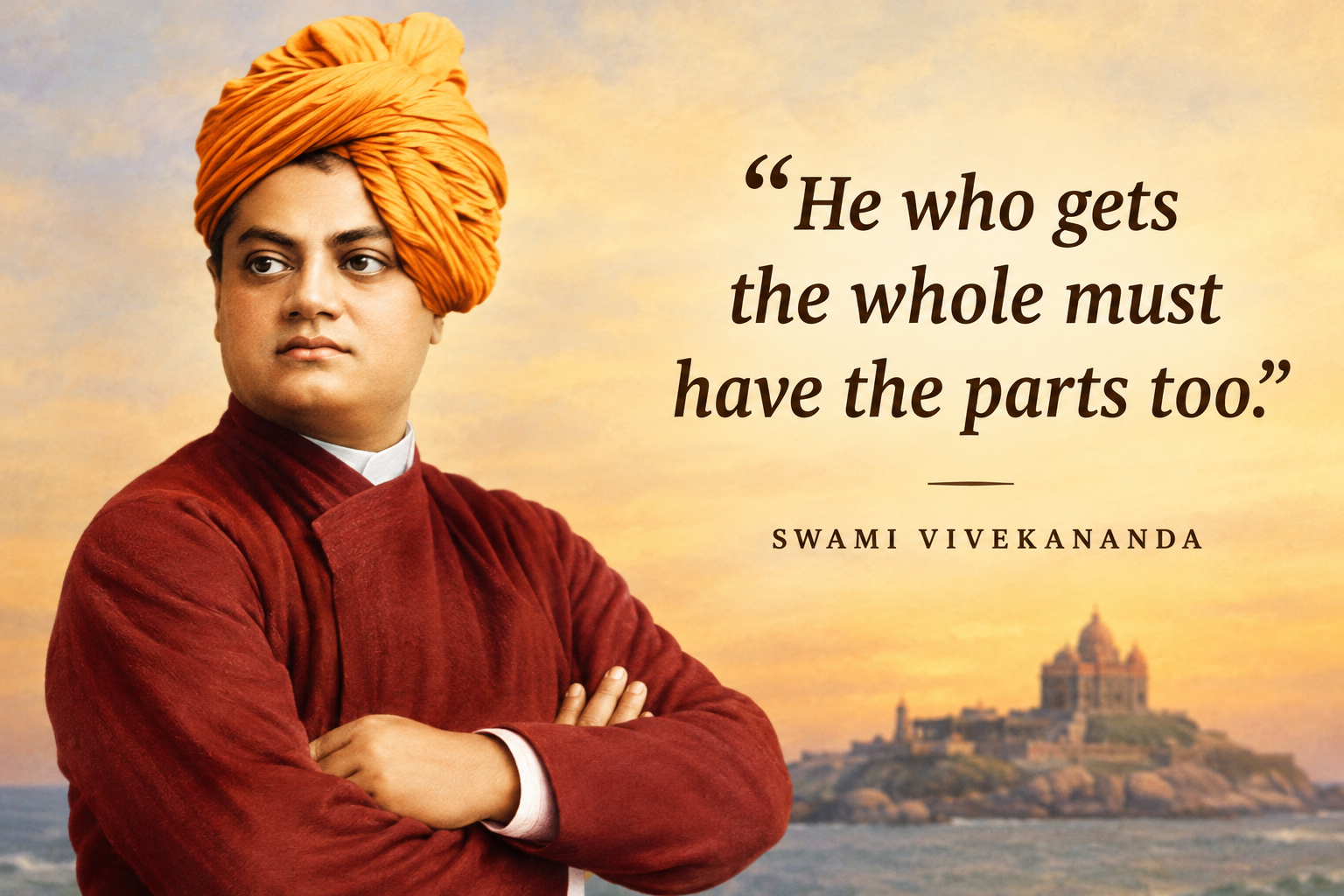
Image created using ChatGPT
A persistent assumption in modern discussions of religion is that the movement from many gods to one God represents the natural and highest trajectory of religious development. According to this familiar narrative, primitive man, confronted with the bewildering multiplicity of nature, first worshipped several gods associated with different forces of the cosmos; with the gradual refinement of religious consciousness, these scattered divine powers were consolidated into the conception of one supreme personal God. Monotheism, in this scheme, becomes the mature form of religion, while whatever lies beyond it is either dismissed as mystical speculation or regarded as a departure from the proper conception of God. Swami Vivekananda’s reading of the Vedic tradition presents a very different intellectual history. For him, the extraordinary feature of the Vedic mind is precisely that it did not regard the conception of one supreme personal God as the terminus of religious inquiry. Monotheism appears in the Vedic development, but the Indian mind, according to Vivekananda, soon found that even this conception did not exhaust the philosophical problem. The question was no longer merely whether there were many gods or one God. It became the far more fundamental question: What is the ultimate reality of which the gods, the universe, and the individual are all manifestations?
To appreciate the force of Vivekananda’s argument, one must first be careful with the terminology. The early Vedic world is often described, rather casually, as “polytheistic,” as though the Vedic seers simply believed in a collection of independent gods competing for jurisdiction over different departments of nature. Such a description obscures an important feature of Vedic religious consciousness. The hymns invoke Agni, Indra, Varuna, Surya, Soma, and other deities, sometimes elevating the deity being addressed to a position of extraordinary supremacy. Yet alongside this multiplicity is a persistent intuition of unity. The divine can be approached through different names and forms without necessarily implying that ultimate reality itself is fragmented into competing divine substances. Vivekananda draws attention to precisely this tendency when he observes that the idea that the same God manifests Himself/Herself in various forms is already present in the oldest portions of the Vedas. The significant movement, therefore, is not simply from “many gods” to “one God”. It is from the apprehension of the many towards an intuition of the One underlying the many.
This is why the conventional evolutionary formula of “polytheism followed by monotheism” is inadequate for understanding the Indian tradition. The Vedic poets were not merely counting gods and gradually reducing their number. They were grappling with a metaphysical problem: how can multiplicity coexist with unity? The divine appears in countless forms, yet the mind repeatedly seeks what lies behind those forms. The famous Vedic intuition — “Ekam Sat Vipra Bahudha Vadanti” — that Truth is one, though sages speak of it in different ways, captures something of this intellectual temperament. Whatever the precise historical development of Vedic passages, the broad philosophical trajectory identified by Vivekananda is unmistakable: plurality does not necessarily imply ultimate fragmentation. The many forms of the sacred may be expressions of a deeper unity.
At a later stage, according to Vivekananda, there emerges a more recognisably monotheistic conception. The divine is increasingly apprehended as a Supreme Being, the ruler of the universe, the guardian of moral order, and the power upon which existence depends. This development is neither trivial nor something to be embarrassed about. The conception of a single supreme divine intelligence provides a profound answer to the problem of multiplicity. The universe is no longer understood as a collection of unrelated powers; it possesses an overarching sovereignty and moral order. God becomes the supreme center to whom the cosmos is ultimately answerable. In the language of religious devotion, this personal God can be the object of love, surrender, prayer, and moral allegiance. But it is precisely here that Vivekananda locates the beginning of the next philosophical problem.
For the religious mind, the statement that there is a supreme ruler may be sufficient. For the philosopher, however, another question immediately arises: Does the existence of a ruler explain the existence of the realm that is ruled? Vivekananda expresses this difficulty with characteristic directness: “A ruler of the world does not explain the world.” The distinction is fundamental. To identify a ruler is to answer the question of governance; it is not necessarily to answer the question of ontology. One may say that the universe is governed by an omnipotent being, but one is still entitled to ask what the universe itself is, what its relation to that being is, and why the ultimate reality should be conceived as an external ruler standing apart from the reality He/She governs. A king may rule a kingdom, but the fact of his sovereignty does not explain the existence of the kingdom. In the same way, the conception of God as cosmic monarch may explain providence, moral authority, and governance, but it does not, by itself, provide the final metaphysical explanation of existence.
This, for Vivekananda, is where the characteristic audacity of the Indian philosophical mind becomes visible. It did not simply stop after discovering one God. It continued to ask questions about the nature of God, the nature of creation, and the relationship between the two. Vivekananda therefore makes a striking statement: “This ancient monotheistic idea did not satisfy the Hindu mind.” The reason was not that the idea of a personal God was meaningless or false. Rather, it did not go far enough. A God conceived exclusively as an external ruler remains, in some sense, within the categories of human experience. He/She is the supreme sovereign, the supreme father/mother, the supreme moral governor. But if the ultimate reality is truly infinite, can it be adequately comprehended through the image of an enormously magnified human ruler? If God is omnipresent, can S/He meaningfully be placed outside the universe? And if everything that exists depends upon Him/Her, what is the ontological status of the universe in relation to Him/Her? These questions take one beyond the simple affirmation of monotheism and into the territory of metaphysics.
It is important here not to misunderstand Vivekananda’s language of “rejection”. When he says that monotheism was rejected, he does not mean that the ancient sages suddenly declared belief in a personal God to be false and discarded it. His understanding of Hindu intellectual development is subtler. Hinduism, as he repeatedly explains it, moves not from error to truth but “from truth to truth—from a lower truth to a higher truth.” The earlier conception is therefore not simply annihilated by the later one. It is transcended and reinterpreted. The personal God remains a genuine and meaningful object of devotion, while philosophy asks whether that personal conception itself rests upon a deeper reality. The lower truth is not necessarily negated; it is incorporated into a more comprehensive understanding.
This principle is essential to understanding the relationship between theism and Advaita Vedanta. The fact that Vedanta speaks of an Impersonal Absolute does not mean that Hinduism suddenly becomes atheistic or that the personal God ceases to have religious significance. Rather, the philosophical question has shifted levels. At the level of devotion, God may be experienced as personal, accessible, and capable of entering a relationship with the devotee. At the level of metaphysical inquiry, however, the question concerns the ultimate nature of Reality itself. What is the substratum underlying all names and forms? What remains when all distinctions imposed by language, perception, and conceptual thought are examined? Vedanta’s answer is Brahman—the Absolute, the ground and ultimate reality of existence.
This is the point at which Vivekananda’s distinction between monotheism and monism becomes decisive. Monotheism asserts that there is one supreme God. Monism asks whether ultimate reality itself is One. These statements may sound similar, but philosophically they are very different. Monotheism can preserve an ontological distinction between God and the universe: God is the creator and the universe is His/Her creation. Advaita asks whether this distinction can remain ultimate. If Brahman is infinite, what could exist outside Brahman? If Brahman is the ground of all existence, what independent reality could stand alongside it? The question therefore moves beyond the numerical proposition “one God” towards the metaphysical proposition that ultimate reality is non-dual.
Vivekananda expresses the hierarchy with unusual bluntness: “Monistic is the highest stage, monotheistic is a lower stage.” The word “lower” here should not be mistaken for an insult or dismissal. It means that monotheism, in his interpretation, represents a less comprehensive metaphysical standpoint. It establishes unity at the level of divine sovereignty; Advaita seeks unity at the level of Being itself. The monotheist asks, “Who is the supreme ruler of the universe?” Vedanta ultimately asks, “What is that reality in which the distinction between ruler and ruled, creator and creation, subject and object, finally rests?” It is the difference between locating the highest authority and asking what constitutes ultimate reality.
This distinction also explains why Vivekananda was so insistent that the Vedas be studied through the “eyeglass of evolution.” The Vedic corpus should not be flattened into a single theological proposition. It contains the record of a long and complex development of religious consciousness. The early hymns, the evolving conception of the gods, the intuition of unity, the emergence of more explicitly monotheistic conceptions and the later philosophical movement of the Upanishads should be understood as parts of a larger intellectual history. Vivekananda therefore sees the Vedas not merely as a collection of ancient religious utterances but as a record of the human mind progressively deepening its apprehension of the divine.
This understanding also changes the way one interprets the relationship between the Vedas and Vedanta. Vedanta does not appear as an entirely new philosophy that arrives to destroy the religious world of the earlier Vedic hymns. It is, rather, an attempt to penetrate the meanings already implicit in that world. The sages did not simply denounce the old conceptions as unfit for a more sophisticated age. As Vivekananda puts it, “the ancient sages began to seek out the reality that was in them.” This captures something fundamental about the Indian intellectual tradition: its philosophical evolutions often occur through reinterpretation rather than wholesale repudiation. The old form becomes the starting point for a deeper insight.
Thus, the movement from the personal god towards the impersonal absolute is not a movement from religion to philosophy in the modern sense, as though philosophy begins only when religion ends. In the Indian context, philosophy itself is part of the religious quest. The question “Who is God?” eventually becomes “What is reality?” The question “Where is God?” becomes “What could possibly be outside the infinite?” The question “What created the universe?” becomes “What is the relation between the apparent multiplicity of the universe and the underlying reality?” It is this continuous deepening of the question that gives Vedanta its distinctive character.
There is also a crucial epistemological dimension to this development. Vivekananda’s insistence that Hinduism progresses from truth to higher truth means that different religious forms can be understood as valid without being regarded as equally final. This allows Hinduism to retain a remarkable plurality of religious approaches without requiring the philosophical conclusion that all conceptions are identical. A devotee may worship Shiva, Vishnu, Devi, Surya, or another chosen form; another may meditate upon the formless Absolute. These need not be understood as mutually exclusive religious worlds. The personal form can be a legitimate means of approaching that which, in its ultimate nature, transcends all form. Form and formlessness are therefore not necessarily competing dogmas; they can represent different modes of apprehending the same ultimate reality.
This is also why reducing Hinduism to either “polytheism” or “monotheism” misses the distinctive structure of its theological and philosophical imagination. Hinduism does not merely offer a larger catalog of gods than other traditions. Its deeper claim is that the One can be approached through the many, and that even the conception of the One must itself be deepened. The personal deity is not necessarily the final metaphysical category. The many are not necessarily ultimate plurality. The One is not necessarily merely one individual divine personality among the totality of things. The philosophical movement ultimately points towards Brahman, beyond the limitations imposed by names, forms, and finite categories.
The distinction becomes particularly important when one considers Vivekananda’s understanding of the relationship between God and the universe. An external personal ruler introduces a conceptual separation between the divine and the cosmos. Vedanta asks whether the universe can really be regarded as wholly external to the ultimate Reality. If everything exists because of Brahman, depends upon Brahman, and is ultimately grounded in Brahman, then the relationship is far more intimate than that between a monarch and his kingdom. The universe is not simply a territory over which God exercises sovereignty. It is situated within a metaphysical order whose ultimate ground is Brahman.
This is where the Vedantic idea of oneness becomes more radical than ordinary monotheism. To say that there is one God does not necessarily tell us whether God and creation are ultimately separate. To say that Brahman is the Absolute raises precisely that question. If reality is non-dual, then the apparent divisions within existence belong to a different order of understanding. The multiplicity experienced through the senses is real at the empirical level, but the philosophical quest is directed towards the substratum that makes all multiplicity possible. Hence the great Vedantic movement from the changing and conditioned to the unchanging and absolute.
It would, however, be a mistake to read Vivekananda as advocating a simple linear historical scheme in which “polytheism” is primitive, monotheism is intermediate, and Advaita is the final achievement for every Hindu. Hindu traditions have never been so uniform. Devotional theism, Shakta traditions, Shaiva traditions, Vaishnava Vedanta, Samkhya, Yoga, Mimamsa, Buddhist and Jain philosophical traditions, and the various schools of Vedanta have generated sophisticated arguments about the nature of reality. Vivekananda’s account is best understood as a philosophical interpretation of the trajectory of Vedic religious consciousness, rather than as a literal chronology in which every historical Hindu community passed through identical stages.
That qualification strengthens rather than weakens his central insight. What Vivekananda is interested in is not merely chronology but the logic of religious consciousness. The human mind first apprehends the sacred in forms. It then seeks unity behind plurality. It conceives a supreme divine personality. Philosophy subsequently asks whether even that conception adequately explains existence. The inquiry then moves towards the Absolute. The important point is not that every believer must travel through these stages in precisely this order, but that Hindu philosophy preserves the intellectual possibility of moving from one level of understanding to another.
This is also why Vivekananda’s interpretation carries significance beyond the narrow question of comparative theology. It challenges the assumption that religious development has a predetermined endpoint. If monotheism is treated as the highest conceivable religious achievement, then Vedanta appears unnecessarily abstract, perhaps even incomprehensible. But if monotheism is understood as one important stage in the larger search for ultimate reality, then Advaita becomes intelligible as the result of a philosophical question being pursued to its furthest implications.
The difference can be expressed simply. Monotheism asks us to affirm there is one supreme God who stands above the universe and governs it. Vedanta asks a more radical question: if reality is ultimately one, can anything truly stand outside it? The first establishes divine unity. The second interrogates the very distinction between the divine and the non-divine.
This is why Vivekananda’s statement that monotheism was “much too human” should not be interpreted as contempt for personal devotion. The personal God is indispensable to the religious life of millions because religion is not merely metaphysics; it is also love, surrender, morality, prayer, and spiritual experience. The problem arises only when one insists that the personal conception must exhaust the possibilities of the divine. For the Vedantic philosopher, the Infinite cannot be confined to the categories through which the finite mind ordinarily understands personality.
The genius of the Indian tradition, in Vivekananda’s reading, lies precisely in its refusal to choose permanently between these levels. The Hindu can bow before a form and contemplate the formless; worship a personal deity and affirm the Impersonal Absolute; approach the divine through devotion and inquire into it through philosophy. The apparent contradiction dissolves when one recognises that the tradition can distinguish between different levels and modes of apprehending reality.
Seen in this light, the history of Vedic thought is not adequately described as a primitive polytheism eventually corrected by monotheism. Nor is it adequately described as a rejection of God in favor of an impersonal philosophical principle. It is better understood as a sustained attempt to move from the apprehension of divinity in particular forms towards an ever deeper understanding of unity. The personal God is an important discovery in this journey, but the philosophical impulse does not allow the journey to end there.
The trajectory that Vivekananda identifies may therefore be described, with due caution, as a movement from the many to the One, from the One as a supreme personal ruler to the One as ultimate reality, and from the distinction between God and creation towards the realization of non-duality. It is not a journey from falsehood to truth. It is a journey from a partial truth to a more comprehensive one.
This is perhaps the most important lesson in Vivekananda’s reading of the Vedas. The Indian philosophical tradition did not merely ask, “How many gods are there?” It asked a question far more difficult: What is that reality which appears to us in multiplicity? It did not stop at asking who rules the universe; it asked what the universe ultimately is. It did not merely seek a supreme being; it sought the ground of being itself.
And so, for Vivekananda, the culmination of the Vedic quest was not simply the declaration that there is one God. It was the discovery that behind the changing forms and names of existence lies an ultimate unity, the Impersonal Absolute, Brahman, within which the apparent divisions of reality are ultimately transcended.
Monotheism, in this vision, is neither an error nor the final word. It is a significant stage in the unfolding of religious consciousness. The personal God answers the human need for relationship with the Divine; Vedanta asks what lies beyond the limitations of that relationship. The Vedic mind, having discovered the One behind the many, continued to ask what that One truly is. And in that relentless movement from the visible to the invisible, from the personal to the impersonal, from the finite to the absolute, Vivekananda saw one of the defining achievements of the Hindu philosophical tradition.
The journey, therefore, does not end with one God ruling a universe outside Himself/Herself. It culminates in the far more radical Vedantic intuition that ultimate reality is One—and that the apparent multiplicity of existence must ultimately be understood in the light of that Oneness.
That, for Vivekananda, was the point at which the Vedic search moved beyond monotheism and opened into Vedanta.
