
The State of Religious Tolerance: Anti-Hindu Prejudice and Civil Rights in North America
Image Courtesy: ChatGPT
1. Introduction
Anti-Hindu prejudice in the United States and Canada constitutes a structurally integrated form of discrimination that threatens the physical safety, security, and civil rights of the Hindu diaspora. A recent technical report by the Indic Heritage Institute (IHI), USA, examines these phenomena in comprehensive detail (Pradhan and Rao, 2026). Drawing upon more than 300 journal and popular media articles, reports, and scholarly works, the report analyzes how anti-Hindu sentiments permeate North American institutional, political, and social structures, thereby filling a critical scholarly gap regarding the impact of legislative initiatives and elite media narratives on the diaspora’s lived experiences. This article provides an overview of the IHI report’s key findings.
Contemporary Hinduphobia in North America weaponizes social identity—specifically through the reductive framing and codification of “caste”—to marginalize a civically integrated and high-achieving minority group. By synthesizing timeline analyses with established sociological frameworks—including Evelyn Kallen’s Principle of Invalidation (1998) and Indu Viswanathan’s Endogenous Cycle of Hinduphobia (2025)—the IHI research demonstrates that anti-Hindu prejudice mirrors historical patterns of identity-based hostility directed toward other minority groups. This bias is sustained by a convergence of colonial-era tropes, religious intolerance, and academic narratives that pathologize Hindu traditions while delegitimizing the community’s right to self-affirmation, self-identification, and self-definition.
Furthermore, our report identifies the primary institutional drivers behind these narratives, evaluating how empirical data aligns with broader models of identity discrimination. Our report analyzes a central sociological paradox: despite high educational attainment and exceptional socioeconomic contributions, the Hindu diaspora faces heightened institutional vulnerability as its professional achievements are reframed as “systemic privilege” rather than individual and community merit.
To counter this systemic bias, the report presents a strategic roadmap for “Competitive Leadership.” It urges the Hindu diaspora to shift from legacy, reactive crisis defense toward proactive institutional stewardship. Grounded in professionalized capital, peer-reviewed research, legal accountability, and structured civic participation, this framework provides a blueprint for securing the Hindu community’s narrative integrity and long-term safety within North America.
2. Foundational Context
Two fundamental constructs form the basis of many contemporary anti-Hindu narratives: the colonial framework of the Aryan Invasion and Migration Theories (AIT/AMT), and weaponized caste constructs. Despite contradictory archaeological and scientific evidence, the AIT/AMT continues to dominate Western discourse on Hinduism, fueling widespread Hinduphobia by claiming that the core foundations of the tradition—namely the Sanskrit language and the Vedas—were introduced by superior foreign invaders, a narrative that directly parallels the racist, colonial rhetoric of the nineteenth century. Complementing this, the modern caste narrative operates as a mechanism to brand a civilization that endured 800 years of oppression under two successive colonizations as a society of inherent oppressors: first, by the Islamic dynasties and then by the European empires. Ultimately, this pervasive propaganda has engineered a stark sociological paradox: despite high civic integration and professional success, the Hindu diaspora faces heightened institutional vulnerability as merit is systematically reframed as systemic privilege, and community/religious identity is seriously undermined by being described as discriminatory and oppressive. These foundational concepts are examined below.
2.1 Aryan Invasion/Migration Theory (AIT/AMT)
A comprehensive understanding of contemporary Hinduphobia requires a nuanced examination of how Hindu identity and history have been structurally misrepresented by Western academic and media lenses. A central point of contention remains the colonial-era “Aryan Invasion Theory” (AIT) and its modern modification, the “Aryan Migration Theory” (AMT)—constructs that originally established a racialized binary in India to justify British rule. Despite groundbreaking scientific counter-evidence— including the archaeological discovery of pre-2000 BCE war chariots at Sinauli, undersea excavations in Dwarka, paleogenetic findings from Rakhigarhi, and satellite mapping of the paleochannel Saraswati River—AIT/AMT persists as an institutional relic that informs modern identity politics and strips Hindus of historical agency.
2.2 The Caste System
The “caste system” remains the most dominant narrative in almost all expressions of Hinduphobia. Sociological research demonstrates that contemporary caste discourse relies on a rigid European categorization (derived from the Portuguese word casta) that oversimplifies a fluid, indigenous structure consisting of over 3,000 jatis, hundreds of sampradayas, and four varnas. While anti-Hindu activist coalitions portray caste as a binary “oppressor-oppressed” paradigm, historical reality reflects a complex continuum where hierarchy was contextual and functional rather than monolithic. Furthermore, British colonial surveys from 1826 challenge these reductive narratives, revealing that in traditional Indian schools (Gurukulas), nearly 50% of students were identified as “Soodras” (Shudra), directly contradicting the claim that education was historically restricted to elite groups.
2.3 Demographic Profile and the Diaspora Paradox
Despite representing just 1.5% of the U.S. population, Indian Americans—48% of whom are Hindu—constitute a high-achieving demographic that contributes 5–6% of federal income tax revenue, owns 60% of hotels, founded 20% of unicorn startups, and holds exceptional educational credentials. However, this economic and academic success underpins the “Diaspora Paradox”: a sociological contradiction where professional merit fails to protect the community from systemic vulnerability. Instead, contemporary academic and legislative frameworks reframe these achievements as “intergenerational privilege,” subjecting the diaspora to specialized diversity bureaucracies and targeted caste policies. Consequently, the community faces a unique double burden: navigating structural anxieties like green card backlogs on one front while confronting institutional profiling, narrative invalidation, and escalating xenophobic hostility across North America on the other.
3. Facets of Anti-Hindu Prejudice
This section in our report examines how anti-Hindu activist groups leverage—and at times construct—flawed research and high-profile legal cases, such as the dismissed Cisco lawsuit and BAPS temple allegations, to simulate a civil rights crisis and codify “caste” in North American policy. This “weaponized legalism” deliberately bypasses standard judicial evidence, risking the structural profiling of the Hindu diaspora.
Additionally, systemic bias within academic institutions and elite Western media narratives invalidates Hindu identity and reinforces institutional hostility. Ultimately, this prejudice escalates from narrative bias into material violence, manifesting as hate crimes and physical attacks on individuals and places of worship that pose tangible security threats to the community.
3.1 Validity of Data Driving the Caste Narrative
Anti-Hindu advocacy groups routinely use compromised data, failed litigation, and repurposed academic frameworks to institutionalize targeted policies against the North American diaspora. The following summary highlights the empirical inconsistencies and theoretical distortions driving this legislative push:
-
- Survey using flawed methodology: The widely cited Equality Labs survey faces intense academic criticism for utilizing a non-representative “snowball” sample of 1,200 self-selected, activist-heavy participants while excluding respondents who lacked a defined caste identity.
- Empirical counter-evidence: Quantitative studies from the Carnegie Endowment and the Indian Century Roundtable contest the Equality Lab findings, with the empirical Carnegie data demonstrating that 32% of Indian Americans do not even identify with any caste.
- Judicial failure of key cases: Benchmark litigation has collapsed under legal scrutiny; the Cisco lawsuit was dismissed for lack of evidence—resulting in sanctions against California’s Civil Rights Department—while a federal probe into BAPS temples was dropped after workers alleged their testimonies were coerced.
- Semantic degradation of lexicons: In Western discourse, the term “Hindutva” has been reduced from its historical meaning of “Hindu-ness” to a pejorative political label, effectively dismissing documented instances of Hinduphobia as political proxies.
- Ideological construction of privilege: “Critical Caste Theory” transposes American racial frameworks onto complex Indian social dynamics, pathologizing diaspora merit as “intergenerational privilege” to provide pseudoscientific validation for bureaucracies that structurally profile Hindu professionals.
3.2 Legislative Overreach in the US and Canada
Anti-Hindu groups systematically attempt to embed unverified sociological assertions into North American statutory language, seeking to institutionalize bias through a weaponized legal system. In California, three major measures—AB-331, SB-403, and SB-509—were opposed by Hindu advocacy groups and ultimately vetoed by Governor Gavin Newsom, who noted that SB-403 was unnecessary under existing anti-discrimination laws. Critics argue that SB-403 would have institutionalized religious profiling based on surnames and dietary habits, while SB-509’s training on “transnational repression” risked profiling diaspora populations as foreign proxies.
This legislative push has expanded to other regions but faces significant resistance. In New York, bills A-6920 and S-6531 failed to advance past committee; both showing a clear disconnect between political narratives and judicial facts. Meanwhile, local ordinances in Seattle and Fresno passed despite proponents admitting a lack of localized evidence, serving primarily as vehicles for ideological signaling. In Canada, the Ontario Human Rights Commission issued a policy identifying caste through surnames and wedding rituals, which critics label a “blueprint for profiling.” Furthermore, the passage of Motion M-128 in the Canadian House of Commons suggests a federal shift toward codifying caste, which opponents fear will facilitate religious stereotyping and exacerbate intra-diasporic divisions.
3.3 Academic Hinduphobia
Institutional Hinduphobia has increasingly permeated academic institutions, systematically marginalizing and misrepresenting Hindu traditions within the global intelligentsia. The 2005 California textbook controversy exemplifies this bias, where curricula over-indexed on colonial stereotypes of caste while omitting Hinduism’s contributions. Challenging these narratives is routinely dismissed as political hegemony, creating a chilling effect that burdens Hindu students with defending their heritage from political suspicion.
This ideological scrutiny extends directly to campus student governance. At UC Berkeley, a Hindu Heritage Month resolution was initially rejected as nationalist rhetoric, forcing Hindu students to endure a year-long validation process not applied to other minority groups. This double standard mirrors broader academic bias, turning student governments into frontlines for the normalization of institutional prejudice.
The tangible impact of these frameworks is substantiated by empirical research from Rutgers University and the Network Contagion Research Institute (NCRI). Their study revealed that exposure to biased “caste training” narratives increases hostile attribution bias, driving a 32% rise in perceived microaggressions and an 11% increase in assumptions of bias against Hindus. This demonstrates that contemporary academic models actively construct prejudice, necessitating a fundamental reassessment of educational interventions.
3.4 Ideological and Cultural Hinduphobia
Hinduism faces historical and ongoing ideological hostility from expansionist movements, manifesting as predatory proselytization, cultural appropriation, and political exclusion. Western organizations fund aggressive conversion campaigns in India that challenge local cultural sovereignty, while prominent figures denigrate Hindu practices as demonic and desecrate sacred spaces. For the Western diaspora, a primary struggle involves reclaiming the sacred Swastika from its mistaken conflation with the Nazi Hakenkreuz—a linguistic error in translations of Mein Kampf. Through tireless advocacy, states like California, New York, and Oregon have recently passed legislation formally distinguishing the two symbols to protect Hindu religious practice from criminalization.
Simultaneously, commercial interests engage in “Western Universalism,” appropriating and commodifying traditions like Yoga, Holi, and Diwali while stripping them of their Vedic and Hindu philosophical and metaphysical foundations. In the civic sphere, the Christian right-wing targets Hindu public representation; leaders have labeled Hindu candidates an affront to Christian nationhood, protested a legally approved Hanuman statue in Texas, and disrupted the first Hindu invocation in the U.S. Senate as idolatry. Together, these exclusionary frameworks reinforce a master narrative that systematically marginalizes Hindus in the American public square.
3.5 Bias in Media
Anti-Hindu bias in the media is as pervasive as it is in other fields. Elite Western media outlets utilize agenda-setting and framing to project oversimplified, reductive frameworks onto India, shaping a skewed public perception that directly impacts the diaspora. Outlets like The New York Times, The Washington Post, and NPR frequently employ provocative headlines and binary labels like “Hindu nationalists” or “Hindu supremacists,” flattening India’s diverse sociopolitical landscape. By centering religious identity and framing local disputes around rigid perpetrator-victim dynamics—practices local journalists avoid to preserve public order—foreign reporting misrepresents ground realities, stokes intercommunal divisions, and is recycled back into Indian media, corrupting domestic social dynamics.
Crucially, this commentary omits vital geopolitical and structural contexts, such as regional security pressures, the steep demographic decline of forced migration of Hindu minorities in Pakistan and Bangladesh, and Indian constitutional frameworks that grant institutional rights to minority groups while denying those rights to majority Hindus. By ignoring these structural nuances, Western media reinforces pre-existing conceptions rather than reflecting a complex reality. Consequently, the North American Hindu diaspora is forced into a defensive posture, continuously justifying its heritage and culture against the backdrop of these deeply biased narratives.
3.6 The Escalation of Physical Violence
Physical violence represents the terminal, most destructive stage of Hinduphobia, where ideological dehumanization catalyzes material aggression. Government data confirm that anti-Hindu hate crimes reached historic levels by 2025. In California, Hindus were targeted in 23% of reported religious bias incidents, making the community a primary target alongside Jewish groups. Across the US, key documented incidents include 20 to 30 gunshots fired at an ISKCON temple in Spanish Fork, Utah, while devotees were inside, and the recent planned massacre at the Arora Hindu Temple in Chicago. In Canada, temples face a distressing surge in vandalism, exemplified by 14 rounds of gunfire targeting a Surrey temple leader’s son’s home and direct assaults on devotees by Khalistani extremists at the Hindu Sabha Mandir in Brampton.
Institutional passivity remains a significant concern, as authorities frequently categorize these incidents as “minor property crimes” rather than hate-fueled targeting, stripping Hindus of their right to civil protection. This escalation from digital rhetoric to physical violence is not an isolated outburst, but the realization of a systemic process that “others” the community. When academic and media organizations validate the characterization of Hindu symbols as icons of supremacy, they provide the ideological permission for physical assaults. Breaking this cycle requires a comprehensive reassessment of the security threats facing the diaspora and its sacred spaces.
4. Understanding Hinduphobia through Theoretical Frameworks
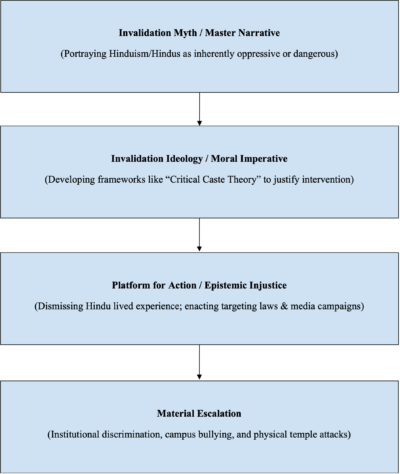
Our study applies a timeline analysis along with two theoretical frameworks, Evelyn Kallen’s Principle of Invalidation (1998) and Indu Viswanathan’s Endogenous Cycle of Hinduphobia (2025), to demonstrate how anti-Hindu groups systematically target the Hindu diaspora to promote their hateful, political, and theological narratives. The frameworks can be summarized as follows:
- Invalidation Myth / Master Narrative: Defines Hindu identity as inherently oppressive, regressive, or morally compromised.
- Invalidation Ideology / Moral Imperative: Constructs theoretical justifications—such as applying Critical Race Theory concepts directly to South Asian history—to mandate external intervention or legal oversight.
- Platform for Action / Epistemic Injustice: Deploys academic panels, media publications, and statutory bills to disempower the community while preemptively dismissing Hindu self-definition or defense as “politically compromised”.
As illustrated in the diagram below, these sequential stages of bias translate into systematic actions that result in institutional discrimination, campus bullying, and physical attacks on Hindus and their places of worship.
5. Strategic Counter Mobilization
This final section in our report outlines a comprehensive blueprint to safeguard the civil rights of the Hindu diaspora by transitioning community engagement from a reactive defense model to a proactive paradigm of “Competitive Leadership.” Structured around four key pillars—independent research, legal advocacy, standardized security, and sustainable philanthropy—the framework provides actionable recommendations for individuals and organizations to enforce accountability and secure long-term narrative integrity.
5.1 Emergence of Hindu Advocacy
Recognizing widespread bias, the Hindu diaspora has established an ecosystem of think tanks, advocacy groups, and digital platforms to champion civil rights. Research organizations like the Infinity Foundation and the Indic Heritage Institute, along with independent scholars and platforms like PGurus, document and counter hostile narratives. Simultaneously, professional advocacy groups like the Hindu American Foundation (HAF) and the Coalition of Hindus of North America (CoHNA) engage government and media, securing the formal recognition of Hinduphobia in legislatures like Georgia and Minnesota and establishing October as Hindu Heritage Month. Despite these successes, detractors try to delegitimize this civil rights work by labeling these organizations as “foreign agents” or accusing them of suppressing academic freedom—claims advocacy groups dismiss as defamatory tropes meant to invalidate real discrimination.
A significant internal challenge is the “institutional inertia” within legacy temple administrations, which have largely transitioned from historic centers of civic and intellectual development into purely ritual spaces. While umbrella organizations like the Hindu Mandir Executives’ Conference (HMEC) address mandir (temple) security, their approach remains reactive rather than proactive. Furthermore, the diaspora’s immense socioeconomic success has not yet translated into institutional capacity; despite being a top-earning U.S. demographic, the community funds very few formal institutions to systematically represent its interests. This discrepancy highlights an urgent need for the diaspora to transition from individual resource accumulation to collective institutional development.
5.2 Actionable Recommendations & Next Steps
To counter the systemic infrastructure of misinformation and hostile behavior toward Hindus, the diaspora must transition to a proactive paradigm of “Competitive Leadership.” This model emphasizes proactive action over reactive defense, information mastery, and the strategic mobilization of resources to shape the institutional environment before harm occurs. For Hindu leadership—including Hindu temple leadership— in the diaspora, this framework rests upon four pillars of proactive engagement with broader North American society: (a) intellectual and legal counter-mobilization; (b) strategic political engagement; (c) institutional stewardship and financial sustainability; and (d) community security and monitoring.
Reversing this course and ultimately preventing Hinduphobia is the responsibility of every Hindu, not just community leaders. If the diaspora intends to dismantle the cycle of hate and misinformation targeted at them and their children, silence is no longer an option. Every member of the community must take decisive action by doing the following:
-
- Educating themselves on the nuances of anti-Hindu narratives, identifying the forces driving them and understanding their real-world impact.
- Engaging in the democratic process by voting in primary and general elections at all levels of government.
- Advocating for Hindu causes through civic engagement, demanding accountability from all candidates in elections, regardless of party affiliation, on the following five critical points:
- Acknowledge the contributions of the Hindu diaspora.
- Recognize Hinduphobia as a distinct form of bias.
- Introduce legislation providing robust legal protections against Hinduphobia.
- Designate October as Hindu Heritage Month to help Hindu organizations raise awareness of Hindu culture among the broader population in the United States.
- Introduce bills protecting sacred Hindu symbols—such as the Swastika—by distinguishing it clearly from the Nazi Hakenkreuz.
6. Summary
The rise of Hinduphobia in North America represents a convergence of colonial-era constructs, ideological hostility, and modern political maneuvers that leverage unverified data and biased academic framing to marginalize a successful diaspora. Overcoming these challenges requires a unified strategy of “Competitive Leadership,” moving away from reactive defense toward proactive civic engagement to develop a legal framework that recognizes the community’s contributions while ensuring neutral treatment under the law. Ultimately, rejecting colonial tropes and embracing the Hindu experience on its own terms is essential for the diaspora to exist safely and equitably within the North American cultural mosaic.
Acknowledgements
The authors would like to express their deepest appreciation to Dr. Subhada Mishra for his time reviewing and providing invaluable feedback to improve this article.
Reference
- Pradhan, S. and Rao, R. (2026, Oct 24). The State of Religious Tolerance: Anti-Hindu Prejudice and Civil Rights in North America. Technical Report, Indic Heritage Institute, USA, Report# IHI-USA-2026-1. October 24, 2026. https://www.researchgate.net/publication/416770132
