
India’s Forgotten Educational Inheritance
‘…..I say without fear of my figures being challenged successfully, that today India is more illiterate than it was fifty or a hundred years ago…..and the beautiful tree perished….’ (1)
When Mahatma Gandhi made this striking observation on the state of education in India in his speech at Chatham House, London, in October 1931, it was unsurprisingly met with scepticism in British intellectual circles. A lively written exchange with Sir Philip Hartog, a leading British educationalist of the time, soon followed. It reflected deep disagreements over the legacy of colonial educational policy.
Several decades later, Gandhi’s remarks would inspire Gandhian scholar Dharampal’s influential study, The Beautiful Tree (2). Drawing on British survey reports from the nineteenth century in regions such as Madras, Bengal, and Punjab, Dharampal argued that indigenous systems of education, while already in decline, compared favourably with the systems prevalent in England at the time on several important measures. These included the density of schools relative to population, duration of schooling, and participation of students from lower social and caste backgrounds.
To have an idea of what education in India would have been at its zenith, one would have to go further back in time. When Bakhtiar Khilji and his marauders plundered Nalanda around 1200 CE, the University of Oxford was still in its formative years and had not yet been granted a royal charter (which it was, in 1248) (3). While inaugurating the campus of Nalanda University in June 2024, close to the ancient ruins, Prime Minister Modi observed that books could be destroyed in flames, but not knowledge. In the presence of heads of missions of seventeen countries, he cast this event as part of a broader Asian renaissance and India’s effort to reconnect with its civilizational legacy.
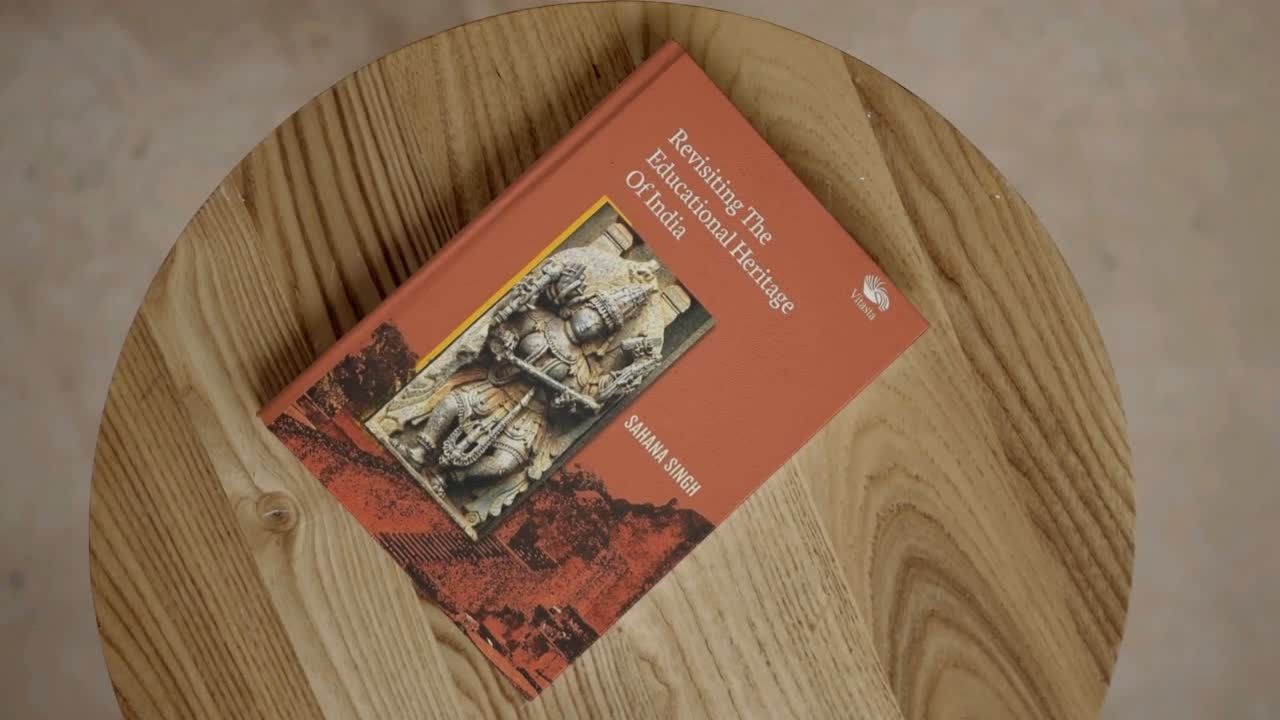
This educational inheritance, scarred by centuries of invasions, distorted by colonial governance, and neglected in the decades following independence, forms the subject of Sahana Singh’s carefully researched book Revisiting The Educational Heritage of India (4). The discussion that follows draws from her work to highlight a few key themes in the long and layered story of India’s systems of education.
A long tradition of learning
Singh traces the origins of renowned universities such as Nalanda to an older ecosystem of learning in which gurus taught in gurukuls and ashrams, often in serene surroundings away from the bustle of towns and villages. The emphasis was not merely on the transmission of knowledge, but on cultivating in students a sense of humility and an awareness of the interdependence of living beings before the commencement of more formal instruction. Commenting on a verse from the Prashnopanishad, Swami Chinmayananda highlights the importance placed on a form of spiritual tuning between teacher and student, so that intellectual comprehension of the Guru’s words could also become a pathway to deeper inner experience.
The Mahabharata refers to many famous hermitages. Some, such as those of Rishi Kanva, are described as clusters of several hermitages, with the central one presiding over the rest. This is akin to a forest university, with different departments offering knowledge on different subjects. The epic also lists eighteen vidyas (disciplines), underscoring that students were not trained in narrow silos. Singh points to physician Sushruta’s insistence that a physician be well-versed in many sciences as an early expression of multi-disciplinary pedagogy. Rishi Narada’s reply to Sanatkumara in the Chandogya Upanishad, listing the subjects he had studied, similarly offers a glimpse into the breadth of learning imparted in gurukuls at the time.
Significantly, Narada then asks to be instructed in the knowledge of the Self, seeking a way to transcend grief. This is an oft-repeated theme in Indian thought. Dr Subhash Kak explains that this reflects a worldview wherein the unfolding of the universe is governed by laws (rta), with the material and conscious worlds seen as complementary aspects of the same transcendental reality. In the Bhagavata Purana, students are advised to pursue empirical knowledge until the realization of its limitations, at which point it becomes a preparation for receiving higher knowledge. Empirical sciences and spiritual pursuits are thus integrated in a larger and deeper understanding of reality.
Universities across the landscape
Singh moves beyond Nalanda and shows how institutions of higher learning were spread across the Indian subcontinent. Centres such as Takshashila, Vikramashila, Mithila, Nabadwip, Kanchi, and Ujjain specialized in different branches of knowledge. These included logic, philosophy, medicine, astronomy, grammar, and Buddhist studies. Practical training was not neglected. In medicine, for instance, students were trained in the identification and use of medicinal plants. Even as late as the nineteenth century, British engineers acknowledged having learnt techniques for building foundations from Indian practitioners.
Seventh-century accounts by Chinese students Xuanzang and Yijing provide a detailed picture of academic life at Nalanda University. According to Xuanzang, Nalanda had a highly competitive entrance examination, with only one in five applicants gaining admission. Foreign students often spent years preparing before entry. There was a network of preparatory schools to help students take the entrance exams. At its peak, the university had as many as 8,500 students and 1,500 teachers. It offered advanced instruction in a wide range of philosophical and practical subjects. Logic and debate, as significant parts of the philosophical tradition, may also have shaped habits of public deliberation (an often invisible core of a democracy), which over time found expression even at the village level.
Temples, matTHhas, and agrahaaras functioned as major centres of learning. Inscriptions from South India reveal how temples helped constitute an educational ecosystem by housing teachers, students, libraries, and residential quarters. Revenues from the nearby villages were allocated for this purpose, alongside community endowments and royal patronage. Artha Shastra, the ancient treatise on governance, even recommends that scholars in the conquered territories be honored, underscoring the premium placed on learning.
Jaati-based systems, despite later distortions, helped preserve knowledge of practical skills and disciplines across generations. Children often acquired high levels of competence at an early age by learning within family and community settings. A child born in the family of classical musicians, for instance, would often be capable of public performance from a relatively young age. This allowed practical knowledge to be integrated with formal learning in temples and institutions. Singh contrasts this with modern systems that typically delay skill acquisition and, in many cases, produce graduates lacking applied knowledge.
How learning was imparted
An interesting chapter in the book highlights memory training as a foundational pillar of ancient Indian education. Refined techniques of memory retention enabled accurate oral transmission of vast bodies of knowledge. Students strengthened their memory through repetition, chanting of mantras, and non-linear cognitive pathways, as seen in the paaTha methods developed for Vedic recitation. This ensured precision in both memorization and pronunciation. The text contrasts this with the modern world’s growing dependence on external memory aids. Drawing on contemporary neuroscience, the chapter notes that disciplined memory training enhances cognitive capacity and suggests that some of these methods continue to hold value.
Another foundational discipline was Brahmacharya. Commonly translated as celibacy, the term carried a broader meaning, including the cultivation of sensory restraint as a way of conserving and redirecting energy towards the dedicated pursuit of knowledge. Techniques drawn from Yoga helped students regulate impulses and develop inner balance. These practices rested on the insight that uncontrolled desires arise first in the mind. By training the mind early, the tradition sought to focus more on addressing the roots of distraction rather than relying on moral policing. While such disciplines may appear austere today, elements of this approach may still help nurture self-restraint in young adults as they prepare for later stages of life.
Many traditional games were not only recreational. They also served educational purposes and helped develop mental agility, strategic thinking, and ethical awareness. This made learning both engaging and intuitive. Board games such as Chaupar, later known as “Snakes and Ladders,” conveyed lessons on Dharma, without overt instruction. Ladders rewarded virtuous conduct while snakes represented moral lapses. Reaching Moksha was the ultimate goal. Chess evolved from the ancient game of Chaturanga, training players in foresight and strategy. Card games such as Krida Patram originally drew themes from the Ramayana and Mahabharata. Physical games encouraged coordination and teamwork. At the same time, traditions recognized dangers of misuse, particularly gambling, and sought to regulate play through social norms.
Storytelling and fables formed another important vehicle of education, transmitting practical wisdom in an accessible manner. Collections such as Panchatantra, Hitopadesha, and Jataka tales used stories featuring animals and everyday situations to convey lessons on conduct, friendship, conflict, and governance. Complex moral dilemmas were distilled into memorable narratives. Rather than offering simplistic solutions, these stories presented competing perspectives to illustrate that human choices are rarely straightforward. Over centuries, these tales travelled widely across Asia, the Middle East, and Europe through translations and adaptations, influencing storytelling traditions across cultures.
The guru occupied a central position in this learning system. Education was seen as more than instruction; it was a sacred system of transmission of knowledge and values across generations. Learning created a debt, Guru Runa, requiring students to live by their teacher’s instructions and to pass knowledge forward. Student life in the guru’s ashram was rigorous, cultivating stamina and patience. Even princes shared the same austere routines. A true guru was expected to embody virtues such as self-awareness, impartiality in enforcing discipline, freedom from desire for fame or wealth, and a parental concern for the well-being of students.
Exporter of knowledge
Generations of Indians educated in the system shaped by Thomas Macaulay perhaps still implicitly share his view expressed in the famous 1835 Minute on Indian Education, that a single shelf of a European library was worth the whole of native literature of India and Arabia. This chapter offers a corrective. It shows how centres of learning in India became sources of knowledge for much of Asia through sustained translation efforts. Scholars from China travelled to India, studied Sanskrit texts, and carried back manuscripts on philosophy, medicine, astronomy, and logic for translation and study at home. From Central Asia and China, these manuscripts found their way into Japan. The journey of Xuanzang in search of sacred texts later inspired the Chinese classic Journey to the West, illustrating how these exchanges entered popular imagination across East Asia.
A second wave of knowledge transmission took place westwards through the Abbasid Caliphate, in the eighth century CE. Indian scientific and mathematical works were translated into Arabic and Persian in centres such as Baghdad. Concepts in astronomy, medicine, and mathematics travelled through these translations into the Islamic world and later into Europe. One everyday example of this exchange is the numeral system used worldwide today, including the concept of zero. The Europeans learnt this from Arabic scholars who themselves had adopted what they called Hindu numerals.
Singh also described how the Sanskrit language and literature shaped intellectual traditions across Southeast Asia, while Europe’s later encounter with Sanskrit texts gave rise to new academic disciplines. The study of Sanskrit grammar, especially Panini’s systematic linguistic analysis, deeply influenced modern linguistics and later helped computer scientists construct programming languages. The broader lesson is that India’s knowledge traditions travelled widely, often leaving enduring marks whose origins remain little recognised by their later users.
Decline in the age of plunder and disruption
The violence unleashed in the twelfth and thirteenth centuries on the leading universities of the time, Nalanda, Vikramashila, and Odantapuri, marked the beginning of a long and turbulent period in Indian history, during which educational institutions came under sustained pressure. Contemporary accounts speak of large-scale killings of monks and scholars and the destruction of manuscripts. These events, Singh argues, created a civilizational rupture from which the earlier traditions of higher learning struggled to recover.
With the consolidation of political power under successive Islamic dynasties, education took a different institutional form. New schools emerged in the forms of maktabs and madrasas, focused largely on imparting Islamic instruction and on training administrators and soldiers for the state. Sanskrit education and institutions lost state patronage. There were a few exceptions, though, most notably under Akbar, who extended some limited support to Sanskrit learning. Village-level primary schools continued to function in some areas, where discriminatory taxation had not entirely eroded local resources. Singh notes that science education in particular suffered during this period, even as Arabic and Persian translations of earlier Indian texts became foundational to learning in West Asia and later Europe.
Yet the story is not one of complete erasure. Some knowledge survived through decentralized and often painstaking efforts. Manuscripts were preserved in homes, temples, and private collections. Centres only nominally under Muslim rule, such as Thanjavur, Melkote (pronounced Melkotay), and Bikaner, emerged as important sanctuaries for endangered texts. What ultimately emerges is a tale of resilience, though achieved at a high cost to India’s intellectual continuity.
The onset of British rule in India was more than political colonization. Initially focused on trade and extraction, the British soon realized that the durability of their dominion would depend on reshaping the intellectual outlook of the population. This marked the beginning of a systematic dismantling of indigenous knowledge systems. Debates between Orientalists, who favoured government support for Arabic and Sanskrit learning, and Anglicists, who argued for English education alone, culminated in Macaulay’s 1835 Minute on Indian Education. This became the precursor to the English Education Act of 1835, which marginalized Sanskrit, Persian, and regional learning. Dharampal’s The Beautiful Tree documents in detail how this disrupted India’s pre-colonial schooling system, even as earlier Indian scientific ideas continued to circulate and influence Europe.
Singh also traces the social consequences of this educational reordering. Traditional scholars lost status, local institutions withered, and new hierarchies emerged based on proficiency in English. Ironically, this transformation occurred at a time when literacy and teacher quality in Britain itself remained uneven. The chapter concludes by observing that an enduring legacy of colonial rule is that India continues to view its own thought and traditions through a foreign lens.
Conclusion
Singh concludes in a vein similar to that articulated by Sri Aurobindo, who argued that the aim of a national education was neither a revival of past forms nor a rejection of modern knowledge, but to build on India’s own being (6). In an age where education has increasingly come to mean information acquisition, competition, and credentialing, the traditional Indic approach with its focus on forming a well-rounded human being, rooted in ethical awareness and an innate respect for nature, rather than merely producing skilled workers, has much to contribute.
India’s educational past, Singh contends, is neither mythical nor romantic. It is well documented in surviving texts as well as in the accounts of foreign travellers. Yet generations have been taught to view this inheritance through distorted narratives, often for political convenience. The task today, she emphasizes, is to produce textbooks that reflect India’s history with greater honesty. Invoking the national motto Satyameva Jayate, the book calls for a mature engagement with the past, one that allows India to move forward with confidence and a renewed sense of purpose.
References
- Gandhipedia. “Speech at Chatham House Meeting”
https://gandhipedia150.in/static/data/highlighted_pdfs_output/London_volume48_book_137.pdf - Goodreads. “A Beautiful Tree: Indigenous Indian Education in the Eighteenth Century”
https://www.goodreads.com/book/show/17931651-the-beautiful-tree - Wikipedia. “University of Oxford”
https://en.wikipedia.org/wiki/University_of_Oxford - Goodreads. “Revisiting the Educational Heritage of India”
https://www.goodreads.com/book/show/58816636-revisiting-the-educational-heritage-of-india - Young, G.M (1979). Speeches by Lord Macaulay with his Minute on Indian Education, p. 345
- Incarnate Word. “Sri Aurobindo on Education”
https://incarnateword.in/compilations/sri-aurobindo-on-education
