
Secularism Was Never Ours
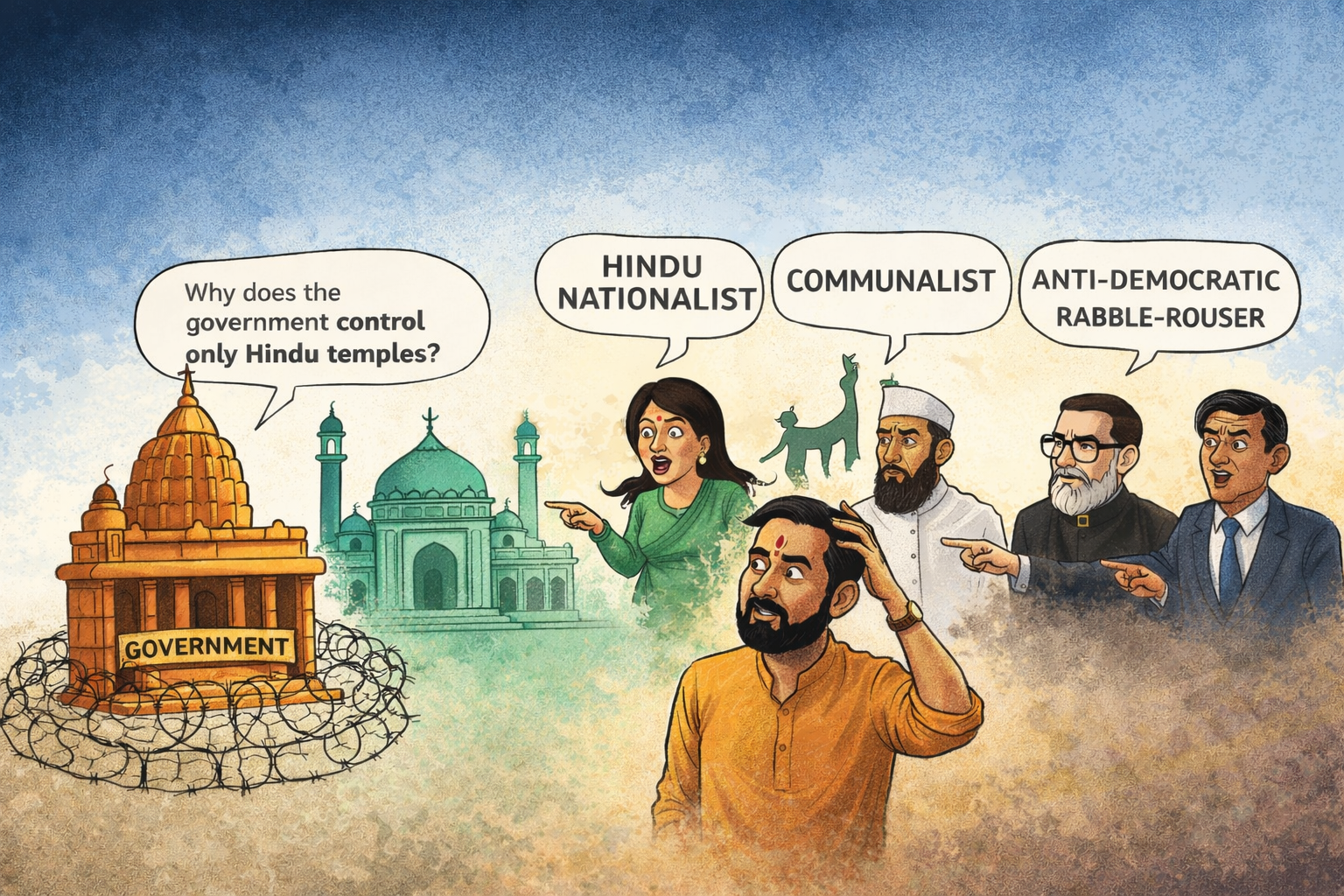
Image created using ChatGPT
How often do we question what “secular” means when we hear that India is a “secular” nation? Not in the way that a 10th-grade civics book would say. Not very often, if at all. We assume it’s true, which is ironic. And this is the very notion I wish to challenge here.
The etymology of this word doesn’t give us a timeless humanist idea. Instead, we find a specific solution to a specific problem faced by a particular civilization in the 16th century. And that civilization was certainly not ours. The word “secular” comes from the Latin saeculum, meaning “a span of time”. Now, as Christianity began to rise in Rome, the Church used “secular” to separate the temporary, earthly world from the divine realm. The complexity behind this word is inconspicuous at first. The use of the word secular is inherently non-neutral. The word did not originate in the philosophies or the ideas of the Enlightenment, but rather came from within the Christian thought as a way of referring to everything in life other than eternal liberation. This is inherently a division between the earthly world and the divine; between the secular and the religious; between the state and the church; between Caesar and Christ. To use a term that refers to this separation when talking about a society in which there isn’t one, can’t be considered neutral; you’ve imported a concept from outside and have claimed it to be universal.
Additionally, George Jacob Holyoake, the last man imprisoned for blasphemy in England, coined the political notion of ‘secularism’ in 1851. In 1842, Holyoake was imprisoned for six months for declaring that “the Deity should be put on half pay”. Later, when it was unsafe to refer to oneself as an atheist, Holyoake coined the word “secularism” and began using it in his journal, The Reasoner, in 1851. This is the word added to the Preamble of the Indian Constitution in 1976, through the 42nd Amendment, to describe a civilization nearly 8,000 years old with its own complex way of connecting governance to the sacred.
Why secularism is incompatible with Bharat will become clearer if we can grasp the nature of the problem it seeks to solve, and its origins. In Christian Europe during the Middle Ages, there were two rival powers: the Church and the State. Both were Christian, but while the former’s role was spiritual, the latter’s was political; both had their own territory and resources, which they continually disputed in a conflict that sometimes became openly violent. The Church could excommunicate kings, an act that carried weight in a society that viewed matters of eternal life after death as important in politics, because if one was excommunicated, his subjects were no longer obliged to obey him. Monarchs sought the privilege of appointing bishops, who were powerful feudal lords, because the Church owned vast amounts of land that came under the control of those who appointed them.
When the West speaks of the separation of Church and State, it actually means that two rival Christian denominations are engaged in a battle for dominance. In 494 CE, Pope Gelasius I wrote a letter entitled Duo Sunt, which articulated a two-pronged view of power – a spiritual power of the priests, and a temporal power of the kings. Then, in 1302 CE, Pope Boniface VIII issued the Unam Sanctam. It asserted that the Roman Catholic Church possessed both spiritual and temporal powers, and the kings were appointed by the grace of the Church. The Roman Catholic Church suffered fragmentation following the Protestant Reformation in the sixteenth century, and this also heralded a new paradigm, which included the Peace of Augsburg in 1555 CE.
This does not align with our modern understanding of the term “secular,” does it? These were Christian denominations working out their own power struggles. The “secular state” that emerged from this was still a Christian state. The only difference being there would no longer be a central figure in Rome issuing orders. France was the most radical of all. The Revolution took over all Church property and got rid of monasteries. They tried to replace Christianity with a “Cult of Reason,” which is as embarrassing as it sounds. By 1905, France passed a law saying that the Republic “neither recognizes, pays salaries to, nor subsidizes any religion”. This law was not a symbol of enlightened thinking; it was a bitter end to a long fight. Similarly, French laïcité was not neutrality toward religion; it was a political act of vengeance against a Catholic institution that had taken feudal dues from peasants for centuries.
The United States’ Establishment Clause, found in the First Amendment, states that Congress shall not pass any law that establishes a state religion. Some have used this to explain why the state should be apathetic to all religious beliefs. However, the American revolutionaries felt, unlike the French revolutionaries, that an educated and moral populace, religious to its core, was a must for a healthy republic. The idea about separating church and state came from a letter sent by Thomas Jefferson to Connecticut Baptists, who needed reassurance of religious freedom after facing harassment by Anglicans. This led to the emergence of three different forms of secularism, each one created to solve a specific Christian dissension: Protestant states working out denominations; France fighting its Catholic Church; and America avoiding the mistakes of the Church of England. These models don’t fit anywhere that did not have the same problems to start with.
The Madras Regulation VII of 1817 put Hindu temples under state control to fight alleged corruption, following the pattern of Protestant interventions against the Church after the Reformation.
The reason why Muslim communities never get entangled in this has to do with the foundational structure. Unlike Christianity, which has a “Church,” Islam lacks an equivalent term. It does not have a Muslim Pope. Ulema are scholars, not priests, possessing neither special abilities nor centralized control over property. The connection between a Muslim believer and his/her God is direct through worship and prayer and does not require any mediation by a priest. In the absence of a Church, there could never be a problem of Church versus State, and consequently, no doctrine was needed to resolve this problem.
Turkey is another great example of what happens when one tries to force secularism where it does not fit. In the 1920s, Turkey embraced the French model of secularism by brute force, under Mustafa Kemal Atatürk. Over the past century, the country has oscillated between secular and Islamic impulses, showcasing just how disruptive an inappropriate secularization can be. Turkey’s secularism was imported, and the country has struggled with it ever since.
Similarly, the Indic civilization has had no “church,” in the Christian sense. This is not a criticism of deficiency. Quite the contrary. It means that our fundamental notions of the sacred were, from the very beginning, different. The fundamental teaching in Christianity is that there is one God, one Christ, one way to liberation for everyone. If you have a different view, you are a threat, or you are in error. Christians know that — it is a core tenet of their religion. But what happens when you put that kind of an exclusionary mindset into a political context? If there is only one truth and only one institution that holds that truth, the question of who is going to be in charge is immediately brought into the realm of religion. Kings must bow down before God. The Church knows what God wants.
Church vs. State conflicts characterized the Middle Ages in Europe. Western secularism did nothing more than find a workable adjustment to that dominant, monopolistic mindset of religion. The question of God’s existence, reality, the achievement of moksha, etc., did not stop the Samkhya-Yoga and Carvaka traditions from coexisting in the Hindu tradition, did not stop a Shaiva monarch from giving donations to a Buddhist monastery, did not stop Jain traders from donating funds for building a temple to Vishnu, and did not stop a Hindu ruler from granting protection to a Zoroastrian community. These last are examples found in pre-Islamic Indian inscriptions.
This is not to claim that the pre-Islamic subcontinent was free of conflicts: there were disputes between sampradayas (traditions). However, the main argument still holds: none of these quarrels arose from conflicting claims about the exclusivity of moksha, which would have made coexistence structurally impossible, and neither were there any claims about the church vs. state divide that secularism tends to invoke. This was not “tolerance” in the Western sense, where one group allows another to exist but could take that away if there’s a problem. In pre-Islamic India, it was different. The path of truth-seeking was multi-fold, and each was respected and supported simultaneously because they were not competing for the same exclusive claim to liberation. There was no conflict between them to manage.
Dharma, which is usually catastrophically mistranslated as “religion,” comes from the Sanskrit root dhr, meaning “to hold” or “to sustain”. It means the order that holds the cosmos, society, and the individual together. It is not a set of beliefs about God. It is not organized around a text, a church, a clergy, or a claim to exclusive truth. None of our sampradayas, maThas, paramparas, darshanas, and vidyas were structured like a Church or in a Biblical fashion. There was no Indian Pope. Without a Pope, there was no Investiture Controversy, no Peace of Augsburg, no Thirty Years’ War, and no French Revolution against a Catholic establishment. Without the French Revolution, there would be no laïcité. The whole chain of events that led to Western secularism never happened in India, because there was never an institutional church in conflict with the state.
Kautilya’s Arthashastra, written in the 4th century BCE, offers many lessons about the king and the sacred that should be discussed in its own light and not as part of a colonial agenda. The king was addressed as the Dharmadhikari, or protector of dharma, and also as the Mangala kaari, or protector of people’s well-being. He founded temples and generously rewarded scholars, and continued to practice all the country’s customs and traditions with the help of scholars, to keep him informed about his dharmic duties. There was no conflict here that needed a legal solution. No Church demanding the king answer to Rome, and no king trying to take Church property. Instead, there was a working relationship between governance and the sacred that lasted through many dynasties and centuries, without anyone needing to invent a new word for it.
That is the Indic model: it’s not separation of state and religion, it’s not adversarial, and it’s not privatization. Instead, it involves responsible custodianship, in which the state nurtures a variety of dharmic investigations without endorsing any single interpretation.
It was during the Emergency of 1976 when Indira Gandhi imposed authoritarian rule. During that time, opposition politicians were imprisoned, the media was muzzled, and Parliament became a mere rubber-stamping institution. Since no one could raise objections, the 42nd Amendment was enacted, which included inserting the word “secular” into the preamble of the Constitution. “Secular” is not a term in the original Constitution of India. It was not an oversight, as this issue had been discussed during the time of framing the Constitution in 1950 by the Constituent Assembly. K.T. Shah proposed “Secular, Federal, Socialistic” in the preamble, but Jawaharlal Nehru did not accept it. According to him, “it did not require any additional term because those were already incorporated in the constitution”. The word was added twenty-five years later, during a constitutional crisis, by a government that had suspended the democracy it claimed to protect (and not as a procedural footnote). Since then, it has often been used as a political weapon.
Today, India’s version of secularism uses three different and conflicting models for three different religious groups. Hindu temples — 38,000 in Tamil Nadu alone — are run by the government under the Hindu Religious and Charitable Endowments Act. Officials control their money, appoint trustees, decide how funds are used, and have even been found by the Comptroller and Auditor General to misuse those funds. It would be akin to imposing the concept of laïcité of France upon the institutions of Hinduism: state control, operation, reform, and takeover.
Masjids and the Islamic Waqf Board are administered under the Waqf Act, which allows Muslim religious bodies to manage their own properties, finances, and internal operations. The Waqf Act provides for community autonomy similar to that of Augsburg.
Church buildings and Christian educational institutions possess separate ownership and finance. They also enjoy the power of managing their educational institutions under Articles 29 and 30 of the Indian Constitution. While they are funded by the government, they are allowed to give admission preferences only to members of their community. It is an American model in which religious freedom coexists with government aid. Thus, we have three separate models of secularism for three distinct communities of India. Today, if we are to raise questions as to why Hindu temples are controlled by the government while mosques and churches are not, we would be labeled either a Hindu nationalist, a communalist, or an anti-democratic rabble-rouser.
So, let’s look at the reality. The Government of Tamil Nadu has been plundering temple money, contributions of religious Hindus, to plug holes in the state’s coffers, fund partisan projects, and build roads. The traditional communities that have for centuries sustained the lifeblood of temple rituals — the musicians, the artisans, the dancers, the sculptors, and the priests — have been left to their own devices. Bharatanatyam, Agamic rituals, and Vishwakarma crafts are not dying out because Hindus are not interested. They are dying out because the structures and institutions that sustained, taught, and transferred skills in these disciplines have been handed over to a bureaucratic apparatus of the state with no commitment or accountability to the communities concerned.
Contrast this with the fact that not a single dime has been touched in the Hajj subsidy, the Waqf Board, and other minority institutions that are state-funded but independent of state administration, and any attempt to address would be described as “communal”. This is secularism in the making, not secularism per se. The Hindu rules are different from everyone else’s, and “secularism” is invoked to prevent any discussion thereof.
The colonizing of India is a process we all know very well. What is not as widely discussed is the process of mental colonization that accompanied it. Upon their arrival, Protestant missionaries and officials brought their worldview of the proper ordering of society. According to them, in every civilization, there is a “religion” in terms of its scripture, clergy, and church that may be separated from the rest of society. This was so in Protestant Britain; therefore, it must be so in every other place. But when they looked at India, they found none of that. There was no Pope, no single scripture, no institutional church, and no uniform creed. A Shaiva and a Vaishnava could disagree about God and still share a temple town without anyone calling it heresy. To Protestants, accustomed to establishing rules and hierarchy, this seemed chaotic. So, as colonizers often do, they decided this “chaos” needed organizing, and that they were the ones to bring it to fruition.
Brahmins were labeled as “priests” in the Protestant sense, even though their roles were nothing like those of Catholic or Protestant clergy. The Vedas were called Hindu “scripture,” even though texts like the Vedas, Upanishads, Puranas, Agamas, and the Gita differ in style, authority, and use. Temples were seen as Hindu “churches,” and so the same logic used in the Protestant Reformation, seeing priestly control as corrupt and in need of state reform, was applied to them. Unfortunately, after independence, India kept this system and called it “secularism”.
Under the Sikh Gurdwaras Act of 1925, Sikhs were granted the privilege of managing their religious sites through an elected body. Even after nearly a hundred years, the practice remains the same. Sikhs maintain their religious organizations and manage their resources without any need for outside intervention.
The Hindu strategy was flawed. They were misguided into believing that control of their temples by the government was secularism. The same government, unable to fix its own railway network, has been made responsible for the Brihadeeswara Temple.
I want to be precise about what I am arguing. I’m not calling for a theocracy. I’m not saying priests should run the government, or that non-Hindus should have fewer rights. My point is that “secularism,” a word invented by an Englishman jailed for blasphemy against the Church of England, is the wrong term for the relationship between the Indian state and our sacred Bharatiya consciousness. The way this word has been used in India is discriminatory, inconsistent, and goes against our civilizational values.
France acknowledges the fact that it is a Christian civilization and is politically secular at the same time. England maintains the Church of England as the national church but still offers protection to minority religions. In the case of the Organisation of Islamic Conference (OIC) countries, there is an Islamic legal foundation for the state safeguarding Islamic interests.
Bharat, home to one of the world’s oldest civilizations, is the only place being asked to give up its civilizational identity for a concept that no one else truly follows. The framework is already there. The dharmic duties of a ruler, known as Rajadharma, must be to protect and respect the freedom of every religious group within a country. Think of the Sikh Gurdwaras Act of 1925 as a prime example: it is an act of legislation that allows the community itself to govern all of its religious places, funds, and elected boards. The government is simply there to defend these rights, not to oversee them.
We gained Swaraj, or self-rule, in 1947. We are yet to savor Swatantra, governing by our own dharmic principles and our indigenous frameworks built upon our civilizational consciousness, instead of using a model imported from a society that once jailed a man for saying the Deity should be put on half pay. Look at the Brihadeeswara Temple in Thanjavur. It was erected in the eleventh century and sustained itself for a thousand years without interruption through the efforts of successive generations of priests and scholars. Enter the East India Company, which, with remarkable arrogance, declared that the system required reform. The system did not require reform. All that was required was to leave it alone. India certainly does not need any more secularism. What India needs is the truth — secularism is alien to Indian civilization and was forced upon India during a period of suspended democracy.
The next time somebody calls you a communalist for stating this, ask them about the last time they read the 42nd Amendment and pondered as to why it was enacted while the opposition was in jail. And remember, there is an older, far better system innate to our Bharatiya Sanskriti, which does not require the subordination of the other.
References:
On saeculum and the Latin etymology of “secular”:
- ‘Saeculum.’ Wikipedia. https://en.wikipedia.org/wiki/Saeculum
On George Jacob Holyoake and the coining of ‘secularism’:
- ‘George Jacob Holyoake.’ Wikipedia. https://en.wikipedia.org/wiki/George_Holyoake
- ‘George Holyoake.’ Humanists UK. https://humanists.uk/person/george-jacob-holyoake/
- Rectenwald, Michael. ‘Mid-Nineteenth-Century Secularism as Modern Secularity.’ ResearchGate, 2017. https://www.researchgate.net/publication/314492016
On the Duo Sunt letter (Pope Gelasius I, 494 CE):
- Deepak, J. Sai. India, that is Bharat: Coloniality, Civilisation, Constitution. Bloomsbury India, 2021.
On the Peace of Augsburg (1555) and Protestant secularism:
- ‘Peace of Westphalia.’ Wikipedia. https://en.wikipedia.org/wiki/Peace_of_Westphalia
On French laïcité and the Law of 1905:
- ‘Secularism in France.’ Wikipedia. https://en.wikipedia.org/wiki/Secularism_in_France
- ‘French Secularism and the Law of 1905.’ AHI Enquiry.
https://www.ahienquiry.org/writing-collect/2022/10/3/french-secularism-and-the-law-of-1 905
On the American Establishment Clause and Jefferson’s Danbury letter:
- Garry, Patrick M. ‘The Myth of Separation: America’s Historical Experience with Church and State.’ Hofstra Law Review, Vol. 33, Iss. 2, 2004. https://scholarlycommons.law.hofstra.edu/hlr/vol33/iss2/4
- ‘Overview of the Religion Clauses.’ Constitution Annotated, Congress.gov. https://constitution.congress.gov/browse/essay/amdt1-1-1/ALDE_00000334/
On Islam’s structural absence of a ‘Church’:
- ‘Understanding Sharia: The Intersection of Islam and the Law.’ Council on Foreign Relations. https://www.cfr.org/backgrounder/understanding-sharia
- ‘From the Caliphate to the Nation-State: How Islamic Law and Politics Intersect.’ https://www.wilsoncenter.org
On Turkey and imported secularism:
- Deepak, J. Sai. India, that is Bharat. Bloomsbury India, 2021. [same as ref. 5]
On Dharma, Rajadharma, and the Arthashastra:
- ‘Rajadharma: The Bharatiya Notion of Welfare State.’ India Foundation. https://indiafoundation.in/articles-and-commentaries/rajadharma-the-bharatiya-notion-ofwelfare-state/
- ‘State and Governance in Kautilya’s Arthashastra.’ Journal of Political Studies (PDF). DOI: 10.5539/res.v4n5p135
- Balagangadhara, S.N. ‘What Does It Mean to Be Indian?’ https://www.balagangadhara.ugent.be
On pre-Islamic interreligious patronage (Shaiva kings, Jain merchants, Zoroastrian refugees):
- ‘Buddhist Endowments by Shaiva Kings under the Maitrakas of Valabhi.’ Academia.edu. https://www.academia.edu
On the Constituent Assembly debates and Nehru rejecting ‘secular’:
- Jha, Shefali. ‘Secularism in the Constituent Assembly Debates, 1946–1950.’ Economic and Political Weekly, 2002.
- ‘Why Framers of India’s Constitution Didn’t Include ‘Secular’ in It.’ The Indian Express. https://indianexpress.com
- ‘Why Nehru Dropped and Indira Inserted the S-Word in the Constitution.’ The Print. https://theprint.in
On the 42nd Constitutional Amendment (1976) and the Emergency:
- ‘Why ‘Socialist’ and ‘Secular’ Were Added to the Preamble.’ The Hindu. https://www.thehindu.com
- ‘Row Over ‘Secular’ and ‘Socialist’: How and Why Were the Words Added.’ Indian Express. https://indianexpress.com
On the HR&CE Act and Tamil Nadu temple misuse:
- ‘TN HR&CE Dept Accused of Misusing Temple Funds.’ The New Indian Express. https://www.newindianexpress.com
- ‘Tamil Nadu: CAG Slams HR&CE Department.’ The Hindu. https://www.thehindu.com
On the Madras Regulation VII of 1817 and British colonial temple control:
- ‘How Hindu Temples Came Under Government Control.’ eSamskriti. https://www.esamskriti.com/e/Culture/Indian-Culture/How-Hindu-temples-came-under-G overnment-control-1.aspx
- ‘The Colonisation of Temples by the Secular State.’ net. https://www.myind.net
On the Sikh Gurdwaras Act of 1925 as a comparative model:
- ‘Manage Hindu Temples Along the Lines of Sikh Gurdwaras.’ Swarajya. https://swarajyamag.com
On the Waqf Act and Articles 29–30:
- ‘Balancing Beliefs: An Analysis Concerning Article 25, Secularism and the Search for a Common Civil Code.’ SSRN. https://ssrn.com
- ‘The Constitutional Blind Spot: The Article 26 Injustice Against Hindus.’ Swarajya. https://swarajyamag.com
