
Hindu Studies: Beyond the Established American Universities
Image courtesy: Hinduism Today
Editor’s note: A version of this paper was presented at the Southeast Conference of the Association for Asian Studies (SEC/AAS) on January 24, 2026.
Why should Hindus establish their own institutions of higher education in the US, and what have they done so far to establish institutions that will offer students Hinduism from the perspective and experience of Hindus? Let us offer some context here: there are about 160-200 major Hindu temples in the US, and potentially up to 1,000 temples, small, medium, and large. There are about 3.3 to 3.6 million Hindus living in the US, and just over one percent of Americans identify themselves as Hindu. Since the 1965 Immigration Act, the number of Indians and Hindus has grown over the decades, with the numbers spiralling after the Y2K event in 2000[1]. On average, Hindus and Jews have the highest levels of educational achievement in the US, and Hindus are the highest-earning religious group, with more than 57 percent of them earning $100,000 or more, surpassing Jews, who have 54 percent among them with such an income level[2]. It is reported that since 2008, Indian-Americans have contributed three billion dollars to American universities (Indiaspora, 2025). If the fairly new Hindu/Indian community is this strong and vibrant, what have they done to shape the American education landscape?
For example, there are over 1,000 religiously affiliated colleges and universities in the US. Of them, 181-221 are Catholic, and the remaining are Protestant and Evangelical. The Council for Christian Colleges and Universities (CCCU)[3] represents more than 150 universities in the US and Canada. A dozen accredited Jewish universities and colleges, with major Jewish institutions like Yeshiva University[4], Brandeis University[5], and the Jewish Theological Seminary of America[6] add to the higher education landscape. Muslim educational institutions include seminaries, madrasas, and higher education institutions in the US, along with 300 Islamic K-12 schools, and Muslim institutions include the American Islamic College, Cordoba University, Islamic American University, and Zaytuna College.
It is in this context that we have to ask how many Hindu universities and colleges have been established in the US. Since the arrival of Swami Vivekananda in 1893 to address the World’s Parliament of Religions, and even earlier, the curiosity and interest of American philosophers and writers like John Adams, Emerson, and Thoreau, Hinduism began to make its presence and influence the religious/spiritual landscape at the margins of American society. In this paper, we will briefly summarize the history of the study of Hinduism in American universities and how, at present, it has become bound by ideological clutter, presentism, and politically inspired agenda-setting. For some historical context of the Indian presence in the United States, and how Hindus and other Indians have sought to find identity in their new place of work, life, and commitments we can consult Takaki, 1989; Dasgupta, 1989; Shukla, 2004; Joshi, 2006; Kurien, 2007; Kumar, 2009; Goldberg, 2010; Chaudhuri, 2013; and Rao, 2016.
With the growing presence of Hindus in the US, and Hindu children now attending schools and colleges across the country, we have begun to notice what it is they are learning about their own traditions and beliefs when they go to school. These children and youth are being told that they are inheritors of “bad faith” or “suspect faith,” or worse yet, of being “Hindu nationalists” and “Hindu supremacists,” or that their primary identity as Hindus is through the lens of caste. How can Hindus, who usually don’t proselytize, negotiate this troubled reality in their new home? To cater to the Hindu/Indian diasporic population in the US, there have been some attempts to establish Hindu/Indian American schools and colleges. The schooling has been mostly through the “bala vihars” in big cities that operate like Sunday schools of any other faith in the US: children do some reading, some singing, some playing of games, and listening to some advice about how to negotiate life in the “regular” schools they attend. But what about Hindu colleges and universities? Are there any Hindu colleges and universities similar to the dedicated Islamic, Jewish, and Christian universities, colleges, and seminaries in the US? Who has taken the initiative to build them, and what has been the result?
We will look at two universities that are trying to get accredited and establish their credentials: the Hindu University of America and the Vivekananda Yoga University. What is their vision and their mission? Who is guiding and leading them, and what do they wish to contribute to the land they call their new home?
The Background:
Of the 4.9 to 5.4 million or so Indians living in the United States today, about 48 percent are Hindu, although they make up 80 percent of the Indian population, as per a Pew Research Center report. While only about 2.5 percent of the Indian population is Christian, they constitute about 15 percent of the Indian immigrant population. Muslims from India are 8 percent (they are about 12 percent of the Indian population), as are Sikhs, who are just about 1.72 percent of the Indian population, but who are now a prominent presence, especially in California and the Western states. The little that Americans read in the mainstream media is almost always about Hindus, and over the past few years, much about “Hindu nationalism,” “caste,” and “Hindutva or Hindu fundamentalism”. In the era of the Trump administration, it has been about immigration, H1B visas, and criminal and negligent Sikh truck drivers. Some people know that Vice President Vance’s wife is Hindu, as well as that Kamala Harris’ mother was Hindu. They have heard about Vivek Ramaswamy, and despite his best attempts to placate the Christian Right, he has had the ignominy of being cast as a caste supremacist on social media.
But how did Hinduism make its presence felt in the US, and what is the status of Hindu or Hinduism studies in the US? How is Hinduism depicted in school textbooks for American children? How many universities have included caste as a category of discrimination in their non-discrimination statutes? How many city councils have passed resolutions condemning the present Indian government? How has the new American politics made Hindus one of the easiest of scapegoats for the myriad social and cultural problems facing the United States?
The issues and challenges confronting the most successful of immigrant groups are many – from the stereotypical depiction of Hindus and Hinduism in school textbooks (see the Hindu American Foundation (HAF) resource page on “Education Policy & Curriculum Reform”) to training sessions on “caste discrimination” conducted by an advocacy group called “Equality Labs” that have been embraced by multinational corporations and the group’s complaints aired in Congressional hearings with the help of Congresswoman Pramila Jayapal, and the inclusion of “caste” as a category of discrimination by states and higher education institutions, ensuring that caste is in the forefront of any discrimination, equity, and inclusion debates. Writers and activists like Rajiv Malhotra have challenged the education establishment since the early 1990s, and Malhotra has labeled the students of the well-known University of Chicago religion scholar, Wendy Doniger, as “Wendy’s children,” and accused her and her students of using Freudian, Marxist, and European continental theories to eviscerate Hindus and Hinduism. In a book published in 2016, “Academic Hinduphobia,” we find a compilation of Malhotra’s original essays on these matters.
According to the Hindu American Foundation’s resource page on how Hinduism is taught in American schools[7], there is no federal curricular standard. It is the individual state’s Department of Education that adopts education codes that apply to public schools. A study done by HAF in 2015 found that “student experience of faith-based bullying was tightly correlated to their perception of the focus on caste in their Hinduism curriculum,” and that there were numerous errors in the presentation of Hinduism, including, “racialized theories about the origins of Indian people,” “the portrayal of the whole of Indian society as ascribing to a rigid, hierarchical and oppressive caste system or Hindus as oppressors and racists,” “karma as fatalism or allowable action determined by a caste system,” “dharma as duty or a set of laws determined by a caste system,” “presenting Jainism, Buddhism, and Sikhism as Hindu reform movements,” “indicating that women in Hinduism are subordinated and subjugated,” and “conflating contemporary political movements and dynamics with Hindu traditions, beliefs, and practices”.
How and what is taught about Hinduism in schools is the direct result of the study of Hinduism in higher educational institutions. School textbook boards, as Hindus found out in the California textbook issue, relied on Hinduism “experts” in universities and colleges to write and edit material about Hindus and Hinduism. While other religions escaped the conflation of social ills with religious teachings, the section on Hinduism did not do so, and thus, whatever was deemed a social problem in India was related to Hindu texts and traditions. Even though the term “Hinduism” is used to label the myriad faith and belief practices, and the millions of pieces of literature that litter the Sanskrit and local language worlds, we do know that there is no consensus among scholars, activists, and faith practitioners on what Hinduism embraces and from when, and based on what texts (see Strube, 2025).
Hinduism is the only surviving ancient religious/civilizational tradition in the world, as the rest of them have been either destroyed or marginalized – from the Greek to the Egyptian, from the Persian to the Mesopotamian, and from Central and South American to the Chinese and Australian. Hinduism and Hindus, therefore, have had to bear the scrutiny and challenges from monopolist and supremacist faith traditions and political movements that have destroyed others’ pasts, and as they seek to historicize their own faith traditions, label them as authentic and traditional, and lump all others in the baskets of “paganism, tribal religions, or polytheism”. Adluri and Bagchee (2014) have argued in careful and extensive detail the tendency in Indology to “corrupt any effective and defensible principles the humanities may have” and how Indologists have molded “Indian civilization to their liking” (Butler, 2018). They critique German Indology’s historical-critical method, arguing that this method “focused on finding interpolations, was less about objective truth and more about constructing a pseudo-history that served European religious and political interests, ultimately failing to grasp the texts’ deeper philosophical and spiritual meaning”.
When one seeks to “study” the “other,” the trap is set. The one who seeks to study the other assumes for himself or herself a higher position, a vantage point, that enables them “to observe,” “to study,” and to “describe and explain”. They are the modern, scientific, rational, and objective eyes and hands that probe and dissect the past and present of others, claiming to sift the real from the make-believe. Anthropologists who initially did field studies around the world came to realize this problem of studying “others” and have sought to “give voice” to the ones they “study”. Thus, we had the “emic” and “etic” approaches – emic from phonemic, and etic from phonetic — with the etic supposedly a social scientific approach searching for universal generalizations, and the emic seeking to focus on understanding phenomena subjectively. But what they and we fail to understand and acknowledge is that any attempt at studying living humanity is fundamentally skewed, and any attempt by those who have embraced supremacist faiths is compounded by their a priori positions on faith, God, reason, and belief. The quest to “study” the “other”, therefore, has become a pseudoscientific attempt, fueled by the needs and the greed of higher education establishments and vested interests in the West. Borrowing poorly retooled technologies from scientists to “explain” how others live, what they believe, and how they behave in what situations, it is very much a project and result of colonialism, and thus inherently flawed (Lewis, 1973).
Therefore, Dr. Vishnu Vardhan, well-known for his Gen AI innovation for healthcare and the developer of Hanooman LLM, a multilingual AI model transforming medicine, and a former orthopedic surgeon with an MIT machine learning background, recently posted on social media the conundrum that Hindus face. He wrote:
“I saw someone ask a question that many people outside India ask, and many of us Hindus struggle to answer properly: “Do Hindus actually believe gods like Vishnu exist? It’s a fair question. And the confusion exists because Hinduism is often approached using the wrong lens. Most people approach religion the way they approach belief systems in the West: either something is literally, materially true, or it isn’t.
“…Hinduism is not built on belief. It is built on experience, inquiry, and contradiction. If you approach it like a belief system, you will never understand it.”
“Hinduism… does not force one final answer about reality. It allows many answers to exist at once, depending on how deeply you’re looking. So, when someone asks, “Do Hindus literally believe Krishna existed?”, they are asking the wrong kind of question. It’s like asking, “Is an electron a particle or a wave?”
“Now here’s the part that really confuses people. I am an atheist. And I am Hindu.
That sentence breaks Western religious logic — but it fits perfectly inside Hinduism. In Abrahamic religions, belief is mandatory. If you don’t believe in God, you are outside the system. An atheist Christian or Muslim is a contradiction. In Hinduism, belief is optional. Inquiry is not… Like Schrödinger’s cat, Hinduism exists in many states at once — and collapses only when you choose how to observe it.
“…Hinduism doesn’t ask you to believe. It asks you to look, to question, to live, and to realize. That’s why it’s not easy to explain. And that’s why it refuses to die”.
Strube (2025) offers another aspect of Hindu identity. He writes: “Decades of discussions have crystallised a range of criticisms that may be levelled against various positions covered between these poles. Those considering Hinduism a modern invention usually focus on Western-educated elites, neglecting both synchronic subaltern and Brahmanical Sanskritic contexts, but also diachronic developments predating the British colonial period. On the other hand, those arguing for the antiquity and unity of Hinduism are often accused of basing their arguments on a chronological leap to the Vedic or ‘medieval’ period (or even idealized images of it) while neglecting more recent developments, notably since the eighteenth century. Such arguments tend to imply assumptions of original purity and authenticity, which are similarly implied in viewpoints that perceive ‘modern Hinduism’ as the ‘neo’ variant (or aberration) of something ‘traditional’. Such perspectives are frequently accused of privileging Brahmanical Sanskritic (often called ‘orthodox’) standpoints that allegedly informed both Orientalist scholarship in the nineteenth century and present-day Hindu nationalist ideologies. Today, it is most widely accepted that nineteenth-century discourses about Hinduism emerged against the background of historical developments predating the European colonial period, with British colonialism marking a period of crucial transformation. It remains contested, however, if those developments constitute a religion and/or a unified system. Approaches to these issues vary drastically.”
We can add another context (there are still many more) for the establishment of Hindu higher educational institutions in the US: recently, the Narendra Modi-led Bharatiya Janata Party government established the “Indian Knowledge Systems” division in the Ministry of Education. Their vision is to “rejuvenate and mainstream Indian Knowledge Systems for the contemporary world. The objective of the IKS Division is to completely decolonize the Indian mind by generating interest and healthy critical reverence for the unbroken knowledge traditions of Bharata for the welfare of the world.” This vision statement, however, is an indication that the people behind this initiative are not well-versed in crafting mission and vision statements. Be that as it may, we do know that in the complex dynamics of the modern, interwoven world, where Indian scholars themselves, trained in the top universities in India and in the West, borrowing all the “modern” lenses for studying humankind, have riven the Indian world asunder with their claims of what happened when, by whose intent, and how. They call themselves Marxists, social scientists, subalternists, feminists, postmodernists, etc., and they are well-established campers in the Indian higher education campground, battling, as they believe, revanchists, traditionalists, patriarchal Brahmins, caste supremacists, Hindutva propagators, Hindu nationalists, and so on, mixing and matching these categories at will and fancy to suit the papers they are writing and the conferences they are presenting in. The majority of these modern scholars are not trained in the Indian traditional Indian texts in traditional Indian settings. They rely on translations, secondary texts, and their learning in modern Indian universities, where their professors, most of them, are from similar backgrounds, training, and inclinations. They are as much the outside observers as their Western enablers and cohorts. Some of them, however, have begun to rebel against this Western hegemony over Indian knowledge systems and have begun pushing back. The founding of the Journal of Indian Knowledge Systems is one of their efforts. In their inaugural issue, the editors of the journal, Dr. Tripathy and Mr. Chaitra, write:
“It will be a travesty if IKS is conceived and delivered as another buzzword after the exhaustion (if not obsolescence) of race/class/ gender template that once guided research programs and nearly reduced social sciences research to the study of centrifugal marginality and difference, a manifestation of what Kapil Kapoor dismissed as ‘bheda buddhi (difference-focusing intellect)’.” The editors assert that their approach to Indian Knowledge Systems is a “disruptive (and simultaneously generative) moment in academic history when the stabilities of legacy scholarship are interrogated and supplanted by the underlying theories and conceptions derivative of Indian life and the systems of thought that guided them.”
The challenges that confront the journal editors are many, especially as they try to get a handle on “all of the cultural knowledge” of a civilizational entity that is at least 10,000 years old, with at least 10,000 facets, and which is living and dying and multiplying in front of our eyes. Such an attempt might lead to biting off more than one can chew, and that error can lead to predictable ends.
It is in this context that we should try to frame the quest for starting Hindu higher education institutions in the US, where the focus is not on studying the other as other, but as a journey in understanding ourselves according to Hindu texts, beliefs, and practices, past and present. The two institutions that I will focus on are the Hindu University of America (HUA), founded in 1989, and the Vivekananda Yoga University (VaYU), started in 2018.
Hindu University of America (HUA):
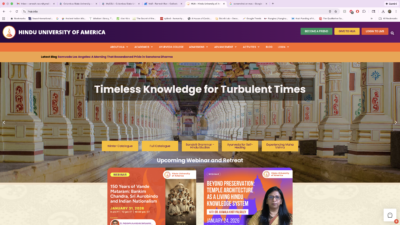
The Hindu University of America (HUA) was established in 1989. For an institution of higher education that was established 36 years ago, there is almost nothing on the HUA website about its beginnings, its founders, their original intent and goals, its past presidents, the changes over the decades, and how HUA has sought to establish itself as an institution of influence and import, and how it has contributed to American higher education ideals and aspirations. What little we can find is from the internet and scattered news reports of some of the turmoil and changes that HUA has experienced over the decades. However, the HUA website now advertises itself as offering “timeless knowledge for turbulent times,” and asking students to “experience transformation,” and “enter the world of Vedic wisdom online”. The website, which this author has monitored over the past few months, seems to incorporate changes and additions constantly, almost on a weekly basis.
In 1989, Dr. Deen Dayal Khandelwal, along with a few of his friends and associates, founded the so-called “university”. In a 1993 report in the Hindustan Times, we read that at HUA, “each student will be required to take several courses on the principles and practices of Hinduism and Sanskrit language to build a base upon which the student can design the spiritual input in his /her life”. We read in “Grokipedia”[8] that HUA was “inspired by the vision of Swami Tilak, a Hindu sannyasin”. In his travels across the US in the early 1980s, he had spoken about establishing an institution “dedicated to preserving and disseminating Hindu philosophy, traditions and knowledge as a means for Hindu immigrants to contribute back to their adopted country”. In 1993, Florida permitted HUA to function as a degree-granting entity.
Some highlights about the growth of HUA (based on internet searches):
- Deen Dayal Khandelwal is identified as the first president of HUA. He was followed by Dr. Bhudev Sharma, who guided the institution early and ensured state authorization in 1993. He served as president till 2003. Dr. Sharma was followed by Dr. Kuldip C. Gupta, who served from 2003 to 2006. Dr. TRN Rao succeeded Dr. Gupta, who was followed by Dr. H R Nagendra, with the current president, Kalyan Viswanathan, succeeding him.
- In 2001, HUA acquired a 9-acre permanent campus in Groveland, FL, funded by a donation from Braham Ratan Agarwal.
- The first convocation of graduates was held on June 19, 2004, when HUA awarded degrees to two students.
- In 2021, a graduation ceremony was held in New York City.
- In 2023, HUA received a $1 million donation from businessman Ramesh Bhutada to bolster the university’s operations, program development, and long-term sustainability.
- In 2024, Kalyan Viswanathan completed five years as the president of HUA.
- In 2024, HUA announced plans for program expansion, including the acquisition of the California College of Ayurveda.
HUA underwent a rocky period when its management and leadership were taken over by Swami Nithyananda in 2007, who was nominated as chairman, and the university was renamed Nithyananda Hindu University[9]. HUA expanded its Vedic curriculum under Nithyananda, who later faced serious criminal and financial allegations (Rediff, November 20, 2007). Braham Aggarwal, the real estate developer and early supporter of the university, was a disciple of Swami Nithyananda. Aggarwal is quoted: “With his (Nithyananda’s) vision and energy, along with the vast infrastructure of centers he has all over the world, there is no doubt the university is under the right leadership. The teachings from Vedic sciences that the university can now offer will enrich people’s lives to follow their path more beautifully.” But with the scandals and allegations, HUA shed its links to Swami Nithyananda and recovered its HUA label.
HUA’s vision and mission statements are interesting. The vision statement reads: “Promoting dialogue across disciplines, cultures, and civilizations, while enabling self-discovery, conscious evolution and harmony, Hindu University of America will set the standard for the study of Hindu Dharma”. Its mission statement reads: “Hindu University of America provides education in knowledge systems based in Hindu thought involving critical inquiry, ethics, and self-reflection. Committed to fostering the culture and traditions of Hindu Dharma in an atmosphere of academic excellence and freedom, it prepares students for service, leadership, and global engagement.”
It is left to the careful reader of these two statements and the courses and programs offered by HUA to wonder how the programs and courses would promote “dialogue across disciplines, cultures, and civilizations” because there are no courses offered in other religions, cultures, and philosophies, and there are no courses in research methods that span the qualitative and quantitative domains, the sciences, the humanities, and the social sciences, and no particular theoretical frameworks or foundations to guide the students. The courses offered range far and wide across the Hindu knowledge spectrum, and would be the envy of any major university, but we find little information about how many undergraduate and graduate students are enrolled, how many have graduated, and what, if any, they have gone on to write, achieve, and become adept in. We also see a lack of connection between the vision and mission statements, and this approach to crafting such statements is also reflected in how the university leadership is organized.
HUA does not have a Vice President of Academic Affairs/Provost, nor deans, nor chairpersons of departments. One searches in vain for the faculty handbook or the student handbook. There is no mention of a strategic plan, nothing about committees and councils, appeals and complaints processes, institutional review boards, policies and procedures, student learning outcomes, faculty workload policies, standards of excellence, faculty responsibilities, etc.
The academic programs are organized under three headings:
- Graduate Division
- Professional Certification
- Community Education Division
In the graduate education division, HUA offers an MA in Hindu Studies, an MA in Sanskrit and Vedic Studies, and a PhD in Hindu Studies. They also offer what they label a “Doctor of Hindu Studies” degree, which, to all purposes, is something unique to an institution of higher education in the US or in India. To read the description of their “PhD” program and their “Doctor” program could leave the potential degree-seeking student perplexed. Twelve faculty members are listed in the graduate division, but their professional and scholarly teaching and writing experiences (except for two or three of the twelve listed) are not commensurate with those that are required in other graduate and doctoral programs. Some 46 faculty members are listed as the “Community Education Faculty”, and this is where HUA has made its public presence felt, offering two and three-week certificate programs on a variety of topics and issues, catering to a growing Hindu American public made up of homemakers, retirees, nostalgic knowledge seekers, and part-time students, to whom these certificates are attractive and which can adorn the walls of their living rooms and offices.
HUA offers all of its graduate courses synchronously, making it difficult for students to learn on their own at their own pace and time. One has heard complaints that some of the instructors have little training in teaching online courses, and that the LMS that HUA uses is the clunky open-source Moodle platform.
HUA’s approach to education and to higher education seems to be now shaped by its president’s ideas and understanding of what Hinduism is all about, and how one should learn about it, and who is best fit to deliver the instructions and the training. It seems evident that he is a one-man leadership team, and a visitor to the HUA website will very quickly realize it by visiting the “President’s Message” webpage[10]. Faculty have complained that there is no provost, and the president has taken up the task, inquiries reveal, to draft the faculty handbook himself. The administrative team does not have any academic administrators – no provost, no dean, no faculty senate, and no university curriculum committee members[11]. Inquiries reveal that the academic calendar is drafted by the president, and faculty, it is claimed, are left in the dark till the last moment to be told what they are expected to teach.
HUA is not accredited by any regional or national accrediting agency. Why a student would pay $18,000 to earn an MA from HUA when the university is not accredited is something left for the student to decide[12].
HUA has a Board of Trustees and a Board of Overseers[13]. Inquiries reveal that all the board meetings are virtual, rare, and the Board of Overseers has not met in five years. Having had the opportunity to talk to a couple of people with the knowledge of the workings of HUA, this author has learned that the president of HUA envisions the university as a “seminary”. But then, further inquiries revealed that the president’s vision is as grand as the sky, and as hazy as any pie in that sky. He has asserted that Hindus “have very little background in creating and operating ‘explicitly’ religious universities,” and it might be pertinent to ask what he means by that, whether he has any experience doing so, and whether HUA wants to be a “religious university,” whatever that means. He seems to conflate societal and political developments with knowledge dissemination, and has said that “The rise of Hindu University of America, especially its reinvention and reinvigoration, in the last six and a half years, is concomitant with, and aligned with, the rise of Hinduism in general, the rise of a specific Hindu consciousness, a Hindutva mindset, that recognizes the unique and special place that Hinduism has in the world”. He offers no evidence for the same, except maybe to imply that with the election of the Bharatiya Janata Party in 2014, and with some of the attempts both in India and among the Indian Diaspora to challenge old academic and institutional power centers, there are indeed such changes that he asserts have come about.
The president argues that HUA is currently a seminary, completely ignoring the nature of Christian seminaries and divinity schools in some of the American universities, the nature of Hindu traditional schools that are labeled “seminaries,” and what it is that such seminaries offer. Not understanding the history, development, organization, and foundation of Christian seminaries, and how the major Christian higher education institutions have separated their “divinity schools” from the larger institution, he asserts that “HUA will develop schools in the Performing Arts, Media Studies, a School of Education, Arthashastra Studies, a School of Mental Health, Counseling, and Chaplaincy, etc., over the next 25 years”. It seems as if the president has turned HUA into a one-man institution, developed his own vision for HUA, without consulting faculty, the trustees, or community supporters. He envisions “HUA to develop in three phases -– first as a seminary, second as a liberal arts and humanities university, and third as a regular mainstream university. As a mainstream university, it can develop further into disciplines such as Science, Technology, Engineering, Business, Law, and Medicine.” He wants HUA to be “protected from the general tendency towards secularization, which is widespread within academia. There is no such seminary in the entire world that focuses on Hindu studies. HUA is therefore a one-of-a-kind institution,” he asserts without offering any serious argument or data to make the claim that he does.
Interestingly, in 2018, when the current president began his stewardship of the institution, he offered a roadmap for the growth of HUA, where, in five years, HUA would achieve the following:
- Enroll 25,000 students
- Hire 200+ faculty
- Offer 500+ courses
- Establish 1-2 physical locations
- Graduated or enrolled108 Master’s and PhD students
- Achieved full accreditation
In that blueprint he offered, he outlined the impact HUA would have on —
- Pluralism and cross-cultural understanding
- Conflict, violence, and terrorism
- Good governance and public service
- Families, communities, and education
- Holistic health and emotional well-being
- Sustainable ecosystems and climate change
- Ethics, social justice, and discrimination, and
- Poverty, scarcity, and inequality
These goals, it is asserted, would be guided by “Vedic Hindu Culture and Dharmic Values”. There are more such grandiose claims in the 24 slides that the president offers. Alas, the ability to dream does not always lead to right action and planned results. We see that at HUA, where two of its world-renowned professors – Dr. Vishwa Adluri[14] and Dr. Joydeep Bagchee[15] — authors/co-authors of a dozen influential treatises, and scores of journal articles – are left unheeded or ignored to guide the very small handful of MA and PhD students seeking to complete writing their theses and dissertations.
HUA has been successful in raising some funds and has enabled the president to run the university more as a small business operation for the past six years. HUA is no University of Austin, and has no hundred-million-dollar donor like Jeff Yass (Priest, 2025), but to attract such support, HUA would need some good leaders skilled in building higher education institutions with a team that has expertise in such matters. With the grand, fantastic, and almost hallucinatory vision of HUA, it is doubtful that any Indian American billionaire would similarly gift a hundred million dollars to the institution to bring to fruition this phantasmagoria. We can only hope that with enough internal pressures and demands, the HUA Board of Trustees realizes that while America has always been a happy hunting and grazing ground for visionaries, handing over the institution to one man, untrained and inexperienced in higher education leadership, teaching, research, and administration, would be yet another “difficult phase” that it should be wary of and distance from.
Vivekananda Yoga University (VaYU)[16]:
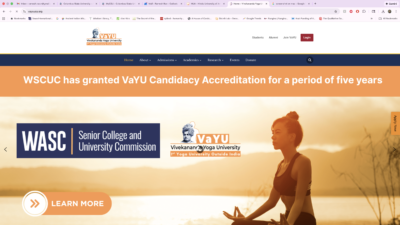
The Vivekananda Yoga University (VaYU) is named after Swami Vivekananda, the visionary who traveled to the US to attend the first Parliament of World Religions in Chicago in 1893, and who not only introduced the concepts of yoga to eager swarms of Americans, but who mesmerized many with his eloquent speeches about humanity, the human quest to transcend and know, and of the grand accomplishments of Hindu saints, scholars, and seers.
VaYU – Vayu – is the Hindu deity of “wind and air”, associated with Indra, the King of Gods. Vayu is air, breath, life, born from the “breath of the Supreme Being Vishwapurusha” (the Cosmic One). The Upanishads describe Him as “life breath of the world”, and therefore the name of the university, a thoughtful pun, leverages both the concept and practice of Yoga, which is all about controlling one’s breath to attain transcendence.
VaYU’s academic and institutional partners include Stanford University, Harvard Medical School, S-VYASA (its founding partner and a deemed-to-be central university in India dedicated to the study of yoga based on the teachings of Swami Vivekananda), and MIT, among others. VaYU is the first university outside India focused on yoga, and its first cohort of students graduated in 2022. Located, officially, in Los Angeles, the university offers online MS, PhD, and MS/PhD degrees drawing upon “evidence-based, modern scientific approach to the ancient Indian science and practice of Yoga”.
What differentiates VaYU from HUA is that its approach to higher education is guided by its leaders, who have decades of teaching experience and have led programs at well-known American universities. Its president, Dr. Sree Sreenath, an Electrical and Systems Engineer, has more than three decades of teaching experience at Case Western Reserve University. He also led Sewa International, a 501 (c) (3) charity for a decade, and equipped himself with an MBA in nonprofits to do so. VaYU’s Provost, Murali Venkat Rao, has a PhD in Yogic Philosophy and an MS in Computer Science. Its Vice President for Research, Dr. Manjunath Sharma, has a PhD in Yoga and Geriatric Medicine, and its Dean of Academics, TS Sreekumar, has a PhD in Yoga and an undergraduate degree in engineering.
While its website has a clunky look and feel, the university’s approach to the academic study and practical experience of yoga is carefully planned by professionals with decades of experience in both higher education institutions and the research and practice of Yoga in India and abroad. Among its faculty are 23 professors, six associate professors, and four assistant professors, 16 of whom are from the US, 18 from India, and one from Japan. They have, together, directed 135 PhD dissertations and 736 MA theses. Their degree offerings are limited and carefully selected. Their list of faculty members is impressive – many of them affiliated with some of the best-known universities in the US and abroad. More importantly, the VaYU website offers information on their licensing and accreditation status, audit reports, and policies and procedures. VaYU is at present pre-accredited and on the road to completing its accreditation with the Western Association of Schools and Colleges. WASC uses the term “pre-accredited” as being synonymous with candidacy accreditation. WASC has granted VaYU candidacy accreditation for 5 years.
According to VaYU’s president, the goal of VaYU is to become an R1 university – affiliated with medical schools and programs, and to make the study of yoga integral to the practice of medicine and the care of health.
Comparison between HUA and VaYU:
- HUA is the older institution, but it was an initiative of community leaders who had little or no experience in building or leading academic institutions. It was funded by businessmen whose heart was in the right place, but who had little knowledge about the nature and functions of higher education. Its path over the past four decades has been rough and patchy, and its leadership a hodge-podge of activists, businessmen, affiliates of political and social movements in India, and academics chosen at random. Its vision and mission statements are garbled and grandiose, and its approach to higher education is marred by the garrulous vision of its current president, who has no training or experience in higher education institutions, either in the US or India. The academic structure is loose, there are no academic leaders at the helm of programs, and its couple of globally known scholars marginalized in their efforts to bring order to the messy “small business” approach to higher education. What HUA has been successful with recently is in the small fundraising efforts and community outreach through its certificate programs. What is not evident to the public, however, is the steady attrition in student recruitment and retention, the frustrations of its well-qualified faculty, and its amateurish approach to higher education, clouded by the superficial understanding of the changes in the approach to the study of Indian texts, practices, philosophies, and rituals.
- VaYU is a younger institution, but it is led by professionals, affiliated with the best, and has a clear set of goals. Its faculty are well-credentialed, the university’s academic and administrative structure is professionally organized, and its approach to accreditation is carefully planned and executed. What it is lacking right now is its ability to raise enough funds to ensure its long-term stability, recruitment of students to ensure the health of its programs, and community outreach to ensure the support and encouragement of its well-to-do members. Their website is clunky, has poor aesthetic appeal, and lacks professional design elements.
The attempts by Hindu Americans to influence and impact the study of Hindus and Hinduism in the US are laudable and need community support and encouragement. Hinduism has much to offer the world, and learned Hindus can lead communities to well-being, good health, prosperity, and peace. However, if those goals are to be achieved, it might best serve the community to merge the two universities under professional leadership, a clear vision, a careful timeline for accreditation, an understanding of the needs of students in the age of AI, a plan to attract and recruit not just Hindu students, but students who are interested in global consciousness, peace, health, wellbeing, rigorous study of texts, and experiential knowledge that they can use to build their own careers, businesses, and institutions. If not, these Hindu initiatives may rarely get a footnote in the annals of American higher education.
References:
Adluri, A., & Bagchee, J. (2014). The Nay Science: A History of German Indology. Oxford University Press.
Butler, E. P. (December 14, 2018). “Indology and the Crisis in the Humanities,” India Facts, http://indiafacts.org/indology-and-the-crisis-in-the-humanities/
Chaudhuri, R. (2013). Forged in crisis: India and the United States since 1947. C Hurst & Co.
Dasgupta, S. S. (1989). On the trail of an uncertain dream: Indian immigrant experience in America. New York: AMS Press.
Goldberg, P. (2010). American Veda: From Emerson and the Beatles to Yoga and meditation: How Indian spirituality changed the West. Harmony Books.
Hindu American Foundation. “Education Policy & Curriculum Reform,” https://www.hinduamerican.org/curriculum-reform
Indiaspora (October 02, 2025). From students to benefactors: Indian Americans’ $3 billion investment in American universities. https://www.globenewswire.com/news-release/2025/10/02/3160552/0/en/From-Students-to-Benefactors-Indian-Americans-3-Billion-Investment-in-American-Universities
Joshi, Khyati (2006). New roots in America’s sacred ground: Religion, race, and ethnicity in Indian America. Rutgers University Press.
Kumar, D. (2009). Indo-U.S. relations: Historical perspectives. Strategic Insights, 8:3, Center for Contemporary Conflict, file:///Users/close/Downloads/791323.pdf
Kurien, P. A. (2007). A place at the multicultural table: The development of an American Hinduism. Rutgers University Press.
Lewis, D. (1973). Anthropology and colonialism. Current Anthropology, 14:5.
Malhotra, R. (2016). Academic Hinduphobia. New Delhi: Voice of India.
Pew Research Center (August 6, 2024). Indian Americans: A survey data snapshot. https://www.pewresearch.org/2024/08/06/indian-americans-a-survey-data-snapshot/
Priest, J. (November 05, 2025). Billionaire Jeff Yass gives $100 million to University of Austin for free tuition. The Texas Tribune, https://www.texastribune.org/2025/11/05/university-austin-jeff-yass-donation-free-tuition/
Rao, R. N. (2016). The Indian experience in the South: Georgia via Guntur. South Writ Large, https://southwritlarge.com/articles/the-indian-experience-in-the-south-georgia-via-guntur/
Rediff (November 20, 2007). Hindu University in US expands Vedic base. https://www.rediff.com/news/2007/nov/20ia.htm
Shukla, S. (2004). India abroad: Diasporic cultures of postwar America and England. Princeton University Press.
Strube, J. (2025). Hinduism, Sanātana Dharma, and the Global Struggle about “True Religion”. In: Conceptualizing Islam, edited by Frank Peter, Paula Schrode, and Ricarda Stegmann, Abingdon: Routledge 2025, pp. 59–76.
Takaki, R. (1989). Strangers from a different shore: A history of Asian Americans. Little, Brown.
Tripathy, J., & Chaitra, M.S. (2025). Mapping the IKS landscape: Counter-history, Pratyabhijñā and the quest for Svarāj. Journal of Indian Knowledge Systems, 1:1, 1-18.
[1] https://www.pewresearch.org/religious-landscape-study/religious-tradition/hindu/
[2] https://www.pewresearch.org/religion/2025/02/26/age-race-education-and-other-demographic-traits-of-us-religious-groups/
[7] https://www.hinduamerican.org/guide-for-reviewing-your-childs-textbook
[8] https://grokipedia.com/page/Hindu_University_of_America
[9] https://new.nithyanandahinduuniversity.org/
[10] https://www.hua.edu/about/presidents-message/
[11] https://www.hua.edu/administrative-team/
[12] https://www.hua.edu/admissions/tuition-and-fees/
