
From Suppression to Revival: Hindu Civilization Reclaims Mahamagha in Kerala
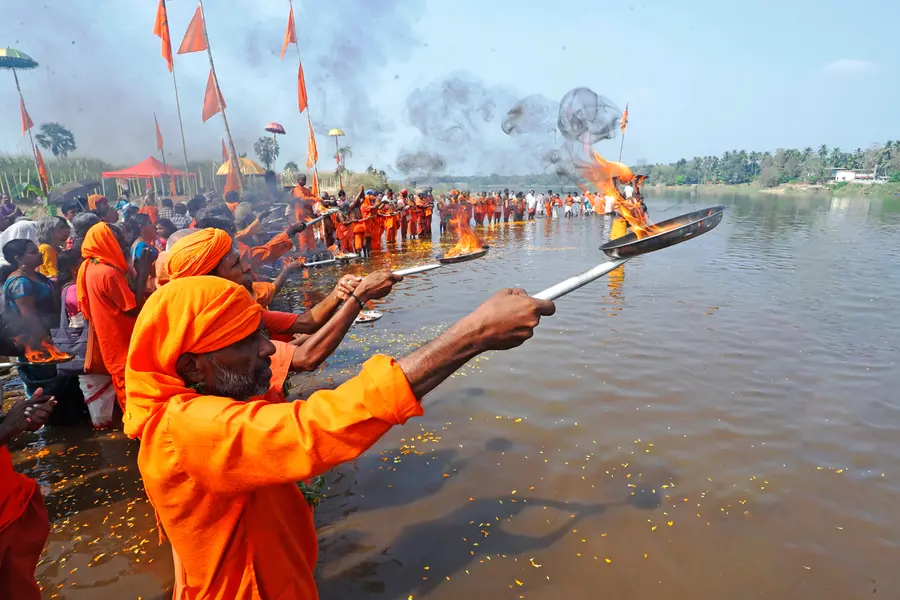
The South Indian State of Kerala, the land that gave birth to Sri Adi Sankaracharya, the proponent of Advaita darshana, witnessed a remarkable revival of its civilizational memory when the sands of Bharatapuzha—Kerala’s venerable Nila—felt the weight of hundreds of thousands of people once again. It was more than a riverbank crowding; it was a recovery of a collective memory. After a hiatus of around two-and-a-half centuries, the Mahamagha Mahotsavam was revived at Thirunavaya on the Bharatapuzha, drawing pilgrims, ascetics, scholars, and ordinary devotees in numbers not seen there for generations. The 17-day Mahamagha Mahotsavam, held from January 18 to February 3, 2026, was described as the “Kumbh Mela of South India” and blended devotional bathing, Vedic rites, classical arts, spiritual discourses, and a complicated choreography of ritual, administration, and modern logistics.
Mahamagha — the great gathering in the lunar month of Magha — had ancient precedents across the Indian subcontinent. Historically, periodic congregations of tirthas (pilgrims), akharas (monastic orders), pandits, and traders turned riverbanks into living cosmologies of faith, discussions, and cultural exchange. Kerala’s medieval grand assembly, the Mamankam festival, revolved around Thirunavaya—a small temple town on the banks of the Nila that functioned as a major congregation site and a center of ritual authority. The revival now aimed to reconnect with that lineage: to re-establish a pan-South Indian ritual hub where sacred baths and mantra chanting came together.
Organisers said the revival was historic: the ritual had been discontinued roughly 250 years ago, and the present event sought to restore the tradition and its spiritual rhythms. The 2026 Mahotsavam — held from January 18 to February 3 — deliberately echoed the scale and pattern of large Hindu tirtha gatherings, with procession, akhara participation, ritual baths (snana), evening river aratis, and a program of talks, yajnas, and cultural offerings.
A Southern Echo of Kumbh Mela
What made the Mahamagha Mahotsavam especially significant was its clear conceptual and ritual resemblance to the Kumbh Mela, India’s largest pilgrimage festival that traditionally draws millions to sacred rivers like the Ganga, Yamuna, and Godavari. Like the Kumbh, the Mahamagha too was centered on the belief that a sacred river became spiritually potent during an auspicious celestial period, making a holy dip (snana) an act of purification and renewal. The presence of sanyasis and akharas, the emphasis on tirtha-snanam, homas, Vedic chanting, spiritual discourses, and mass pilgrim participation, all mirrored the broader Kumbh ethos—where devotion, renunciation, and scholarship merged into one living spiritual civilization. While the Kumbh is widely known for its 12-year cycle, the Mahamagha at Bharatapuzha sought to revive a similar periodic river-based congregation in Kerala, offering devotees in the South an opportunity to experience the spiritual grandeur of a “mahaparva” without travelling to the North.
What Happened on the Riverbank
At the heart of Mahamagha was the snana — the sacred bath. Pilgrims trooped into ghats, often guided by local priests and saints, to immerse themselves and perform rites for ancestors, an act believed to confer removal of sins and spiritual merit. The evenings at Thirunavaya were punctuated by the Nila Arati — a moving ceremony of lamps, Vedic intonations, and devotional singing that framed the river as living myth. The akharas, led by Mahamandaleshwars and senior gurus, carried out initiations, discourses, and public debates; classical artists gave concerts; and religious scholars delivered lectures connecting ritual practice to textual tradition and contemporary life.
Beyond the spectacle, the Mahotsavam witnessed dialogue sessions on river conservation, traditional arts, Ayurveda, and the role of ritual practice in modern community life. The stated aim was to make the festival a living forum: devotional intensity on the one hand; cultural revival and intellectual exchange on the other.
Inauguration
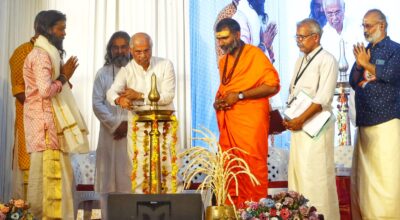
(Kerala Governor Rajendra Viswanath Arlekar lighting the lamp at the inaugural ceremony)
The inaugural ceremony unfolded as a compelling blend of ritual grandeur and public significance, signalling both the revival of an ancient tradition and its contemporary relevance. Kerala Governor Rajendra Viswanath Arlekar formally inaugurated the Mahotsavam by hoisting the Dharma (saffron) flag and lighting the traditional lamp, in the presence of public representatives, senior officials, and revered spiritual leaders. In his inaugural address, the Governor noted that the spirit of the Kumbh Mela evoked the sacred memory of Sree Rama’s return to Ayodhya, adding a deeper cultural resonance to the occasion. The opening rites gained further momentum as the Dhwaja Ghosha Yatra culminated at the precincts of the Navamukunda Temple, where the Governor performed the Dhwajarohanam, amid Vedic chants, mantras, and the rhythmic resonance of collective japa.
Soon after, thousands of devotees flowed to the riverbank, stepped into the waters for the Magha Snana, alongside Mahamandaleshwar Swami Anandavanam Bharati Maharaj, the driving force behind the festival’s revival. The Vedic recitations, led by Gayatri Gurukulam under the guidance of Acharya Arun Prabhakarji, lent the proceedings a powerful spiritual cadence—underscoring that this was more than a ceremonial launch, but a conscious effort to anchor the Mahotsavam in ritual continuity and public legitimacy, as a collective spiritual awakening on Kerala’s sacred riverbanks.
The public response had been overwhelming, with attendance figures rising from thousands to lakhs over the festival period, and tens of thousands converging on the riverbanks during the peak bathing days. This renewed pilgrimage attracted devotees not only from across Kerala, but also from neighbouring states, prompting many to describe it as a southern reflection of the great Kumbh gatherings of North India. Such massive footfall called for meticulous planning—temporary bathing ghats, crowd and traffic management, sanitation and drinking-water facilities, medical camps, transport coordination, and constant liaison with the district administration had become essential to the smooth conduct of the Mahotsavam.
Tensions and Troubles
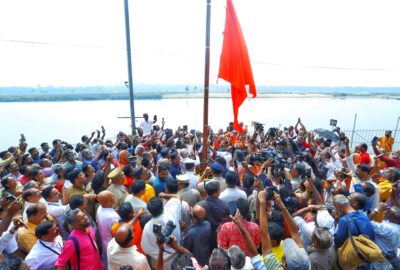
(The gathering at the flag hoisting ceremony)
It would not be an exaggeration to say that, in Kerala’s intensely polarized and minority-influenced political climate, no major Hindu festival was allowed to proceed without hurdles. With elections to the Kerala legislative assembly approaching and appeasement politics in the air, the Mahamagha Mahotsavam too faced an administrative roadblock when the local village officer invoked river-protection statutes and issued a stop memo, alleging encroachment and questioning the use of heavy machinery for preparing temporary ghats. The organizers mounted a firm legal challenge before the Kerala High Court, maintaining that all required permissions had been secured and that temporary arrangements were essential for safe access and orderly crowd movement. Even as they fought the case, the organizers reiterated their commitment to protecting the river and its banks, promising strict environmental and ecological safeguards. In the end, the festival moved forward—seen by many devotees as not merely an administrative clearance, but a hard-earned victory for the Hindu faith and perseverance.
The Idea of Pilgrimage
One of the most notable features of Mahamagha was that the participating monastic orders were pan-Indian in character. Akharas — ancient martial-disciples’ lineages long associated with Himalayan and Gangetic tirthas — threaded their ceremonial presence into the Thirunavaya program. Their rituals, processions, and doctrinal performances brought a visible link to the classical Kumbh rituals of North India, while also generating dialogues about local religious practice and ritual authority. For many devotees in Kerala, the presence of the akharas was both awe-inspiring and an occasion for thoughtful reflection on traditions, rituals, and spiritual practice.
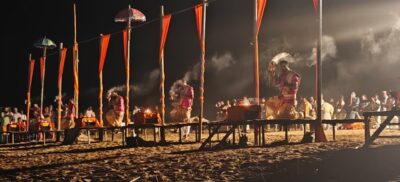
(Nila Arati)
The revival also opened up a wider, constructive conversation on inclusivity and cultural expression—how best to celebrate the river’s sacredness, and how a contemporary public festival could harmonize local temple traditions with pan-Indian ritual forms. Such reflections, often taking place quietly behind the scenes, helped shape how these large spiritual gatherings were embraced by local communities, cultural observers, and civil society voices, strengthening the Mahotsavam’s relevance for a wider cross-section of people.
Art, Memory, and Commerce
The Mahotsavam also became a cultural stage. Traditional Kerala art forms — music, Kathakali, Vilasini Natanam, and folk theater — were included alongside yoga sessions, discursive panels, and small-scale fairs selling religious books, handicrafts, and food. For artists and cultural performers, the congregation offered both livelihood and a rare audience concentration. For local businesses — from hotels and small eateries to transport operators — the event was a welcome economic injection. Yet commercialization carried its own pitfalls: the festival’s spiritual ambience could be tested by rows of stalls, loud amplification, and the pressure of monetization. The challenge for organizers was to keep devotional core practices visible while enabling cultural livelihood opportunities without letting commerce eclipse sanctity.
Devotees, Ascetics, and Observers
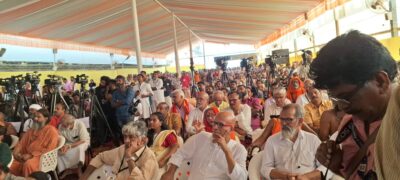
(Massive gathering at the inauguration)
Walking through the ghats during the Mahotsavam, one met many kinds of pilgrims: elderly men performing shraaddha for ancestors, young families seeking a communal experience, sanyasis who had come from distant akharas, and volunteers who ran medical tents and food relief points. For many devotees, the ritual bath was an embodied piece of continuity — a sense of touching a sacred time and place that linked personal grief, gratitude, and hope. For ascetics, the gathering was a reaffirmation of monastic networks and a platform for teaching. For environmentalists and local leaders, the gathering was also a test of civic capacity and ecological responsibility. These diverse voices gave the festival its layered texture.
A Coordinated Effort
Hosting a gathering of this scale on a riverine plain was as much an administrative challenge as it was a profound spiritual celebration. For the smooth conduct of the Mahotsavam, Hindu organizations and ashrams across Kerala came together in close coordination, ensuring that the utsav unfolded with discipline and devotion. Volunteers from the RSS and its affiliate organisations played a key role in crowd management, safety oversight of temporary bridges, sanitation arrangements, and emergency medical support.
The Spirit of Revival
The Mahamagha revival stands at a meaningful confluence of faith, heritage, and collective identity, but its deeper significance lies in the way it has fostered a renewed sense of Hindu unity across Kerala. For the organizers and spiritual communities, restoring this ancient ritual was not merely an event-management exercise—it was an act of cultural renewal, reconnecting society with traditions that had weakened over time due to historical disruptions and shifting social currents. For the wider public, the Mahotsavam offered a living classroom of Sanatana Dharma, where scriptures, temple customs, river worship, Vedic chanting, japa, dharma discourses, and sacred bathing seamlessly came together in a continuous spiritual experience.
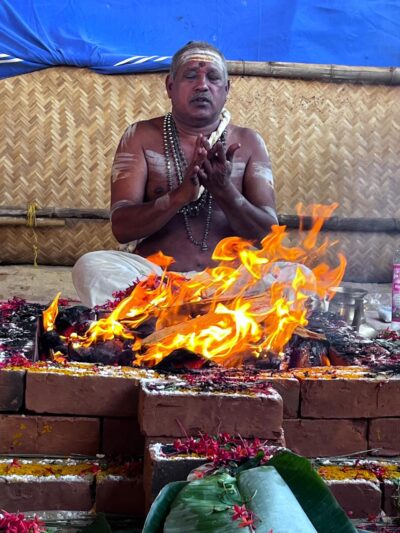
(Vedic Havan)
Equally important was the spirit of collective participation it generated. Ashrams, Hindu organizations, temple communities, and volunteers came together with a shared purpose, reminding devotees that the strength of Hindu society lies in coordination without conflict and devotion without division. In that sense, the Mahotsavam became more than a pilgrimage—it became a platform that encouraged scriptural study, disciplined ritual practice, and cultural continuity, while also inspiring the younger generation to understand the deeper meaning behind traditions rather than viewing them as mere spectacle. Ultimately, what rose to the surface was a powerful blend of devotional fervor, cultural confidence, and social cohesion, as Kerala reclaimed a timeless pilgrimage experience in a contemporary setting.
A Beginning, Not an End
As the lamps were gently lifted from the water and the last pilgrims stepped away from the ghats, the Mahamagha Mahotsavam left behind a larger promise—of a legacy that can endure well beyond the festival days. The gathering had the potential to deepen Hindu understanding of environmental responsibility as dharma, strengthening public awareness about the living health of the Bharatapuzha. At the same time, the momentum of cultural revival could translate into sustained initiatives in scriptural learning, spiritual discourse, literary engagement, and greater support for traditional arts and temple-linked heritage practices. Much will depend on the post-festival follow-through—how effectively the goodwill, attention, and collective energy generated by the Mahotsavam are channelled into long-term benefits for Hindu society. Above all, the festival reaffirms a timeless truth: the river is both sacred and sustaining, and its wellbeing flourishes best through a shared spirit of custodianship—uniting devotees, community organisations, and public institutions in an enduring partnership.
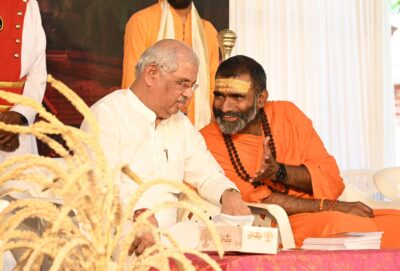
(Kerala Governor and Swami Anandavanam Bharati Mahamandaleshwar of Juna Akhara)
The Mahamagha Mahotsavam on the banks of the Bharatapuzha was much more than a large congregational event. It was a cultural experiment—an attempt to stitch together historical memory, devotional practice, and contemporary civic responsibility. The festival’s success will not only be measured in attendance figures or photo spreads, but in whether it strengthens the Hindu way of living, benefits the river ecologically, and leaves durable spiritual and cultural institutions for future generations. If the old lyric of the Nila is to continue—the river that carries stories, ashes, and songs—then the Mahotsavam must become a beginning, not just a celebration: a ritual that awakens long-term commitment to an age-old culture and civilization.
Note: All photos courtesy Pradeep Krishnan
