
The Irrelevance of Vijay Tendulkar: Deconstructing his Philosophy of Theater
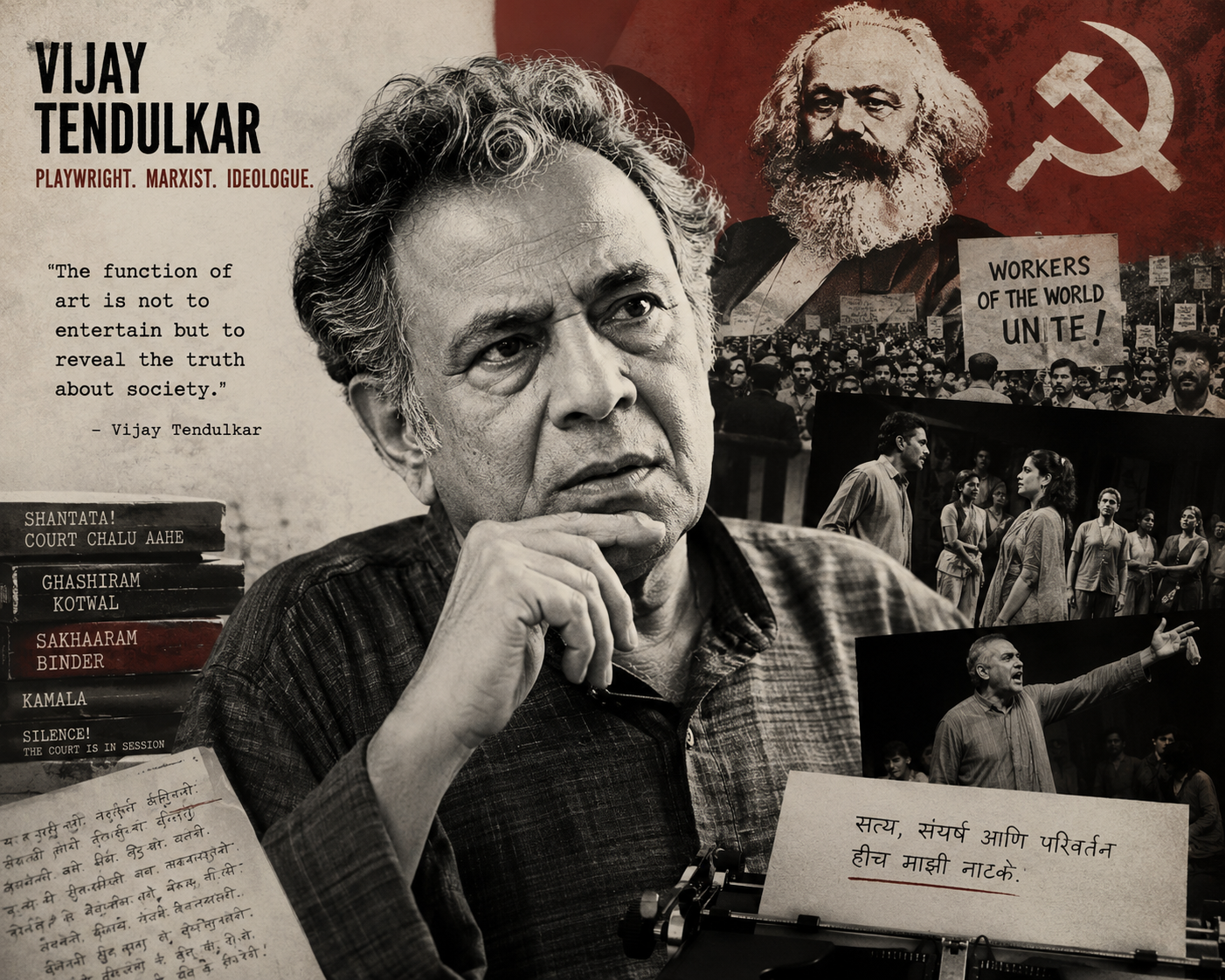
Image Created Using ChatGPT
Introduction: The Weight of a Continuing Aura
Vijay Tendulkar is not a writer who needs to be rescued from obscurity. Even half a century after the composition of his major works, he remains one of the most celebrated and venerated names in Marathi theatre and one of the few Indian playwrights who continue to be read, translated, and staged across the world. It is precisely this — the sheer persistence of the aura, its stubborn refusal to fade even as the society it claims to critique is undergoing transformation — that guides this critique. A dramatist whose work still commands attention must also remain answerable to criticism, especially when the prestige attached to his name tends to discourage hard questions about his methods, societal imagination, and ideological influence.
This essay does not attempt to survey Tendulkar’s entire output. Rather, it looks at some of his best-known and frequently read and taught plays like Ghashiram Kotwal, Gidhade (Vultures), Shantata! Court Chalu Aahe (Silence, the Court is in Order), Sakharam Binder, Shrimant, and Kamala [i]to understand and isolate a recurring pattern of the construction of his plays that offers a method for reading his other works. The claim here is not that these plays exhaust the evidence, but that they establish the basic grammar to make sense of Tendulkar’s other work and to understand his premise and its praxis.
The task therefore is not to announce or predict Tendulkar’s irrelevance but to argue for his active critical demotion — from neutral sociological witness using realism as a lens for storytelling to a quasi-ideologue who uses theatre and plays as vectors in an ideological project to depict societies idiosyncratically. To render Tendulkar irrelevant, in the sense intended here, is therefore an act not of erasure but a scholarly correction.
Honesty as Performance
Tendulkar and his works are generally described in the vocabulary of honesty, courage, and as a writer who refused to look away from uncomfortable social truths, choosing always to write what he witnessed rather than what convention found comfortable. This description has been absorbed almost without qualification into the critical apparatus that now surrounds him: Tendulkar the fearless truth-teller, Tendulkar as social conscience, Tendulkar as the dramatist who dared where others faltered. The question this essay poses is a simple one: was he really all that he is described and characterized as?
Ghashiram Kotwal – one of his most celebrated and arguably one of the most controversial plays — offers the ideal test case for this question. Ghashiram Kotwal continues to be recreated on the stages in various languages and interpretations. In fact, a new version is already being played in Hindi with noted actor Sanjay Mishra taking the lead. Interestingly, Ghashiram Kotwal, unlike some of his popular plays, reaches beyond generic social critique to invoke real historical personalities under their own names: Nana Phadnavis, the formidable statesman who held the fracturing Peshwa administration together for the better part of two decades, and Ghashiram Savaldas, the actual police chief appointed to the Kotwali of Pune under his patronage. But beyond the names, hardly anything matches the known history.
Ghashiram Kotwal is a fictionalized account of Kotwal Ghashiram, a Brahmin outsider humiliated in Pune, who allies with the powerful minister Nana Phadnavis and rises to become the city’s ruthless police chief. He terrorizes the city under Nana’s patronage, until public anger grows too large and Nana abandons him to a mob. The play borrows real historical names and one recorded incident — deaths in Ghashiram’s custody — but builds an invented story of political betrayal around them.
The extant historical records substantiate only certain elements of the plot. The historical Ghashiram Savaldas was indeed responsible for certain crimes — like the death in the custody of a group of Telangi Brahmin visitors to Pune. What does not survive scrutiny is the portrait constructed around this single documented episode: the play stages Nana Phadnavis as habitually lecherous, casually cynical, and actively complicit in Ghashiram’s rise and eventual fall, tolerating and instrumentalizing the Kotwal’s tyranny for his own political convenience before discarding him the moment popular anger became inconvenient.
Consider, against the received wisdom of Tendulkar’s fearless honesty, a deliberately counter-intuitive point: had the playwright genuinely been committed to honesty, Ghashiram Kotwal might have been a substantially different play where the characters in the play would have shown at least some parity with what the historical records tell us about these figures. However, it appears that the distortion of the historical record is not incidental scaffolding around an otherwise defensible dramatic structure but forms the play’s entire ideological architecture.
Nana Phadnavis is remembered by a considerable body of historical scholarship — including by contemporaneous British observers — as a capable statesman.[ii] A playwright genuinely committed to historical honesty has two available options: he could dramatize Ghashiram’s documented excess without simultaneously recasting his patron into a lecherous villain — allowing the moral weight of the episode to fall where the record actually places it — upon Ghashiram himself — rather than distributing it evenly across an invented portrait of ministerial depravity. Alternatively, he could declare at the outset itself — that what follows is a fictional account, making no claim upon the biographical record of real, identifiable men. Tendulkar did neither. He retained the real names, the real offices, the real documented episode of the Brahmins’ deaths in custody and alongside freely inventing the moral architecture that surrounds and interprets that episode. The disclaimer that the play now has about its lack of historicity is not really a consequence of conscientious decision on the part of the writer, but instead a consequence of the court direction after sustained protest over its treatment of both Nana Phadnavis individually and the Maratha rule collectively — failing which the international tour of the play could not have been possible.[iii]
This retreat deserves scrutiny rather than the ready acceptance it has generally received in subsequent critiques. To borrow real names, real offices, one documented atrocity, and then to construct around that isolated fragment an entirely invented moral universe in which the historical figure closely associated with competent statecraft is recast as a cynical enabler of tyranny is not honesty in any sense worth defending. It is, rather, the appropriation of historical authority without a submission to historical accountability.
Nothing prevented Tendulkar, had his interest genuinely lay in the showcasing of how ordinary men are corrupted by the patronage of the powerful, from inventing his ministerial patron with abandon as he invented the entire narrative of Ghashiram’s rise and fall. Instead, he transformed a real, identifiable, and largely respected historical administrator into an enabler and a villain. That the villain’s own community is cast across the play as disgraced and complicit suggests strongly that the historical frame was never incidental scaffolding but the central strategic point of the exercise.
This, the essay contends, is the clearest and most legible instance of a pattern that recurs across the whole of Tendulkar’s dramatic output — the deployment of realist or quasi-documentary form not in the service of discovering truth but in the service of pronouncing a verdict that had already been reached in advance of the evidence.
The Recurring Grammar of Delegitimization
If Ghashiram Kotwal uses historical narrative as a method of dramatic insinuation, the remainder of Tendulkar’s major plays discussed here demonstrate an identical method. However, the objects here are ordinary, non-historical institutions of Indian social and cultural life like the family, the middle-class social world, and religious and customary practice. Underneath these and connecting all three is a consistent and deliberate pattern of identifying the main antagonist as a person with questionable character and of a peculiar social identity.
If read as single unconnected events, each play offers a captivating account and a scathing criticism of the social situation being addressed in the play. Indeed, the performances and direction in the play would have certainly amplified the intended impact. But reading these plays alongside each other lays bare the method and practice of isolating institutions to delegitimize them. It is therefore more productive to isolate some of these recurring issues in his plays, since it is precisely the repetition of an identical structural pattern across otherwise unconnected plays that discloses the ideological grammar necessary to study Tendulkar’s work.
A writer who occasionally stumbles upon a monstrous family might reasonably claim to have observed an aberration. But a writer who returns to the monstrous family, the monstrous marriage, the monstrous administration, and the monstrous social tribunal across an entire career, with an alarming regularity, is no longer merely observing; he is offering a thesis. It is this thesis, fundamentally inspired by tenets of the typical Marxist account of “superstructural institutions” as instruments of domination.
The Delegitimization of the Family
Across Tendulkar’s dramatic corpus, the family is staged as a site of active violence whose true and essential nature is embedded in violence and domination. In Gidhade (The Vultures), Tendulkar portrays a grim account of the Pitale family, an aging father, his sons, and his daughter, locked in an ugly fight over money and property where every member schemes against the others. The conflict turns violent when the pregnant daughter-in-law is assaulted by the family itself, ending her pregnancy. The title calls the family “vultures” outright, framing the cruelty as their true nature rather than a breakdown. Thus, the title itself serves as an effective metaphor that forecloses — before a single line of dialogue is written or spoken — any reading of the family’s cruelty as contingent, remediable, or specific to this household rather than diagnostic of the institution as such.
The play’s most notorious scene, in which a pregnant woman is assaulted with a violence that ends her pregnancy, functions in the play’s structure less as a discrete plot development requiring its own explanation than as a kind of thesis statement rendered in flesh: the family devours its own, and this devouring is not an event but a condition. Crucially, no countervailing image of an intact, functional, or even an ordinary family is offered against which the Pitale household might register as an aberration rather than as an exemplar.
Similarly, in Shrimant, an earlier and arguably a gentler work, Tendulkar portrays a wealthy family that discovers their unmarried daughter is pregnant and responds not with honesty but with damage control, using their money to buy her a convenient bridegroom and protect the family’s reputation. The play shows the family choosing prestige over the daughter’s well-being, treating her crisis as a problem to be managed. Here, the family functions primarily as a machinery of concealment, purchasing a compliant bridegroom to manage an inconvenient pregnancy rather than confronting its implications honestly. Familial loyalty here is rendered structurally indistinguishable from a financial transaction executed in the currency of reputation.
Even Kamala — a play inspired by a real-life incident of an Indian Express journalist, Ashwin Sarin, exposing rural flesh market [iv] — ostensibly concerned with journalistic ethics and the trafficking of women, ultimately redirects its critical energy towards the institution of marriage itself. In Kamala, Tendulkar portrays a journalist, Jaisingh, who “buys” a trafficked woman named Kamala at an illegal human market to expose the trade in a story. His wife Sarita, initially horrified by what she sees, gradually recognizes that her own marriage isn’t so different from Kamala’s purchased servitude. Indeed, in one of the play’s most dramatic exchanges, Kakasaheb — Sarita’s uncle — sees the distress shared by Sarita and Jaising and asks Sarita what has happened between them, seeking the reason for her evident sadness. A crestfallen Sarita responds with a single, telling word: “Marriage.” Her terse yet unmistakable reply suggests that marriage itself is at the root of their unhappiness and estrangement.
In each instance, the governing dramatic move is identical: the family is not shown failing, an event that would imply a standard from which it has fallen; it is shown functioning exactly as it was structurally designed to function, and that design, in Tendulkar’s presentation, is domination and oppression. This is, in its essential logic, indistinguishable from the classical Marxist reading of the bourgeois family articulated by Friedrich Engels in The Origin of the Family, Private Property and the State: the family understood not as a natural or spontaneous unit of affection but as an institution engineered for the consolidation and transmission of property and the corresponding subordination of women and children within it.[v] Tendulkar does not argue this thesis explicitly; he dramatizes it repeatedly, allowing the accumulated weight of incidents to perform the argumentative labor. And in doing so, he achieves something more rhetorically powerful, and less easily contested, than argument: the appearance of observation.
The Denigration of the Middle Class
A second, closely related pattern governs Tendulkar’s treatment of middle-class respectability, which functions throughout his work not as a social class but as a euphemism for repression. Shantata! Court Chalu Aahe (Silence! The Court is in Order) stands as the classic instance of this operation. In Shantata! Tendulkar portrays a group of amateur actors who rehearse a play by staging a mock courtroom trial for fun, picking Miss Benare, an unmarried and pregnant colleague, as the “accused.” As the game continues, the group’s questions stop feeling like a play and start to feel real, leaving Benare publicly shamed by people she considered friends — exposing how easily ordinary, respectable people turn cruel given a socially acceptable excuse. The narration is intentionally structured to make the game and the reality it was meant to simulate become indistinguishable. The implication that is drawn home is the idea that this cruelty was never manufactured by the game but was already present within the group’s ordinary, outwardly respectable sociability, requiring only an occasion to surface.
Across Tendulkar’s work, the middle class is not shown as a separate social group with varied characteristics. Instead, it represents the same desires and instincts that appear more openly in other sections of society. Although the middle class may seem more refined in its language and behavior, moments of crisis reveal that its basic impulses are no different. It is never permitted to be simply what most middle classes in most societies are for most of the time — unremarkable, imperfect, muddling through its compromises without rising to the level of the diabolical.
This structural refusal to grant the middle class any register other than latent cruelty bears a direct genealogical relationship to the Gramscian account of bourgeois civil society as the terrain upon which hegemonic consent is manufactured and naturalized: for Antonio Gramsci, it is precisely the middle strata’s institutions — its associations, its rituals of sociability, its performances of respectability — that do the ideological labor of reproducing consent to domination without recourse to overt coercion.
Tendulkar’s dramaturgy performs exactly this unmasking operation: the mock trial functions as a Gramscian allegory in which the apparatus of consent-manufacture (the game, the performance, the shared theatrical project) is caught in the very act of becoming the apparatus of coercion, thereby exposing the supposed continuity between bourgeois civility and violence.
Traditions and Institutions as Oppressive by Design
The third recurring pattern is Tendulkar’s treatment of religious and customary practice. It is here that the ideological substrate underlying his work becomes most legible. Custom, ritual observance, and personal piety are consistently coded across his plays not as neutral or even occasionally consoling features of ordinary social existence and transcendental seeking — as they demonstrably are for a great many people in their individual “lived experience” — but as instruments that actively produce, or at a minimum provide a convenient cover for suffering that could not otherwise sustain itself.
In Sakharam Binder, Tendulkar portrays a bookbinder who lives outside marriage and disavows his own caste (Brahmin) he was born into, taking in women thrown out by their husbands. He takes them in exchange for housework and sex, and beats them when they don’t comply. The play follows two women who live with him in turn — Laxmi, devout and submissive, and Champa, who rejects both religion and obedience — using their contrasting personalities to ask whether devotion helps women endure abuse or enables it to continue.
Laxmi’s devout religiosity is staged as consistent with her servility and her victimhood: her piety is not incidental to her degradation but intrinsically linked to it, functioning almost as a mechanism of self-anaesthetization that renders her abuse bearable to her. Champa, by contrast, rejects both religious observance and domestic submission in the same gesture and is granted the play’s only sustained register of dignity and agency. The moral coding here could hardly be more explicit: proximity to custom correlates with abjection, while distance from custom correlates with authenticity and self-possession.
In Ghashiram Kotwal, the invocation to Lord Ganesha that opens the performance and the devotional abhangas interwoven throughout its musical structure are deliberately and repeatedly juxtaposed against scenes of lechery, administrative cruelty, and eventual mob violence, so that religious celebration and observance themselves become the ironic wrapping paper for the moral rot the play wishes to expose: the sacred is invoked not to be honored but to be implicated.
Nowhere across the major plays does custom or religious practice appear as a source of genuine consolation, communal solidarity, or transcendent meaning; tradition, in Tendulkar’s hands, is never shown malfunctioning under specific historical pressures — it is shown working precisely as it was designed to work, and its design is revealed to be oppression. This is the dramaturgical equivalent of the Marxian interpretation of religion in the realm of superstructure, which fundamentally is false consciousness that helps to endure the oppression. The famous Marxist dictum that “religion is the opium of the masses” is internalized where religion is presented as a necessary anesthetic that renders an otherwise intolerable social order bearable to those it exploits. A natural implication that follows from this premise is that disenchantment with religion is then a precondition for any genuine liberation.
The Recurring Brahmin Antagonist
The fourth pattern is at once the most striking and the least remarked upon in mainstream celebratory evaluation of Tendulkar: the persistent and non-random social location of his principal antagonists within the educated, ritually observant Brahmin milieu. Nana Phadnavis, a Chitpavan Brahmin chancellor, is the presiding architect of tyranny in Ghashiram Kotwal and the play’s Brahmin community collectively is staged as a decadent chorus — “throwing their turbans in the air” in pursuit of the Lavani dancer Gulabi. Interestingly, the same community later is shown to be demanding Ghashiram’s execution, which the play frames as rank hypocrisy.
Kashikar, the domineering husband and self-appointed presiding judge of the mock trial in Shantata, is also cast as a Brahmin. The patriarchs who preside over the Pitale household in Gidhade and the respectable arrangers of concealment in Shrimant are drawn, in name, occupation and social positioning, from that same recognizable milieu.
Across play after play, spanning several decades, the community historically associated in Maharashtra with priesthood, and textual and administrative authority, is cast with striking regularity as the source of domestic, social, and political cruelty even as the plays’ own rhetoric simultaneously generalizes outward to indict “the family,” “society,” or “the middle class” in the abstract and universal register.
A genuinely representative dramatic sociology of social and religious faultlines in India, drawing its villains in rough proportion to documented social reality across India’s vast diversity of region, caste, class and community, would not exhibit this degree of isolation and attention. Tendulkar’s does: it returns, with a regularity too consistent across too long a career to be plausibly explained as coincidence, to a single community as the vehicle through which institutions in general are indicted — a pattern that maps with some precision onto a longer trajectory within twentieth-century Indian Marxist and socialist cultural criticism, in which Hindu religious and textual authority is understood not merely as one hierarchy among many but as the paradigmatic ideological apparatus of Indian class society.
Read within this genealogy, Tendulkar’s recurring antagonist is not a series of independent character choices but a structural position within an inherited critical schema — the theatrical analogue of the priest or landlord in socialist realist fiction, present not because empirical observation repeatedly delivered him but because the underlying theoretical framework required him.
The Withheld Ending
A fifth and formally distinct pattern deserves separate notice, because it operates not at the level of character or theme but at the level of dramatic structure itself. It is also arguably the most rhetorically effective device in Tendulkar’s arsenal precisely because it has been almost universally read as a mark of artistic restraint rather than as a persuasive strategy in its own right.
Nearly every play discussed above declines to furnish anything resembling formal closure. Shantata ends with Benare left alone on stage in a state of collapse, the trial-game abandoned rather than resolved and no repair attempted. Gidhade offers no reckoning for the Pitale family beyond the accumulation of violence already witnessed; no character is punished, redeemed, or even condemned by the play’s own internal mechanisms.
Sakharam Binder closes on an act of violence — where Sakharam and Laxmi kill Champa — whose consequences are left unstated. Ghashiram Kotwal ends with a killing performed by the very community that had earlier enabled the killer, an act of mob justice that settles nothing about the administration that produced Ghashiram in the first place. Instead, it showcases a monologue from Nana which reinforces the entire architecture of the play discussed earlier in the essay.
Kamala leaves Sarita’s recognition of her own condition suspended, without any indication of what she might now do with that recognition. Though she ends up saying that he will break off her servitude eventually, but is shown currently is concern of her husband losing his job – an indication that the marriage will probably not solve the problem and will feed into the oppressor. In each case, the curtain falls not on resolution but on suspension. This recurring refusal of closure has been praised as a sign of Tendulkar’s artistic uniqueness — his refusal to offer audiences the false comfort of a tidy ending, his commitment to leaving the audience in the discomfort the material itself demands.
This essay proposes a more skeptical reading. A playwright who wished merely to call for the reform of an institution would ordinarily be expected to gesture, however faintly, towards the shape reform might take, or at minimum to dramatize a character capable of imagining it. The systematic withholding of any such gesture with some level of consistency functions instead as a quiet and persuasive insinuation that these institutions are not merely damaged but are beyond repair — that the absence of an alternative on stage reflects the absence of any genuine alternative in principle. This is a considerably more radical claim than a call for reform, but it is one the plays never have to state outright. The unresolved ending allows the audience to conclude unassisted, experiencing it as their own insight rather than as the playwright’s argument – a pattern too prominent to be ignored as coincidence.
The Ideological Substrate: Tendulkar and the Impulse to Delegitimize
The patterns discussed earlier in the essay, considered together rather than in isolation, are not a set of literary habits arrived at independently through the accumulated social observation. They constitute the recognizable pattern of a specific ideological formation, one with clear and traceable affinities to the Marxist and post-Marxist critique of the family, religion and inherited custom as superstructural instruments of domination that must be actively delegitimized.
Classical Marxist theory does not pause to ask whether the “bourgeois family” functions well for most of its members; it holds, as a matter of ideological commitment rather than as an empirical finding subject to revision, that such institutions exist to reproduce hierarchy, private property, oppression, and false consciousness.
It is this inherited theoretical grammar — family as concealed violence, custom as complicity, respectability as an excuse for coercion — and, running through Indian left cultural criticism specifically, the “Brahminical” religious and scriptural establishment as the carrier of ideological domination requiring exposure and dismantling. Once this substrate is understood, it becomes difficult to continue reading Tendulkar as a writer who happened to encounter the worst possible variation of every institution he examined.
The absence of even one institution — family, marriage, religious custom, respectable middle-class community or historical administration — that survives the play’s scrutiny with its legitimacy intact is not the coincidence of five empirical observations arrived at through open-minded inquiry. It is the unmistakable signature of a writer working outward from a settled prior conviction: that these institutions are not occasionally flawed, correctable through reform, but are structurally and necessarily oppressive by their very nature. Consequently, dramatizing their most extreme conceivable failure does not constitute a departure from the realist method but rather is the entire ideological purpose for which the realist form has been conscripted.
Realism, in Tendulkar’s hands, functions not as a commitment to representative accuracy but as an ideological technology. Read in this light, Tendulkar is best understood not as a neutral chronicler who happened to stumble upon the very worst version of every social institution he chose to examine in his plays, but as an artist who directed his imaginative and formal energies consistently around a broadly Marxian thesis of institutional delegitimization. A thesis which he pursued with sufficient consistency that it must be used as the primary interpretive key to his work as a whole.
Whether he was writing his plays consciously as a Marxist or not is entirely immaterial here. Indeed, he himself on multiple occasions said that he has not written any of his plays through any one ideological frame and that he himself is not attached to any ideological school of thought. For him, his plays were a medium to explore trapped human tendencies which inevitably come to the surface through a specific circumstantial force. At the center of those tendencies was man’s undeniable proclivity to violence – physical, verbal or psychological. Even his admirers and apologists would want everyone to believe that his plays were fundamentally an exposition of embedded violence in human societies where ‘peaceful co-existence’ was but a temporal mirage.
Even if one is to concede that this truly was his position, it is difficult to ignore the biases — discussed earlier in the essay – that he continuously entertained in his work. The subjects that he took, the relationships that he defined through those subjects, and the way they were narrated all were influenced – wittingly or unwittingly – through an ideological grooming that might have informed Tendulkar’s formative years. This essay by Tendulkar offers some clues. That he was influenced by Communism and participated in Marxist study circles in his early life is not something that can be ignored. He himself has accepted this part of his life[vi]. Association with such communist circles inevitably means romanticizing radical politics and strong social aversion expected in the Marxist worldview as a matter of ideological commitment. He engaged with various radical Marxist student movements and theatre groups in Mumbai too. Kobad Ghandy, a prominent name associated with the Indian Marxist movement and once accused and jailed for Maoist activities, talks about how theatre personalities like Tendulkar used to like them and support them in their politics.[vii]
To deny any Marxist leanings in his writings, therefore, is simply not possible, especially when one can note the unmistakable Marxist impulse of attacking and delegitimizing Hindu social and religious institutions. That the so-called progressive writers and artists have toiled hard to keep him alive points further to the fact that his ideas resonate with these ideologues who share the same zeal of attacking Indian social and cultural institutions as a matter of ideological commitment and not with a sincere feeling of reforming them for the better.
The consequence of this recognition is not insignificant. It bears directly on how his plays ought to be read, studied, taught, and probably even staged. If Tendulkar is understood as a sociological witness using realism in his plays, his plays then function within public and pedagogical discourse as evidence that audiences and students are implicitly invited to conclude — that is what Indian/Hindu family life, religious custom, and middle-class community substantively are.
If he is instead received, correctly, as an ideological mouthpiece working consciously or unconsciously within a specific and identifiable intellectual tradition, his plays then can justly be seen as one of the arguments against a peculiar social reality. These two claims are not equal; they are not interchangeable, and the failure of decades of largely adulatory appreciation to distinguish clearly between them is precisely the failure this essay focuses on.
Conclusion: Toward Genuine Discussion, Against the Aura
Seeking to understand the ideological underpinnings and influences on Tendulkar’s works is not an argument against his craft. The fact that he is one of the most influential writers in modern India cannot be understated. This essay does not challenge the artistic value of his works. The claim advanced here is narrower, more precise, and for that reason, more difficult to dismiss: that the sociological and historical authority routinely and almost automatically extended to these plays — their treatment in classrooms and media alike — as testimony about what Indian institutions essentially and inherently are is therefore misleading. Moreover, this unearned authority does substantial and ongoing intellectual harm precisely because it has been allowed to operate for half a century without the scrutiny that any comparably sweeping body of social argument would normally invite.
A play that borrows a real statesman’s name and office to indict him beyond what the documentary record will bear, or that returns with consistent regularity across an entire career to the same community as villains while simultaneously generalizing its verdict outward to indict “society,” “the family,” and “tradition” in the abstract, is not testifying to anything. It is offering arguments — and must be met with contestations, examination, and honest reckoning with the ideological premises that produced them.
Tendulkar’s defenders observe that Ghashiram’s cruelty and the deaths of the Brahmins in his custody are independently attested even in biographical accounts of Nana Phadnavis — a concession that lends the play’s central premise at least partial documentary support and complicates any claim that the episode was invented from nothing. Others argue that Tendulkar’s own repeated and public insistence that the play was allegorical “legend,” oriented toward contemporary phenomena such as the rise of the Shiv Sena and the accompanying authoritarian drift[viii], ought to be taken at face value as a statement of authorial intention.
Defenders of the wider corpus further note that family violence, cruelty, and the disguised sexual economy underlying nominally respectable marriages are anecdotally documented social realities across India and not just inventions requiring an ideological explanation. The dramatic extremity is in any case a long-established and legitimate device deployed by dramatists without thereby convicting the form itself of bad faith. These counter-arguments merit serious and continuing engagement and the case advanced in this essay is offered as a critical thesis for scholarly debate rather than as a final verdict. But the weight of the counter-arguments is more limited than it first appears.
The fact that the isolated elements of a play are historically or sociologically attested does not license the invented moral architecture built around them. Also, because unresolved endings are available to dramatists in general does not explain why Tendulkar’s corpus deploys them with such total and one-directional consistency, always against the same institutions, always in the same political direction, and never once toward an alternative image of what repair might look like. It is this asymmetry, more than any single instance, that the counter-readings cannot fully dissolve.
This is precisely why Tendulkar’s continuing relevance as realist-observer and careful teller, his global academic veneration, the persistent and celebrated revival of Ghashiram Kotwal itself in ever-new theatrical idioms renders this deconstruction not an act of belated iconoclasm but a corrective, long overdue. To render Tendulkar irrelevant, in the sense this essay has sought to establish, implies essentially two things: first, it is to insist that he be read, plainly and clearly, not as society’s honest and disinterested mirror, but one of society’s most formally gifted ideological advocates. Tendulkar as a dramatist repeatedly criticizes the family, tradition, religious customs, and the moral and administrative authority associated with a particular community under the premise of exploring violence embedded in societies. These arguments should, however, be examined as carefully as any other political argument: with equal critical scrutiny, adequate evidence, and without granting undue respect or exemption from criticism.
Second, the supposed expression of violence that he constantly takes recourse to is fundamentally an ideologically driven expression of certain social realities, and that it may not necessarily be the final verdict of how societies function. True, violence is an inescapable and unfortunate reality in every society. But rationalizing it through ideological blinkers is a sly way of justifying destructive ideologies like Communism – and this is precisely what Tendulkar does with the help of his dramatic brilliance. To render him irrelevant is to emphasize that what he wrote is neither a consistent nor an inevitable social reality. To make him irrelevant is to therefore peel off the sociological authority attached to his works and see them purely for what they are – just a piece of art and nothing more.
***
[i] The five plays discussed in the essay are widely recognized and considered to be Tendulkar’s finest plays. The plays are originally in Marathi. However, the English translations of the plays are available. For instance, readers can access 4 of the plays discussed in this essay through their English translations published by Oxford University Press. See Tendulkar, V (1992). Vijay Tendulkar: Five Plays, Oxford University Press
[ii] Deodhar, Y. N (1962), ‘Nana Phadnis and the External Affairs of Maratha Empire’, Popular Book Depot, Bombay
[iii] Deshpande, S. (2021), ‘Long After His Death, Vijay Tendulkar Returns to Upset the Republic of Hurt Sentiments’, The Wire https://thewire.in/the-arts/vijay-tendulkar-republic-of-hurt-sentiments-jaat-hi-pucho-sadhu-ki
[iv] Pandey. P, (2011) Vijay Tendulkar’s Play Kamala: A Symbol of Slavery, Journal of Teaching and Research in English Literature Vol 3 No. 2
[v] Engels, F. (1884) The Origin of the Family, Private Property and the State
[vi] Mitra. S (1980), Vijay Tendulkar: Indian theatre’s only complete philosopher’, India Today https://www.indiatoday.in/magazine/society-and-the-arts/story/19801231-vijay-tendulkar-indian-theatre-only-complete-philosopher-773665-2013-12-02
[vii] Nayar, M. (2021) ‘I consider myself a radical seeking to change society’, Interview / Kobad Ghandy, The Week https://www.theweek.in/theweek/cover/2021/03/11/i-consider-myself-a-radical-seeking-to-change-society.html
[viii] My writing has always been honest’, Vijay Tendulkar’s interview in the Frontline, 2005 https://frontline.thehindu.com/arts-and-culture/cinema/article30207362.ece
