
The Breast Tax : Real, Lie, or Legend?
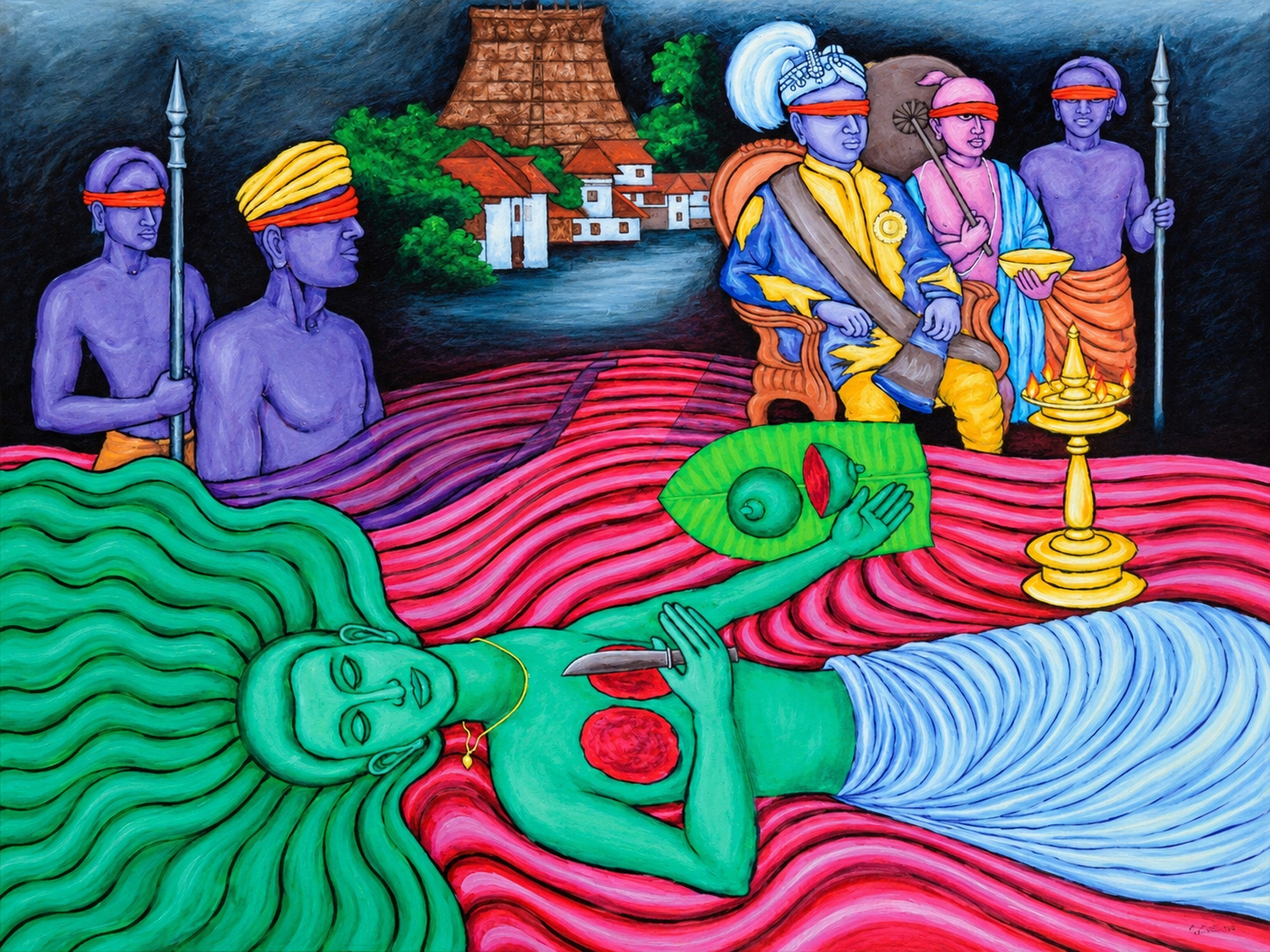
Image Courtesy: BBC
An examination of Travancore’s revenue records, royal proclamations, historical scholarship, and the evolution of an uncertain oral narrative into one of India’s most widely repeated historical claims.
I still remember the first time I encountered the story of the so-called “Breast Tax”. I was in Class IX. Like many others, I was introduced to a narrative that has since become one of the most widely circulated accounts of caste oppression in nineteenth-century Kerala.
According to the popular version, women belonging to lower castes in the princely state of Travancore were prohibited from covering their breasts unless they paid a special tax called Mulakkaram. The amount allegedly depended upon the size or attractiveness of a woman’s breasts, and revenue officials supposedly examined or measured them to determine the tax payable. The narrative then introduces Nangeli, an Ezhava woman from Cherthala. When a revenue official allegedly arrived to collect the tax, she refused to pay. Instead, she supposedly cut off both her breasts, placed them on a banana leaf, and presented them to the official. She subsequently died from her injuries. Her husband, identified in different accounts as Chirukandan or Kandappan, is said to have taken his own life by jumping into her funeral pyre. Horrified by the incident, the ruler allegedly abolished the tax. It is an emotionally overwhelming story. It is also a story that deserves historical scrutiny.
The question is not whether caste discrimination existed in Travancore. It did. Nor is the question whether subordinated communities experienced restrictions on clothing, movement, social status, and dignity. They did. The question is much more specific: Did Travancore impose a tax on women for the right to cover their breasts? Was Mulakkaram a clothing levy, or was it a gender-differentiated personal tax that has subsequently been misinterpreted? These are different historical propositions. They must be investigated separately.
An actual historical tax cannot automatically authenticate every subsequent explanation of its name. Equally, a genuine struggle against caste discrimination cannot establish an event merely because that event makes the historical injustice more dramatic. The objective here is not to deny historical oppression. It is to distinguish documentary history from subsequent interpretation.
-
The Fundamental Error: A Literal Translation is not Historical Evidence
The popular breast-tax narrative begins with the Malayalam word Mulakkaram. The word is broken into two parts: mula, meaning breast, and karam, meaning tax. From this literal translation, the conclusion is drawn that women were required to pay for the right to cover their breasts. This is a fundamental error of historical interpretation.
The name of a tax does not, by itself, establish its legal incidence, administrative purpose, or assessment mechanism. Those matters must be established by examining the revenue system in which the levy operated.
Historian Manu Pillai addresses this precise problem in his research essay, Kerala, Breasts, and the Tax that Wasn’t. Pillai explains that Travancore imposed personal or poll taxes on members of several subordinated communities, including Nadars, Ezhavas, Mukkuvas, Parayars, and Pulayars. In certain local systems, the terminology differentiated between the personal levy applicable to men and that applicable to women. The corresponding terms included Thalakkaram for men and Mulakkaram for women. The essential distinction is that the latter was a gender-differentiated personal levy, not a payment for permission to cover the breasts.
Pillai’s interpretation is also supported by the views of Devika, a historian at the Centre for Development Studies, Thiruvananthapuram. In a January 2021 interview published by The Telegraph, Devika explained that Mulakkaram was a regular tax levied on members of subordinated communities, whereas comparable personal taxes were levied on men. Manu Pillai was even more explicit: “It has been misunderstood as a tax for the right to cover breasts — there was no such tax.”
This is not an argument that women were never taxed. It is an argument about what the tax was actually imposed for. The distinction is crucial. The existence of a female personal tax does not establish the existence of a tax on breast covering.
-
The Historical Evidence: What did Travancore Actually Regulate?
The strongest evidence against the popular interpretation comes from the actual history of Travancore’s clothing regulations. If women were prohibited from covering their breasts unless they paid Mulakkaram, one would expect the relevant administrative orders to establish some relationship between payment of the levy and permission to wear upper-body clothing. However, the historical proclamations discussed in Pillai’s research point towards a different arrangement.
In 1812, during the administration of Colonel John Munro, a proclamation permitted certain Christian converts belonging to the Ezhava and similar communities to cover their breasts in the manner followed by Christians elsewhere. The subsequent clarification permitted the use of jackets known as kuppayam, while restricting the use of the upper cloth associated with Nair women. These provisions are discussed in Agur’s Church History of Travancore, particularly Appendix XVIII(l) and XVIII(lvii).
The distinction is important.
The administration differentiated between a jacket that covered the upper body and the upper cloth associated with a particular caste status. The controversy was therefore not simply about whether women could cover their breasts. It also concerned which garment they could wear and what social status that garment represented. This interpretation is reinforced by the subsequent events of 1829, when the Travancore authorities again clarified the restrictions concerning the upper cloth.
The documentary references include:
- C. M. Agur, Church History of Travancore, Appendix XVIII(l), concerning the 1812 proclamation.
- C. M. Agur, Church History of Travancore, Appendix XVIII(lvii), concerning the subsequent clarification.
- V. Nagam Aiya, The Travancore State Manual (1906), Volume I, page 528, as cited by Pillai.
These historical documents are more valuable for understanding the administration’s actual position than modern retellings that assume Mulakkaram was a payment for breast covering.
An important qualification must nevertheless be maintained: the proclamations concerning clothing do not, by themselves, prove that no discriminatory personal tax existed. What they demonstrate is that the legal regulation of clothing and the personal taxation of subordinated communities were distinct matters.
-
The Upper Cloth Movement: A Struggle for Social Status, not Simply Breast Covering
The popular narrative frequently conflates the Upper Cloth Movement with a supposed prohibition against women covering their breasts. This overlooks the historical character of the movement.
Robert Hardgrave Jr., in his influential 1968 research paper, The Breast-Cloth Controversy: Caste Consciousness and Social Change in Southern Travancore, published in The Indian Economic and Social History Review, examines the conflict through the framework of caste consciousness and social change. His work is a foundational scholarly reference for understanding the controversy. The dispute involved Nadar women seeking the right to wear the upper cloth, a garment associated with social position and caste privilege. The distinction between a jacket and the upper cloth was not merely a matter of physical coverage. The garment carried social meaning.
This is why the 1812 permission to wear jackets did not end the agitation. If the entire dispute had been about covering the breasts, permission to wear jackets would have substantially resolved the matter. Yet the conflict continued for decades because the women sought the social recognition associated with the upper cloth.
The historical work of Dick Kooiman, Conversion and Social Equality in India: The London Missionary Society in South Travancore in the 19th Century (1989), further illuminates the relationship between religious conversion, social mobility and the clothing controversy. Manu Pillai’s 2026 investigation brings these developments together and argues that the struggle was fundamentally connected with the assertion of social status.
In 1829, the Travancore authorities again clarified that certain women could cover their breasts with jackets but could not adopt the upper cloth in the manner of Nair women. The conflict eventually culminated in renewed violence during 1858–1859.
The point is not that women experienced no restrictions. They did. The point is that the historical restrictions concerned caste hierarchy and the social privilege associated with clothing.
The Upper Cloth Movement is documented evidence of caste-based clothing restrictions. It is not documentary evidence of a tax imposed for the right to cover breasts.
-
Historical Travellers Contradict the Modern Assumption about Clothing
Another weakness in the popular narrative is its assumption that the absence of upper-body clothing necessarily represented a special punishment imposed upon lower-caste women. Historical travellers’ accounts challenge this assumption.
- In 1583, Sheikh Zainuddin Makhdoom wrote Tuhfat al-Mujahidin, describing the clothing conventions of Kerala. His account describes men and women across social categories wearing relatively little clothing, with a short garment around the waist.
- In 1623, Italian traveller Pietro della Valle visited Kozhikode. He described women in the royal household, including the sisters and nieces of the Zamorin, without upper-body garments. His account also describes the queen wearing a cloth around her lower body.
- In the seventeenth century, Dutch traveller John Nieuhoff described the queen of Kollam wearing a garment around her waist, with the upper portion of her body largely uncovered.
- John Henry Grose, in A Voyage to the East Indies (1772), also recorded clothing conventions in which women did not ordinarily cover their breasts.
Nineteenth-century sources provide further observations.
- William Logan, in Malabar Manual (1887), recorded that Nair women traditionally went uncovered from the waist upwards. He also described the social meaning of upper garments, which could indicate lower caste status rather than higher status.
- Mary Billington’s nineteenth-century observations similarly discuss the unusual social significance attached to upper-body clothing in Kerala.
These sources are particularly important because they demonstrate that clothing conventions in Kerala were historically different from contemporary assumptions about modesty.
The relevant authorities include the following:
- Sheikh Zainuddin Makhdoom, Tuhfat al-Mujahidin (1583), translated by S. Muhammad Husain Nainar.
- Pietro della Valle, The Travels of Pietro della Valle in India, Volume II.
- John Nieuhoff, seventeenth-century travel accounts.
- John Henry Grose, A Voyage to the East Indies (1772).
- William Logan, Malabar Manual (1887).
- L. K. Anantha Krishna Iyer, The Cochin Tribes and Castes (1912).
These accounts do not establish that all women enjoyed equal freedom of dress. They establish something more specific: the absence of upper-body clothing was not exclusively imposed on subordinated women.
The social meaning of clothing in Kerala cannot simply be reconstructed by importing Victorian or contemporary ideas of modesty into an earlier historical period.
-
Where is the Evidence that Officials Measured Women’s Breasts?
The most sensational part of the modern narrative is the claim that the tax depended upon the size, beauty, or attractiveness of a woman’s breasts. This is not a minor embellishment. It alleges a highly specific administrative practice. If Travancore actually assessed women according to the physical characteristics of their breasts, there should be some documentary indication of how that assessment operated.
One would reasonably expect to find:
- A prescribed schedule of rates;
- Official instructions concerning measurement;
- Assessment rules;
- Revenue registers recording individual liabilities;
- Administrative correspondence;
- Disputes arising from the alleged assessment procedure.
Where are these records?
Manu Pillai directly addresses this assertion in his 2026 research essay. He identifies the claim of breast measurement as an exaggeration for which there is no historical proof. The modern assertion that revenue officials physically measured women’s breasts has not been substantiated by any contemporary Travancore administrative instruction or assessment record identified in the research examined here.
The allegation is also associated with later publications, including Sadasivan’s A Social History of India (2000), as well as subsequent retellings. But a modern author’s assertion concerning a nineteenth-century administrative practice does not establish that the practice existed. Where is the original assessment regulation? Where is the revenue instruction? Where is the corresponding administrative record? Until such evidence is produced, the claim that tax liability was calculated according to breast size or attractiveness must be treated as unsupported.
It is important to distinguish between the historical existence of Mulakkaram and the much more specific allegation that officials measured women’s breasts. The former is supported by historical discussion of personal taxation. The latter has no comparable documentary foundation.
-
An Important Discovery in the 1937 Historical Record: The Mala Arayan Tradition
One of the most significant findings in Pillai’s 2026 research concerns Anantha Krishna Iyer’s Travancore Tribes and Castes, Volume I (1937). The book records an oral tradition among the Mala Arayan community in the Poonjar region. According to the account, the Poonjar ruler imposed a personal tax on the Arayans. The tax was described as Thalakkaram for men and Mulakkaram for women. The account further records that when a tax collector pressed the community for payment, a man allegedly cut off his head in protest against the male levy, while a woman cut off her breast in protest against the female levy.
This is particularly important because it offers an alternative historical context for the mutilation narrative. The account does not describe a woman paying for the right to cover her breasts. It describes a personal tax for females and a corresponding levy for males.
Pillai argues that the terminology was used to distinguish taxation by sex. He also notes that under the Travancore administration, the expression Talayara was used for personal taxation affecting both sexes. The 1937 account therefore establishes that a story involving bodily mutilation in protest against gender-differentiated taxation existed in an earlier recorded oral tradition. It does not establish the popular Nangeli episode as a documented event in early nineteenth-century Travancore.
This raises an important historical question: Did the later Nangeli narrative draw upon, adapt, or independently reproduce an older oral tradition? Pillai considers several possibilities, including the possibility of a separate incident involving an Ezhava woman.
The responsible conclusion is not to declare every oral account as fabricated. It is to distinguish the existence of an oral tradition from the documentary verification of a particular historical event.
-
The Abolition of Personal Taxation: The 1815 Proclamation
The chronology of abolition provides another important test of the popular narrative. According to Pillai, the relevant personal taxes imposed upon subordinated communities were abolished in 1815 under the administration of Colonel John Munro, following pressure from Christian missionaries. Pillai identifies the relevant royal proclamation in Agur’s Church History of Travancore, Appendix XVII(liv), page 573.
This is an important documentary reference because it provides an identifiable administrative context for the abolition of personal taxation.
The chronology is therefore:
Year |
Historical Development |
| From the 1750s | Personal taxation imposed on several subordinated communities, according to Pillai’s research |
| 1808 | Revenue collected from Nadars and Ezhavas reportedly amounted to approximately ₹88,000 |
| 1812 | Proclamation permitting certain Christian converts to wear jackets |
| 1815 | Abolition of the relevant personal taxes, according to the proclamation cited by Pillai |
| 1829 | Further clarification concerning clothing and the upper-cloth privilege |
| 1858–1859 | Renewed conflict concerning the upper cloth in southern Travancore |
This chronology is important because the popular story frequently attributes abolition directly to Nangeli’s alleged death.
The 1815 proclamation provides a separate administrative explanation for the abolition of the personal taxes. It does not establish that no individual ever resisted taxation. But it means that the alleged causal connection between Nangeli’s death and the abolition of the levy cannot be accepted without independent evidence.
-
What do Historians say About Nangeli?
The historical existence of Nangeli must be examined separately from the question of whether a breast-covering tax existed. Sabin Iqbal’s 2020 investigation, The Legend of Nangeli, is particularly useful. The article records the observations of Travancore historian Malayinkeezhu Gopalakrishnan, who could not locate Nangeli or the popular breast-tax narrative in the Mathilakam Records, which were important administrative records maintained at the Sri Padmanabhaswamy Temple.
This absence is relevant, but it must not be overstated. A rural woman belonging to a subordinated community might not necessarily appear in official records. The absence of a name does not prove that the individual never existed. Manu Pillai also acknowledges this limitation.
Oral traditions can preserve historical experiences that official documents fail to record. They are especially important when studying communities excluded from the institutions that produce written history. However, oral tradition and documentary verification are not interchangeable.
A community’s memory of resistance may be historically meaningful even when the precise identity, date, and circumstances of an event cannot be independently established. The problem arises when later narrators add specific details and present them as established nineteenth-century facts.
There is no contemporary documentary corroboration identified for the complete sequence involving Nangeli, the tax collector, the banana leaf, her death, her husband’s suicide and the immediate abolition of the levy. The appropriate conclusion is that Nangeli’s story remains an unverified oral tradition in its popular form.
-
How an Uncertain Narrative acquired the Authority of Established History
The development of the Nangeli narrative raises another important question: How does a historical allegation acquire credibility through repetition?
The story has appeared in newspapers, books, international publications, films, paintings, and educational discussions. The BBC’s 28 July 2016 report, The Woman Who Cut Off Her Breasts to Protest a Tax, brought the narrative to a substantial international audience. But a modern media report cannot serve as independent proof of a nineteenth-century event. The 2020 Open investigation also discusses how the narrative gained wider recognition through contemporary artistic representations, including Murali T.’s painting.
The Telegraph’s January 2021 investigation, The Breast Tax That Wasn’t, is especially important because it records the disagreement between popular interpretations and the views of historians Pillai and Devika. The News Minute’s March 2023 investigation into the Channar Revolt provides further scholarly perspectives, including those of Rajan Gurukkal and Malavika Binny. Importantly, these publications demonstrate that the historical interpretation is contested. The popular narrative is not an undisputed historical conclusion.
There is also a serious problem of circular referencing. Author A repeats an unsourced story. Author B cites Author A. A newspaper cites Author B. An international publication cites the newspaper. A textbook cites the international publication. Eventually, readers encounter several publications and assume that there must be several independent historical sources. But there may still be only one original allegation.
Ten publications repeating an unsourced claim do not constitute ten independent historical confirmations.
Repetition creates familiarity; it does not offer evidence.
-
Academic Research: What the Scholarly Literature Establishes
The argument against the popular interpretation does not rest on one historian or one newspaper article. It draws upon several bodies of historical research.
Robert Hardgrave Jr.’s (1968) The Breast-Cloth Controversy: Caste Consciousness and Social Change in Southern Travancore was published in The Indian Economic and Social History Review. Hardgrave’s research provides an important historical account of the caste and status dimensions of the Upper Cloth Movement.
- Devika’s (2005) article, The Aesthetic Woman: Re-forming Female Bodies and Minds in Early Twentieth-Century Keralam, was published in Modern Asian Studies. This research examines the transformation of gender norms, clothing, and social reform, as well as the construction of modern female respectability in Kerala.
Dick Kooiman’s (1989) article, Conversion and Social Equality in India: The London Missionary Society in South Travancore in the 19th Century, examines the relationship between missionary activity, religious conversion, and social mobility, providing important historical context for the clothing controversy.
Volume I of Anantha Krishna Iyer’s (1937) three-volume work Travancore Tribes and Castes can be accessed here. This is an early ethnographic record of the Mala Arayan tradition involving Mulakkaram and Thalakkaram.
Kishore Ram’s (2021) work, Body as Revolt: The Myth of Nangeli was published in Shanlax International Journal of English. This paper examines the representation of Nangeli in contemporary cultural and literary narratives.
Binu and Manoharan’s (2021) article, Absence in Presence: Dalit Women’s Agency, Channar Lahala, and Kerala Renaissance, was published in the Journal of International Women’s Studies. This paper is important for understanding the historical invisibility of Dalit women and the need to examine their experiences critically rather than relying exclusively on official narratives.
These works do not all attempt to prove that no breast-covering tax existed. Their value lies in establishing the historical context against which the popular interpretation must be evaluated.
-
The Contrary Evidence
A serious historical argument must also address research that challenges the narrative of the breast tax.
In January 2026, Mahimai Dass published Revisiting the Nangeli Incident of Mysore in Al-Shodhana. She argues that documentary evidence of a breast tax in the Kingdom of Mysore makes the possibility of a similar tax in Travancore worthy of reconsideration. Her argument deserves examination. However, the existence of a tax in Mysore cannot automatically establish the existence of an identical tax in Travancore. These were separate political jurisdictions, with their own administrative and revenue systems.
Evidence from one kingdom may provide comparative historical context. It cannot replace evidence establishing the legal incidence, assessment, and collection of a particular tax in another kingdom. Similarly, some modern academic and popular accounts repeat the claim that women were taxed according to breast size. The important question is whether those publications produce independent contemporary assessment rules or merely repeat earlier allegations.
A historical claim cannot be established by the number of publications repeating it.
-
The Documentary Test: What Would Prove the Existence of a Breast Tax?
At this stage, the burden of proof must be made explicit. If someone asserts that Travancore imposed a tax specifically on women for covering their breasts, the relevant evidence would include:
- A royal proclamation or revenue regulation establishing the levy as a condition of breast covering.
- An assessment schedule specifying that the tax was payable for wearing upper-body clothing.
- Official instructions to revenue collectors establishing how such liability was determined.
- Revenue records linking payment to the right to wear particular garments.
- Administrative correspondence or contemporary complaints describing the enforcement of such a rule.
For the additional allegation that the tax depended upon breast size or attractiveness, the evidence would need to be even more specific. One would expect a valuation method, prescribed assessment criteria, or official instructions concerning physical measurement. None of these has been established by the sources examined in this article.
The Kerala State Archives’ historical collections, including revenue records, Huzur Khajana accounts, Huzur Thirattu and royal orders, remain important avenues for further research. A complete archival investigation would be necessary before claiming that every possible record has been exhausted.
But the burden of proof cannot be reversed. Those asserting the existence of a specific breast-covering tax must produce evidence for it. The inability of critics to prove a universal negative does not establish the positive allegation.
-
What the Historical Evidence Establishes
The findings can be summarized as follows:
| Popular assertion | Historical position |
| Mulakkaram was a fee for covering breasts. | The interpretation advanced by Pillai and Devika identifies it as a female personal levy, not a clothing fee. |
| Women were charged according to breast size. | No contemporary assessment schedule establishing this has been identified. |
| Officials physically measured women’s breasts. | No credible contemporary administrative instruction or record has been identified. |
| Lower-caste women could never cover their breasts. | The 1812 proclamation permitted certain Christian converts to wear jackets, although caste-based garment restrictions remained. |
| The Upper Cloth Movement was simply about covering breasts. | Hardgrave’s research and the historical proclamations demonstrate the importance of caste status and social mobility. |
| Nangeli’s death immediately abolished the tax. | The relevant personal-tax abolition is associated with an 1815 royal proclamation cited by Pillai. The alleged causal connection is unverified. |
| The complete Nangeli episode is documented in nineteenth-century records. | No contemporary documentary corroboration of the complete popular narrative has been identified. |
The historical distinction is therefore quite clear.
There was discriminatory taxation. There were caste-based clothing restrictions. There were genuine struggles against social hierarchy. But these facts do not establish the existence of a tax imposed specifically for the right to cover women’s breasts.
Conclusion: Historians Should Offer Evidence, not Embellishments
The historical experiences of women and subordinated communities in Travancore deserve serious recognition. Caste-based discrimination, restrictions on clothing, and struggles for social dignity are important subjects of historical inquiry. Their significance does not depend upon the acceptance of the Nangeli narrative in its most sensational form. Indeed, unsupported embellishment can weaken the credibility of genuine historical injustices.
The evidence examined here supports a substantially different interpretation.
Mulakkaram was a historical term associated with personal taxation of women in certain revenue systems. The interpretation advanced by historians Pillai and Devika is that it was a gender-differentiated personal levy, not a fee for the right to cover the breasts. Travancore’s 1812 and 1829 clothing proclamations, the documented history of the Upper Cloth Movement, the 1815 personal-tax abolition reference, and the earlier Mala Arayan oral tradition provide important context for understanding how the modern narrative may have developed.
There is no established documentary evidence of a system in which women were individually measured and charged according to breast size or attractiveness. Nor has a contemporary administrative instrument establishing a tax specifically for breast covering been identified.
The popular account of Nangeli, including the mutilation, the banana leaf, her subsequent death, her husband’s suicide, and the immediate abolition of the tax, remains unverified.
This conclusion should not be confused with a denial of caste oppression. The struggle of Nadar women over upper clothing was real. The restrictions they faced were real. The discriminatory personal taxes imposed upon subordinated communities were real. None of these historical realities requires us to accept an unsupported explanation of Mulakkaram.
We can accept the argument that absence of evidence is not evidence of absence. It is an important principle, particularly when researching communities whose experiences were excluded from official historical records. But it cannot serve as a device by which a positive historical allegation is exempt from scrutiny.
The burden of establishing a tax specifically imposed for covering women’s breasts lies with those making that claim. A literal translation, a modern anecdote, an emotionally powerful painting, or a hundred publications repeating the same assertion cannot substitute for the original legal or administrative evidence.
If a contemporary Travancore revenue regulation establishing such a tax exists, it should be produced and examined. Until then, the popular breast-tax interpretation cannot be presented as established history.
Mulakkaram existed. Discriminatory personal taxation existed. Caste-based clothing restrictions existed. But the alleged tax on the right to cover women’s breasts, particularly one calculated according to breast size or attractiveness, has not been established by the historical evidence.
The distinction is not semantic. It is the difference between what history documents and what later narratives have made of it.
History should be difficult enough to challenge a myth, and honest enough to preserve the truth even when the myth is more compelling.
The question is not whether the story moves us. The question is whether the evidence establishes that it happened.
References
Primary and Early Historical Sources
- Agur, C. M. (1903). Church History of Travancore. See Appendix XVII(liv), p. 573, and Appendix XVIII(l) and XVIII(lvii), concerning the proclamations discussed above. The original edition should be consulted for exact transcription.
- Aiya, V. Nagam (1906). The Travancore State Manual. Volumes I–III. Travancore Government Press.
- Iyer, L. K. Anantha Krishna (1937). Travancore Tribes and Castes. Volume I, pp. 165–166.
- Iyer, L. K. Anantha Krishna (1912). The Cochin Tribes and Castes. Volume II.
- Makhdoom, Sheikh Zainuddin (1583). Tuhfat al-Mujahidin. Translated by S. Muhammad Husain Nainar (2005).
- Della Valle, Pietro. The Travels of Pietro della Valle in India. Volume II, edited by Edward Grey, Hakluyt Society.
- Grose, John Henry (1772). A Voyage to the East Indies.
- Logan, William (1887). Malabar Manual.
- Mateer, Samuel (1883). Native Life in Travancore.
- Nieuhoff, John. Voyages and Travels into Brazil and the East Indies. Historical travel account.
Academic and Historical Research
- Hardgrave, Robert L. Jr. (1968). “The Breast-Cloth Controversy: Caste Consciousness and Social Change in Southern Travancore.” The Indian Economic and Social History Review, 5(2), 171–187. DOI: 10.1177/001946466800500205.
- Devika, J. (2005). “The Aesthetic Woman: Re-forming Female Bodies and Minds in Early Twentieth-Century Keralam.” Modern Asian Studies, 39(2), 461–487. DOI: 10.1017/S0026749X04001519.
- Kooiman, Dick (1989). Conversion and Social Equality in India: The London Missionary Society in South Travancore in the 19th Century. Manohar Publications.
- Pillai, Manu S. (2026). “Kerala, Breasts, and the Tax that Wasn’t.” 4 April 2026.
- Ram, Kishore (2021). “Body as Revolt: The Myth of Nangeli.” Shanlax International Journal of English, 9(4), 1–8.
- Binu, K. D., and Manosh Manoharan (2021). “Absence in Presence: Dalit Women’s Agency, Channar Lahala, and Kerala Renaissance.” Journal of International Women’s Studies, 22(10), 17–30.
- Dass, Mahimai (2026). “Revisiting the Nangeli Incident of Mysore.” Al-Shodhana, 14(1), 1–12. DOI: 10.70644/as.v14.i1.1.
Contemporary Historical Investigations and Reporting
- Gautam, Swati (2021). “The Breast Tax That Wasn’t.” The Telegraph, 14 January 2021.
- Iqbal, Sabin (2020). “The Legend of Nangeli.” Open, 13 August 2020.
- Bharathy Singaravel, Cris and Nithya Pandian (2023). The News Minute, investigation into the Channar Revolt and its historical context.
- BBC News (2016). “The Woman Who Cut Off Her Breasts to Protest a Tax.” 28 July 2016.
- Vepachedu, Sreenivasarao (2025). “Non-Existent Breast Tax Myth of Missionaries, East India Company and Colonial Stooges: Laundering Citations and Consensus.”
- Divya J. “Beyond the Margin: Nangeli’s Struggle Against Breast Tax.”
- Heritage: Journal of Multidisciplinary Studies in Archaeology (2021–22), Volume 9, p. 440, for a contrasting account of Mulakkaram.
