
Bharat Under Narrative Siege: Hindu Identity, Ideological Networks, and the Contest for Civilizational Sovereignty
Image Courtesy: Google AI
1 Introduction
In September 2021, nearly seventy academic units from 49 universities co-sponsored Dismantling Global Hindutva, an online conference (K. Sharma 2021). The Hindu American Foundation called it ‘a partisan event related to politics in India’ (HAF 2021); the organisers said they distinguish the Hindu faith from Hindutva (K. Sharma 2021). The documents alone can’t settle who was right.
So, terms matter. Hinduism means the plural religious and philosophical traditions. Hindutva, set out by V. D. Savarkar in 1923 (Britannica n.d.), is the political ideology of a Hindu nation. Hindu nationalism is the movement built on it, which supporters call cultural nationalism. Indian nationalism is the Constitution’s wider civic project.
How far does organised activity challenge Hindu traditions, and how can India respond without abandoning pluralism? My argument is that the contest has moved from religion and elections to authority: who interprets, preserves and represents the inheritance. I call this civilizational sovereignty, built on five pillars (Figure 1). It means capacity, not insulation. Public documents from 2014 to November 2026 show real hostility toward Hindus, open and institutionally backed advocacy against Hindutva, and no proof of a covert campaign against Hinduism itself.
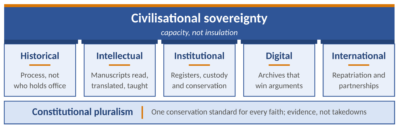
Figure 1. The five pillars of civilizational sovereignty (author’s model)
2 Historical Foundations: Colonial Historiography and Memory
Colonial writers set categories that both sides still use. Mill divided India’s past into Hindu, Muslim and British periods (Thapar 1989), and Elliot and Dowson’s chronicles cast medieval rule as despotism (Eaton 2000).
Marxist-influenced historians answered differently. Thapar (1989) argued that a unified Hindu community was partly a modern construction; Lorenzen (1999) countered that a Hindu identity, defined partly against Muslims, predates British rule by centuries. Both are arguments to win in print, not by decree. Few professional historians studied temple desecration, leaving it to partisans (Eaton 2000); Eaton finds it selective, aimed at temples tied to enemy kings (Eaton 2024).
Ayodhya shows the stakes. A 1991 report by R. S. Sharma, M. Athar Ali, D. N. Jha and Suraj Bhan argued there was no evidence of a temple under the Babri mosque (Jha 2009). The Supreme Court later accepted that the structure beneath it was ‘not an Islamic structure,’ yet noted that the Archaeological Survey of India (ASI) couldn’t say why it was destroyed or whether a temple was demolished (Chandra 2019). Evidence overtook the historians’ certainty and left demolition unproven.
A private suit ended with Penguin India withdrawing Wendy Doniger’s The Hindus in 2014 (NPR 2014); NCERT’s 2022 ‘rationalisation’ dropped the Mughal courts chapter and a paragraph on the 2002 Gujarat riots, citing pandemic load and overlap (Scroll Staff 2022). Historical sovereignty rests on process, not on who holds office.
3 Domestic Ideological Contestation
Somnath is the oldest argument. In March 1951, Prime Minister Jawaharlal Nehru told President Rajendra Prasad he didn’t ‘like the idea of your associating yourself with a spectacular opening of the Somnath Temple,’ but wouldn’t ‘press my point any further’ (National Herald 2020). Modi has suggested Nehru opposed restoration; The Wire replies that his cabinet consented (The Wire 2026). Both records stand.
The 2024 Ram temple consecration reopened it. Congress declined what Jairam Ramesh called ‘clearly an RSS/BJP event’ (PTI 2024), the CPI(M) objected to a state-sponsored religious ceremony (PTI 2023), and Congress noted that all four Shankaracharyas had also stayed away (The Week 2024). Those statements are documented. The motives each side imputes aren’t.
Some statements go further. In 2023, the DMK’s Udhayanidhi Stalin said Sanatana Dharma should be ‘eradicated like dengue and malaria’; in 2024, the Supreme Court told him he’d abused his rights (South First 2024). He blamed the doctrine for discrimination. I worry that likening a living tradition to a disease is stereotyping, though one minister isn’t a movement.
The RSS answers with cultural nationalism. RSS chief Mohan Bhagwat said in 2018, ‘If we don’t accept Muslims, it’s not Hindutva’ (P. Sharma 2018), and the Supreme Court’s 1995 judgment read Hindutva as a way of life, not bigotry (Supreme Court of India 1995). Critics reply that Savarkar’s own test, India as fatherland and holy land (Britannica n.d.), leaves Muslims and Christians outside. Words aren’t deeds, but a public position can be tested against conduct.
4 Transnational Ideological Networks
USCIRF’s 2026 report called for targeted sanctions on RAW and the RSS (Padmanabhan 2026), and its country brief recommends ‘country of particular concern’ status (USCIRF 2026). Delhi says USCIRF ‘has persisted in presenting a distorted and selective picture of India’ (Padmanabhan 2026). Both are positions, not findings of fact.
Hostility toward Hindus is documented, at a modest scale. A 2022 Rutgers-linked study found a slur aimed at South Asians used over 250 times a day on Twitter, from almost nothing in 2019 (Sudhakar et al. 2022); Hindus for Human Rights accepted its early findings but disputed its labels and its authors’ undisclosed ties (HfHR 2022). The FBI logged about 32 anti-Hindu offences in 2025, 1.2 per cent of religion-based hate crimes (IANS 2026). The Hindu American Foundation counts at least 19 temple-vandalism incidents since 2022 and attributes them to Khalistan activists from graffiti and timing, though no group has claimed them (HAF 2025). That’s inference, not demonstrated coordination.
Funding is the newer test. At Congress’s Bharat Summit in Hyderabad, BJP leaders said the Center for Economic and Policy Research, where invitee Guillaume Long works, ‘reportedly received $420,000’ in 2021 from the ‘Open Society Policy Center’ (PTI 2026b). IRS filings show two 2021 grants totalling $420,000 from the Open Society Action Fund, among many funders (Grantable n.d.). The ED’s March 2025 Bengaluru searches (PTI 2025) have, as far as I can find, produced no published findings. Salman Khurshid said Congress engages progressive organizations ‘transparently and openly’ (ANI 2026); Congress leaders say 115 to 150 guests were blocked, while the MEA says visa matters are ‘sovereign functions’ (PTI 2026b; Amirapu 2026). A grant isn’t a command. Transparency is a fair demand of every political forum, though USCIRF says the FCRA has been used against minority-serving groups (USCIRF 2026).
I can document open, institutionally backed advocacy against Hindutva and measurable hostility toward Hindus (Table 1). A covert campaign against Hinduism itself, I can’t.
Table 1. What the public record supports
| Claim | Best public evidence | Status |
| Hostility toward Hindus | FBI data; Rutgers keyword counts | Documented, modest scale |
| Open advocacy against Hindutva | Conference sponsored by 49 universities | Documented, public |
| Foreign funding of that advocacy | $420,000 in grants to CEPR | Grants real; intent unshown |
| Covert campaign against Hinduism | None found |
Unproven |
5 Digital Information Ecosystems
Social media doesn’t create these disputes. It hardens them. Leicester is the best-documented case. A 2026 inquiry chaired by Juan Méndez called online disinformation a ‘central accelerant’ of the 2022 disorder and found that Hindu nationalist and political Islamist actors both sought to inflame division, the former with ‘greater resources’; it and the government’s own review have both faced doubts over independence (Gohil 2026). When every referee is contested, ‘coordinated campaign’ claims become rival dossiers.
EU DisinfoLab’s 2020 ‘Indian Chronicles’ shows what a defensible dossier looks like. It traced a fifteen-year network of fake outlets and resurrected NGOs to the Srivastava Group, and reported amplification by the agency ANI (Machado et al. 2020). Covert amplification costs credibility, whoever runs it. India’s better model is the Traditional Knowledge Digital Library, which helped challenge foreign patent claims on neem and turmeric (P. Sharma 2026). Digital sovereignty means archives that win arguments, not louder megaphones.
6 India’s Response: Sovereignty in Practice
The state’s response is large, and more plural than its critics allow. India reports 653 antiquities repatriated since 2014, against 13 before (Hindustan Samachar 2026; MillenniumPost 2025). UNESCO inscribed Deepavali in December 2025 and the Buddhist site of Sarnath in July 2026 (GN Bureau 2025; Singh 2026; UNESCO 2026). An India-led UN resolution made 21 June International Yoga Day, with 177 co-sponsors (President of the General Assembly 2015). Marathi, Pali, Prakrit, Assamese and Bengali became classical languages in 2024 (PMIndia 2024), and the IKS Division had opened 25 centres by December 2022 (Rajya Sabha 2022). Sarnath and Pali, besides Deepavali, complicate any charge of a single-faith agenda.
The gaps are institutional. Only about a dozen repatriated objects have reached their states of origin, and in March 2025 no state or museum had claimed 297 antiquities returned from the US (ThePrint 2025; MillenniumPost 2025). A 2013 audit found 92 protected monuments missing; ministers told the Rajya Sabha in February 2026 that none are now untraceable (PTI 2026a). The manuscript survey recorded 2.25 crore (22.5 million) manuscripts, yet about eight lakh (800,000) are digitized, and roughly 250 are fully transcribed, while 54 institutions in 23 countries hold Indian manuscripts abroad (P. Sharma 2026; Figure 2). Sovereignty over heritage shows in registers and custody, not announcements.
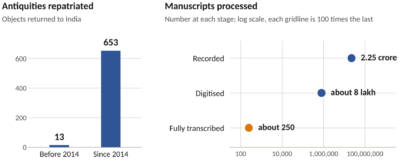
Figure 2. Antiquities repatriated and manuscripts processed. Sources: Hindusthan Samachar 2026; MillenniumPost 2025; P. Sharma 2026
7 Comparative Perspective: China, Japan and Greece
Japan’s 1950 Law for the Protection of Cultural Properties, passed after the 1949 Hōryū-ji fire, protected tangible and intangible heritage under one expert-led system (Agency for Cultural Affairs n.d.; MEXT 1993). India can borrow the principle: protect by cultural value, and put expert advice before ministerial decision.
Greece shows the multilateral route. Its Parthenon claim has been before UNESCO’s return-of-property committee since 1984; in 2021 the committee asked the United Kingdom to enter ‘bona fide dialogue’, and London answered that it remains a matter for the British Museum’s trustees (UNESCO 2022). India leans on one partner: the US supplied 559 of 610 recoveries in 2020 to 2024 (ThePrint 2025).
China shows the risk of state-embedded outreach. Confucius Institutes at US universities fell from about 100 in 2019 to fewer than five by mid-2023, with many schools citing concern for federal funding (GAO 2023).
8 Policy Recommendations
Institutions, not rhetoric, close these gaps (Table 2).
| Pillar | Documented gap | Priority intervention |
| Historical | Textbook revisions contested | Statutory expert council publishing its reasons |
| Intellectual | About 250 of 2.25 crore manuscripts transcribed | Fund transcription, translation and open licences |
| Institutional | 92 monuments missing in a 2013 audit | Public monument register, audited independently |
| Digital | Contested dossiers, as in Leicester | University-run archive publishing evidence, not accusations |
| International | Manuscripts held in 54 institutions abroad | Digital reunification; funded chairs; joint journals |
Two rules keep this plural. Apply one conservation standard to Buddhist, Jain, Sikh, Muslim, and Christian sites, and answer false claims with evidence, not takedowns. Pew found 84 per cent of Indians say respecting all religions is very important to being truly Indian, so confidence and pluralism aren’t rivals. But 67 per cent of Hindus and 80 per cent of Muslims also say it is very important to stop women in their community from marrying outside it (Pew Research Center 2021). Pluralism in principle still coexists with separation by preference (Figure 3), and sovereignty that ignores the gap protects monuments but loses neighborhoods.
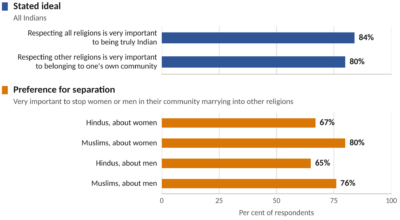
Figure 3. Pluralism in principle, separation by preference. Source: Pew Research Center, 2021
9 Conclusion
Civilizational sovereignty means knowing the past well enough to argue about it in public. The documents show a contest more than a siege: measurable hostility toward Hindus, open and institutionally backed advocacy against Hindutva, and covert influence from several directions. Critics will say that ‘confidence’ can slide into exclusion, and Leicester shows the worry isn’t idle. The weakest pillars are the plainest: public registers and readable manuscripts. A civilization confident enough to open its archive to critics has little to fear from them.
References
Agency for Cultural Affairs, Japan. n.d. “Fire Prevention Day for Cultural Properties.” https://www.bunka.go.jp/english/policy/cultural_properties/awareness_raising/fire_prevention/
Amirapu, Deepika. 2026. “‘What We Are Dealing With’: Rahul Gandhi Slams Centre for Denying Visas to 150 Bharat Summit Delegates.” ThePrint, November 15, 2026. https://theprint.in/india/what-we-are-dealing-with-rahul-gandhi-slams-centre-for-denying-visas-to-150-bharat-summit-delegates/3099079/
ANI. 2026. “Khurshid Hits Back at BJP over Bharat Summit 2026 International Ties.” Asianet Newsable, November 14, 2026. https://newsable.asianetnews.com/india/khurshid-hits-back-at-bjp-over-bharat-summit-2026-international-ties-articleshow-n1ahqkg
Britannica. n.d. “Vinayak Damodar Savarkar.” Encyclopædia Britannica. https://britannica.com/biography/Vinayak-Damodar-Savarkar
Chandra, Divya. 2019. “‘SC Said Huge Temple Existed’: Is Ex-ASI Member’s Claim True?” The Quint, November 10, 2019. Quotes the Supreme Court’s judgment of November 9, 2019, at 906-7. https://www.thequint.com/news/webqoof/ayodhya-verdict-supreme-court-said-huge-temple-before-how-true-is-former-asi-member-claim-fact-check
Eaton, Richard M. 2000. “Temple Desecration in Pre-modern India.” Frontline, December 22, 2000. https://mail.franpritchett.com/00islamlinks/txt_eaton_temples1.pdf
Eaton, Richard M. 2024. “Richard Eaton on the Desecration of Hindu Temples in India.” Interview by Sudha Ramachandran. The Diplomat, January 2024. https://thediplomat.com/2024/01/richard-eaton-on-the-desecration-of-hindu-temples-in-india
GAO (US Government Accountability Office). 2023. China: With Nearly All U.S. Confucius Institutes Closed, Some Schools Sought Alternative Language Support. GAO-24-105981. October 30, 2023. https://www.gao.gov/products/gao-24-105981
GN Bureau. 2025. “Diwali Now Part of UNESCO’s Intangible Cultural Heritage List.” Governance Now, December 10, 2025. https://www.governancenow.com/news/regular-story/diwali-now-part-of-unescos-intangible-cultural-heritage-list
Gohil, Neha. 2026. “Disinformation Was ‘Central Accelerant’ in Leicester Hindu-Muslim Clashes, Inquiry Finds.” The Guardian, February 2026. Read via inkl. https://www.inkl.com/news/disinformation-was-central-accelerant-in-leicester-hindu-muslim-clashes-inquiry-finds
Grantable. n.d. “Center for Economic and Policy Research: Grant Funding Profile from IRS 990 Filings.” https://grantable.co/nonprofits/center-for-economic-and-policy-research-morg_59f51c6bc8f341d5a24db5bea6b77263
HAF (Hindu American Foundation). 2021. “Letter Regarding DGH Sponsorship.” August 19, 2021. https://www.hinduamerican.org/wp-content/uploads/2021/08/Letter_Regarding_DGH_Sponsorship.pdf
HAF. 2025. “HAF Media Guide: Who Is behind the Recent Spate of Hindu Temple Vandalism?” Last modified April 21, 2025. https://www.hinduamerican.org/haf-media-guide/
HfHR (Hindus for Human Rights). 2022. “Hindus for Human Rights Responds to the Rutgers Report on Digital Hinduphobia.” July 19, 2022. https://www.hindusforhumanrights.org/en/blog/rutgersresponse
Hindusthan Samachar. 2026. “653 Stolen Sculptures and Artifacts Repatriated under Prime Minister Modi’s Heritage Drive: Gajendra Singh Shekhawat.” May 13, 2026. https://english.hindusthansamachar.in//Encyc/2026/5/13/cultural-heritag-Gajendra-Shek.php
IANS. 2026. “FBI Data Reveal 189 Anti-Sikh, 32 Anti-Hindu Hate Crime Offences across US in 2025.” Free Press Journal, August 19, 2026. https://www.freepressjournal.in/world/fbi-data-reveal-189-anti-sikh-32-anti-hindu-hate-crime-offences-across-us-in-2025
Jha, D. N. 2009. “Interview with D. N. Jha, Eminent Historian: ‘Historians Who Come in Proximity to Power Change Their Secular Lines.’” History News Network, December 1, 2009. Originally published in Frontline 26. https://www.hnn.us/article/120852
Lorenzen, David N. 1999. “Who Invented Hinduism?” Comparative Studies in Society and History 41 (4): 630-59. https://doi.org/10.1017/S0010417599003084
Machado, Gary, Alexandre Alaphilippe, Roman Adamczyk, and Antoine Grégoire. 2020. “Indian Chronicles: Deep Dive into a 15-Year Operation Targeting the EU and UN to Serve Indian Interests.” EU DisinfoLab, December 9, 2020. https://disinfo.eu/publications/indian-chronicles-deep-dive-into-a-15-year-operation-targeting-the-eu-and-un-to-serve-indian-interests
MEXT (Ministry of Education, Culture, Sports, Science and Technology, Japan). 1993. “For the Protection and Utilization of Cultural Properties.” Chapter 3 of a government white paper. https://www.mext.go.jp/b_menu/hakusho/html/hpae199301/hpae199301_2_107.html
MillenniumPost. 2025. “‘In Last 11 Years, over 640 Antiquities Repatriated from Different Countries.’” March 27, 2025. https://www.millenniumpost.in/nation/in-last-11-years-over-640-antiquities-repatriated-from-different-countries-604183
National Herald. 2020. “Insight: Nehru’s Misgivings on Somnath Temple Shared with Dr Rajendra Prasad.” NHS Bureau, August 5, 2020. https://www.nationalheraldindia.com/india/insight-nehrus-misgivings-on-somnath-temple-shared-with-dr-rajendra-prasad
NPR. 2014. “Author of Book Yanked in India Says Move Has Backfired.” Interview with Wendy Doniger by Robert Siegel. https://www.npr.org/transcripts/277043653
Padmanabhan, Keshav. 2026. “India Slams USCIRF’s ‘Persistent Selective Criticism’, Urges Reflection on Hindu Temple Attacks in US.” ThePrint, March 17, 2026. https://theprint.in/diplomacy/india-slams-uscirfs-persistent-selective-criticism-urges-reflection-on-hindu-temple-attacks-in-us/2881086
Pew Research Center. 2021. Religion in India: Tolerance and Segregation. June 29, 2021. Face-to-face survey of 29,999 adults, November 2019 to March 2020. https://www.pewresearch.org/religion/2021/06/29/religion-in-india-tolerance-and-segregation/
PMIndia. 2024. “Cabinet Approves Conferring Status of Classical Language to Marathi, Pali, Prakrit, Assamese and Bengali Languages.” October 3, 2024. https://www.pmindia.gov.in/en/news_updates/cabinet-approves-conferring-status-of-classical-language-to-marathi-pali-prakrit-assamese-and-bengali-languages
President of the General Assembly (69th session). 2015. “Statement at the Special Event on the International Day of Yoga.” New York, June 21, 2015. https://static.un.org/en/ga/president/69/pdf/statements/20150621-yoga.pdf
PTI. 2023. “‘Religion Personal Choice’: CPI(M)’s Sitaram Yechury Turns Down Ram Temple Inauguration Invite.” Free Press Journal, December 26, 2023. https://www.freepressjournal.in/india/religion-personal-choice-cpims-sitaram-yechury-turns-down-ram-temple-inauguration-invite
PTI. 2024. “Congress to Boycott Ayodhya Ram Temple Consecration Ceremony.” Onmanorama, January 10, 2024. https://www.onmanorama.com/news/india/2024/01/10/congress-leaders-decline-invitation-to-ram-temple-consecration.html
PTI. 2025. “ED Searches Soros’ Funding Agency, Investment Arm in Bengaluru to Probe FEMA ‘Violations’.” DT Next, March 18, 2025. https://www.dtnext.in/news/national/ed-searches-soros-funding-agency-investment-arm-in-bengaluru-to-probe-fema-violations-826756
PTI. 2026a. “3,686 Sites under ASI, No Protected Monument or Sites Untraceable at Present: Govt Tells RS.” ThePrint, February 5, 2026. https://theprint.in/india/3686-sites-under-asi-no-protected-monument-or-sites-untraceable-at-present-govt-tells-rs/2847150
PTI. 2026b. “BJP Asks Rahul Gandhi to Explain Invite to Guillaume Long for Cong’s Bharat Summit 2026.” ThePrint, November 14, 2026. https://theprint.in/india/bjp-asks-rahul-gandhi-to-explain-invite-to-guillaume-long-for-congs-bharat-summit-2026/3098719/
Rajya Sabha. 2022. Unstarred Question No. 1641, “Indian Knowledge System in New NEP.” Ministry of Education, answered December 21, 2022. https://rsdebate.nic.in/bitstream/123456789/734647/1/PQ_258_21122022_U1641_p197_p198.pdf
Scroll Staff. 2022. “Paragraphs on Gujarat Riots, Chapter on Mughal History Removed from NCERT Textbooks.” Scroll.in, June 17, 2022. https://scroll.in/latest/1026397/scroll_in
Sharma, Kritika. 2021. “Hinduphobia or Battle against Bigotry? ‘Dismantling Global Hindutva’ Seminar Sparks Controversy.” ThePrint, August 30, 2021. https://theprint.in/india/hinduphobia-or-battle-against-bigotry-dismantling-global-hindutva-seminar-sparks-controversy/724908
Sharma, Pratul. 2018. “No Hindutva without Muslims in India, Says RSS Chief Mohan Bhagwat.” The Week, September 18, 2018. https://www.theweek.in/news/india/2018/09/18/no-hindutva-without-muslims-in-india-says-rss-chief-mohan-bhagwat.html
Sharma, Pratul. 2026. “India’s Manuscript Mission Needs a Faster Pace, Says Parliamentary Panel.” The Week, August 12, 2026. https://www.theweek.in/news/india/2026/08/12/indias-manuscript-mission-needs-a-faster-pace-says-parliamentary-panel.html
Singh, Sunanda. 2026. “UNESCO Adds Ancient Buddhist Site of Sarnath to World Heritage List; Know about This Significant Place.” Free Press Journal, July 26, 2026. https://www.freepressjournal.in/lifestyle/unesco-adds-ancient-buddhist-site-of-sarnath-to-world-heritage-list-know-about-this-significant-place
South First. 2024. “Supreme Court Rebukes Tamil Nadu Minister Udhayanidhi Stalin over His ‘Eradicate Sanatana Dharma’ Remark.” March 4, 2024. https://thesouthfirst.com/news/supreme-court-rebukes-tamil-nadu-minister-udhayanidhi-stalin-over-his-eradicate-sanatana-dharma-remark
Sudhakar, Prasiddha, John Farmer, Joel Finkelstein, Parth Parihar, and Lee Jussim. 2022. Anti-Hindu Disinformation: A Case Study of Hinduphobia on Social Media. Network Contagion Research Institute, NCLabs and the Miller Center for Community Protection and Resilience, Rutgers University. https://millercenter.rutgers.edu/wp-content/uploads/2022/07/Hinduphobia-NC-Labs_6.22.22.pdf
Supreme Court of India. 1995. Dr. Ramesh Yeshwant Prabhoo v. Prabhakar Kashinath Kunte, 1996 AIR 1113, 1996 SCC (1) 130. Decided December 11, 1995. https://indiankanoon.org/doc/925631/
Thapar, Romila. 1989. “Imagined Religious Communities? Ancient History and the Modern Search for a Hindu Identity.” Modern Asian Studies 23 (2): 209-31. https://doi.org/10.1017/S0026749X00001049
ThePrint. 2025. “610 Stolen Antiques Were Recovered between 2020-24, Highest from USA, Modi Govt Tells Parliament.” July 21, 2025. https://theprint.in/india/610-stolen-antiques-were-recovered-between-2020-24-highest-from-usa-modi-govt-tells-parliament/2697232/
UNESCO. 2022. “The Parthenon Sculptures.” Document ICPRCP/22/23.COM/5.Rev. Intergovernmental Committee for Promoting the Return of Cultural Property to Its Countries of Origin or Its Restitution in Case of Illicit Appropriation. Copy hosted by ERT News. https://www.ertnews.gr/wp-content/uploads/2022/05/UNESCO.pdf
UNESCO. 2026. Decision 48 COM 8B.17: Ancient Buddhist Site of Sarnath (India). World Heritage Committee, 48th session, Busan, July 2026. https://whc.unesco.org/en/decisions/?id_decision=9171
USCIRF (US Commission on International Religious Freedom). 2026. Country Brief: India. Washington, DC: USCIRF, August 2026. https://www.uscirf.gov/sites/default/files/2026-08/2026%20India%20Country%20Brief.pdf
The Week. 2024. “Congress Defends Declining Ram Temple Invite, Says No Intention to Hurt Religious Sentiments.” Web Desk, January 12, 2024. https://www.theweek.in/news/india/2024/01/12/congress-defends-declining-ram-temple-invite-says-no-intention-to-hurt-religious-sentiments.html
The Wire. 2026. “FactCheck: Modi Is Wrong about Nehru on Somnath Temple.” May 15, 2026. https://thewire.in/communalism/factcheck-modi-is-wrong-about-nehru-on-somnath-temple
