
Consequences of Moral Absolutism: Reflections on the Delhi NEET Protest
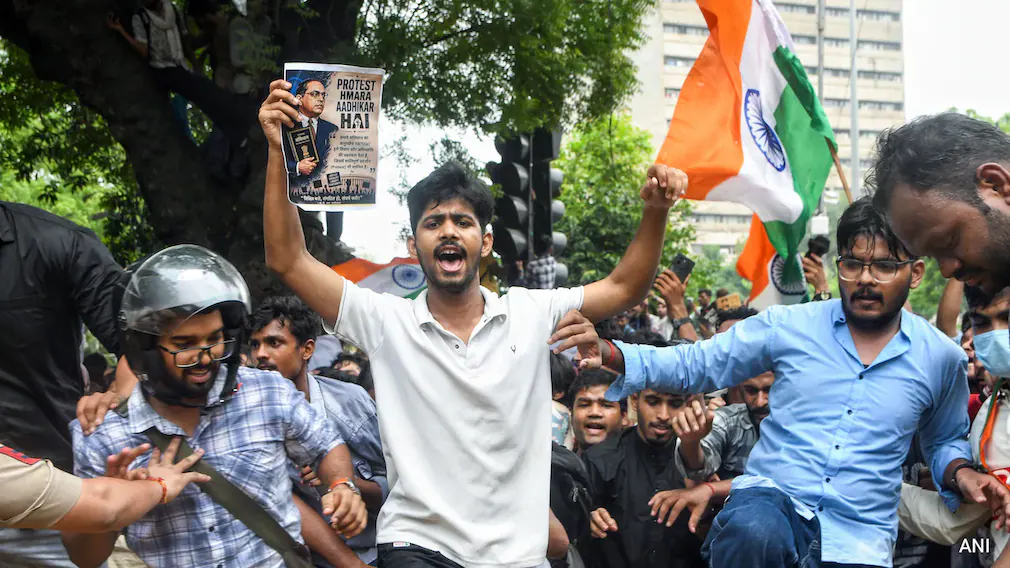
Image: courtesy of NDTV
Editor’s Note: IndiaFacts seeks to hew to the limited arena of challenges to and attacks against Hindus and Hinduism. We have occasionally published essays, commentaries, and book reviews that do not strictly fit within our ambit. This essay by Akshay Ranade and the previous book review by Pradeep Krishnan are also exceptions, therefore. They are made in the context of the still-developing events in India about education in particular, the nature of the Indian Republic in general, and the ambit of and limits to protests in a democracy, close to the celebration of the 79th year of India’s Independence, three weeks from the date of this publication. We hope readers will therefore consider this essay and the previous book review worthy of inclusion and publication on our platform.
***
On Saturday, Dharmendra Pradhan resigned as India’s education minister, and the Cockroach Janta Party (CJP) — the movement that had occupied Jantar Mantar for about seven weeks — called it a victory. On the surface, it seems that way: the government confirmed it had accepted the movement’s core demands, from Pradhan’s exit to compensation for the families of students who died by suicide after the leak forced a re-exam, and thousands of young protesters spent the evening celebrating in the streets. Is this, though, quite the unambiguous triumph it is being described as — and is it a triumph for the reasons being given?
Notice now the language of triumph. Congress leaders called the resignation a vindication for the youth, with Rahul Gandhi calling for an end to this “regime”. Samajwadi Party chief Akhilesh Yadav called Pradhan’s resignation proof that the “world’s largest party” had been forced to yield to what he termed a “revolution” by the youth — a word chosen, it seems, for its charge rather than its precision. Yogendra Yadav, the usual suspect and the perpetual agitator, put the underlying claim in plainer terms than his elected counterparts: that the future of Indian democracy will be “decided from the streets,” not by Parliament or by elections — almost insinuating that the Opposition ought to abandon its faith in electoral politics altogether in favor of what he calls a “politics of resistance.”
It is worth focusing on that vocabulary rather than rushing past it. “Regime,” Revolution,” “Not by Parliament,” “Politics of Resistance” in place of electoral politics. These are not neutral descriptions of a protest that won a battle against an incumbent government duly elected by the people; they indicate and describe a specific political argument about where legitimate authority in a democracy actually resides, made in the euphoria of celebrating a win, when the scrutiny of the specific word or term is not necessarily the focus. A resignation obtained this way — under calibrated street pressure, rampaging mobs, and a ramped-up confrontation en route to Parliament — rather than a resignation following due process, or a government voted out for its failures, ought to be pondered upon.
The first teaches what street pressure can extract from a democracy; the second teaches what a democracy is supposed to be and how it functions. This is not to take away the grief and fury behind the issue of the NEET exam paper leak in particular and systemic problems in general. It is only to say that any politics dressed in the language of “revolution” and “the streets over Parliament,” however sincerely articulated, deserves to be met with a healthy measure of skepticism and concern about where such language leads us.
Paris Spring 1968: A Riot That Ran Out of Reasons
The Spring of 1968 was unexpectedly hot for France as the Latin Quarter of Paris turned into a battlefield with young students tearing up paving stones and hurling them at the police. Cars lay overturned and burning along the boulevards. Armed by the outrage against the existing order and morally sanctioned by the professors and philosophers who lent their authority to the crowd through the decades of churning of ideological churning that sought to delegitimize “existing orders”. For a few extraordinary weeks, it looked as though the French state would fall.
Fortunately for France, it did not. Having seen the consequences of bloody revolution in its own history, which eventually paved the way for authoritarianism, the French probably knew better. Far from the replacement of the order, the government reasserted control, called elections, and came back with a resounding mandate. The barricades came down, and the students went back to being students. What was left to show for the fury was strikingly thin: the grievances that had sent them into the streets — the rigidity of French universities, the paternalism of an exam-obsessed system — were barely touched, and no serious reform followed in any hurry. What followed instead was cultural residue: a mood, a mythology, a season remembered as a symbol of defiance more than a policy achievement. What the May 1968 protests would reveal to any objective observer is that moral certainty, however thrilling in the moment, is not the same thing as being right, and that a crowd persuaded of its own virtue can do a great deal of damage while accomplishing very little of what it set out to do.
This is worth remembering now that Delhi’s own confrontation over the NEET-UG paper leak has ended in celebrating the resignation of the Minister of Education rather than in institutional reform. The temperature at Jantar Mantar across seven weeks — the tear gas, the memes, the hunger strikes, the conviction that anyone standing in the way of the protestors’ demands stood on the side of corruption — carried an unmistakable echo of that Parisian summer: a real grievance, seized by a generation persuaded that its outrage was itself proof, curdling into spectacle that has now been declared reform.
To recall the French protest is not to draw any parallels, but examples from the past can help us make the point more emphatically – which is that when a real grievance, seized by a generation convinced that its outrage is itself a form of proof, can eventually result in something closer to just a spectacle than reform. Interestingly, our own Constituent Assembly anticipated this very possibility and prophetically warned about such tendencies. Dr. Ambedkar, on November 25, 1949, cautioned that India must abandon the tools of civil disobedience, non-cooperation, and satyagraha now that constitutional avenues of redress were finally available to every citizen. Ambedkar declared: “If we wish to maintain democracy not merely in form, but also in fact, what must we do? The first thing in my judgement we must do is to hold fast to constitutional methods of achieving our social and economic objectives. It means we must abandon the bloody methods of revolution”, adding further that, “where constitutional methods are open, there can be no justification for these unconstitutional methods. These methods are nothing but the Grammar of Anarchy and the sooner they are abandoned, the better for us”. Here he was not necessarily condemning street protests as much as he was cautioning against the possibility of using the democratic tools to undermine the very democracy that granted it under the guise of self-assumed righteousness. That warning unfortunately has not aged well in India.
The Grievance That Got Mugged on the Way to Parliament
None of this is to say the anger of the students is completely manufactured. Lower the decibel, and one can clearly notice the institutional failure. The Central Bureau of Investigation (CBI) enquiry into the paper leak has identified an elaborate chain running across states through intermediaries that facilitated the leaks. The agency has made arrests and is reportedly moving towards a formal chargesheet naming the full chain of accused. The process may not be an adequate consolation to those who suffered in the process and had to undergo the agony. India’s education bureaucracy and the examination system have earned closer scrutiny, and it would be dishonest to pretend otherwise.
But somewhere between the protest’s first gathering in June and the tear-gassing of protestors near Parliament in its final days, the gravity shifted. What began as a demand for accountability became a referendum on the government, prosecuted with the moral certainty of a generation raised on the binary logic of social media.
Scroll through the incessant video reels coming out of Jantar Mantar and elsewhere in the country, and one can hardly miss the sharp memes, viral one-liners mocking ministers, music and mirth threaded through genuine anger. Often, they overstepped the line of basic decency expected in public engagement and unwarranted, distasteful personal diatribes were hurled at political leaders without a hint of caution or care. But underpinning this messaging is something far less healthy: a closed moral universe in which anyone who questioned the protestors’ methods, timeline, or escalating demands was cast not as a fellow citizen with a different view on the issue, but as complicit in the crime itself. There is no longer much room in that universe for the person who says, “the leak is a scandal, but marching on Parliament seeking the resignation of the Education Minister may not be the way to fix an exam leak”. That person does not get to debate. He gets cancelled.
This is moral absolutism in play: it collapses a complicated institutional problem into a simple morality play that reduces the solutions into immediate binaries. The specifics of the case faded into the background long before Saturday, July 25, 2026; what the CBI has actually been pursuing barely featured in the protestors’ messaging in the final weeks. What was featured instead was a single demand, repeated until it swallowed the whole story: resign!
A resignation is a political scalp, not a systemic fix. It does not rewrite the National Testing Agency’s (NTA) security protocols or even explain how an examiner in Pune got unsupervised access to the exam paper. This is not to say that resignation of the highest authority is not a measure of accountability. It certainly can be — but there is a forum, medium, and process for that. It is important to bring accountability through institutions like the Parliament, where the executive responds to issues that led to lapses and lack of oversight; once identified, it must be dealt with through merited punishment. But that process in itself becomes secondary if the focus is not on satisfying a political point also. In this case, Minister Pradhan’s exit satisfies the mood of the protestors far more than it repairs the examination system that started it — the reforms the government says it has “accepted” now need to be watched, in painstaking procedural detail long after the cameras and the reels have moved on.
Righteous, But Not Quite Right
There is nothing inherently suspicious about political sloganeering inside a student movement; citizens are entitled to connect an exam scandal to a wider indictment of governance if that is genuinely where the evidence leads. Anger at the ruling party is not, by itself, evidence of bad faith.
What is suspicious — what should worry anyone who cares about the health of Indian democracy, regardless of party — is the contempt the protestors have for the opposing viewpoint. It is one thing to organize, argue, and vote against a government whose politics you reject. It is another to decide it should not be permitted to complete the tenure the electorate gave it, simply because you disapprove of its politics. That distinction is the entire difference between democratic opposition and something closer to its opposite, and the fact that this refusal arrives wrapped in moral righteousness rather than raw political ambition should make it more alarming, not less.
This is precisely how totalitarian instincts have always smuggled themselves into popular movements — not through a villain who announces contempt against the existing order but through a vanguard so certain it alone grasps the true, factual shape of justice that it sees the society’s patience with the existing order as false consciousness to be corrected. History’s most efficient totalitarianisms began by convincing people that systems were too slow and too corrupted to be trusted and the revolution — which only they could see — was necessary. A crowd this convinced of its own virtue does not pay attention to its own contemptuousness but instead believes that its “feelings” constitute historical necessity.
Listen closely to the vocabulary at Jantar Mantar and a particular intellectual lineage becomes hard to miss. This is not a grievance carefully argued; it is the language of totalizing negation, in which everything — parents, family, school system, examining state, and the Prime Minister’s office itself — is folded into a single state of corruption. Support for the protest is treated not as one legitimate position among several but as the only position a decent person could hold, so anyone outside the tent is naive, bought, or complicit.
This style of protest did not materialize on its own; it is a fairly direct export of a strand of Indian academic culture that has spent decades teaching its students that every institution is, at root, an instrument of oppression. Handed to these young college entrants without the caveats that gave the original theory some intellectual rigor, it becomes not a method of inquiry but a script — pre-loaded with its villain and verdict, needing only a scandal to set “praxis” in motion. The crux is that the conviction doesn’t necessarily rest on the case file; it rests on faith in an abstract architecture of power the facts are expected to confirm. When righteousness precedes evidence, it stops being political analysis and starts being liturgy.
At Jantar Mantar, hardly anyone held up a placard reading “overthrow the government”. That would be too crude, too easy to dismiss. The demand was subtler, and the subtlety is what makes it worth flagging in hindsight. What was circulated instead, in speeches and reels, was a narrative that Indian democracy could no longer correct itself through Parliament — the Opposition too weak, the institutions too captured — and that the street was therefore where the real correction had to happen. It is a short step from “we must protest until we are heard” to “we cannot wait for the system we were taught to trust to be destroyed”. Tellingly, the protest’s guest list came to include some of India’s most practised advocates of the “street-over-Parliament” argument — Yogendra Yadav’s arrival at the site, and Arundhati Roy’s after him, both following a well-worn pattern of lending a local grievance the vocabulary of a much larger case against the Indian state. Their presence didn’t make the protesters insincere. But it should raise a red flag about which argument this movement was enlisted to make — and about how comfortably it succeeded.
No society is perfect, and no government has ever been. This one is not either. We inherited an imperfect system from the generation before us — and whichever government sits in Delhi after the next election will inherit an imperfect one in turn. That is not a defect in democracy; it is its ordinary condition. A healthy democratic culture never asks how to achieve a perfect government, because that government does not exist. It asks how to make this imperfect system a little better, reform by reform, election by election. The moment a movement stops asking that question and starts demanding perfection, it has stopped being a reform movement and become something else. The demand for perfection, however sincerely felt, is one of history’s oldest red flags: every totalitarian project of the twentieth century sold itself as the pursuit of a perfect, uncorrupted order, cleansed of the compromises ordinary politics requires. Politics of perfection is not the cure for a flawed democracy. It is usually the beginning of the end of one.
Democracies therefore do not survive on the moral certainty of any one generation, however sincere. They survive on institutions and on the public’s willingness to keep faith with those institutions even when they move slower than outrage demands. The NEET paper leak is a legitimate wound, and it deserves an unforgiving push for reform. None of that requires bringing down a government mid-tenure. It requires sustained, specific pressure aimed at the actual mechanics of the failure — not a mood, however viral, aimed at the man at the top.
There is a larger implication behind all this which pertains to the much-talked-about Gen Z — the generation which seems to have captured the imagination of all in the recent past. This is a generation that seems to have come of age inside two overlapping systems that reward moral certainty over moral complexity. One is a media environment built to surface the most shareable, us-versus-them version of any story, because that is what captures attention. The other is an education and public discourse that has, for years, trained its young minds to see structural villainy first and institutional nuance second, reaching for systemic indictment before the harder, slower vocabulary of policy detail. Neither force is a conspiracy. But together they produce a protester who can build a formidable viral movement and still not know, months in, what the CBI’s chargesheet actually alleges. Such a generation does not need to be told to feel less. It needs to be asked to know more — to trade the certainty of a caption for the discomfort of a case file.
The grievance was real. The anger was earned. But an exam system is not fixed by a minister’s resignation, and a democracy is not made healthier by a generation that has just learned it can bring down a government through sustained pressure fueled by a sense of moral absolutism. That conviction, however righteous it felt on the streets of Jantar Mantar this weekend, is not the language of reform. It is the oldest language of totalitarianism there is — and it deserves recognition as such now, at the moment of its apparent triumph, rather than later, once the precedent it has just set is someone else’s to use.
