
Beyond the Red Flag: An Ex-Communist’s Rediscovery of Bharat
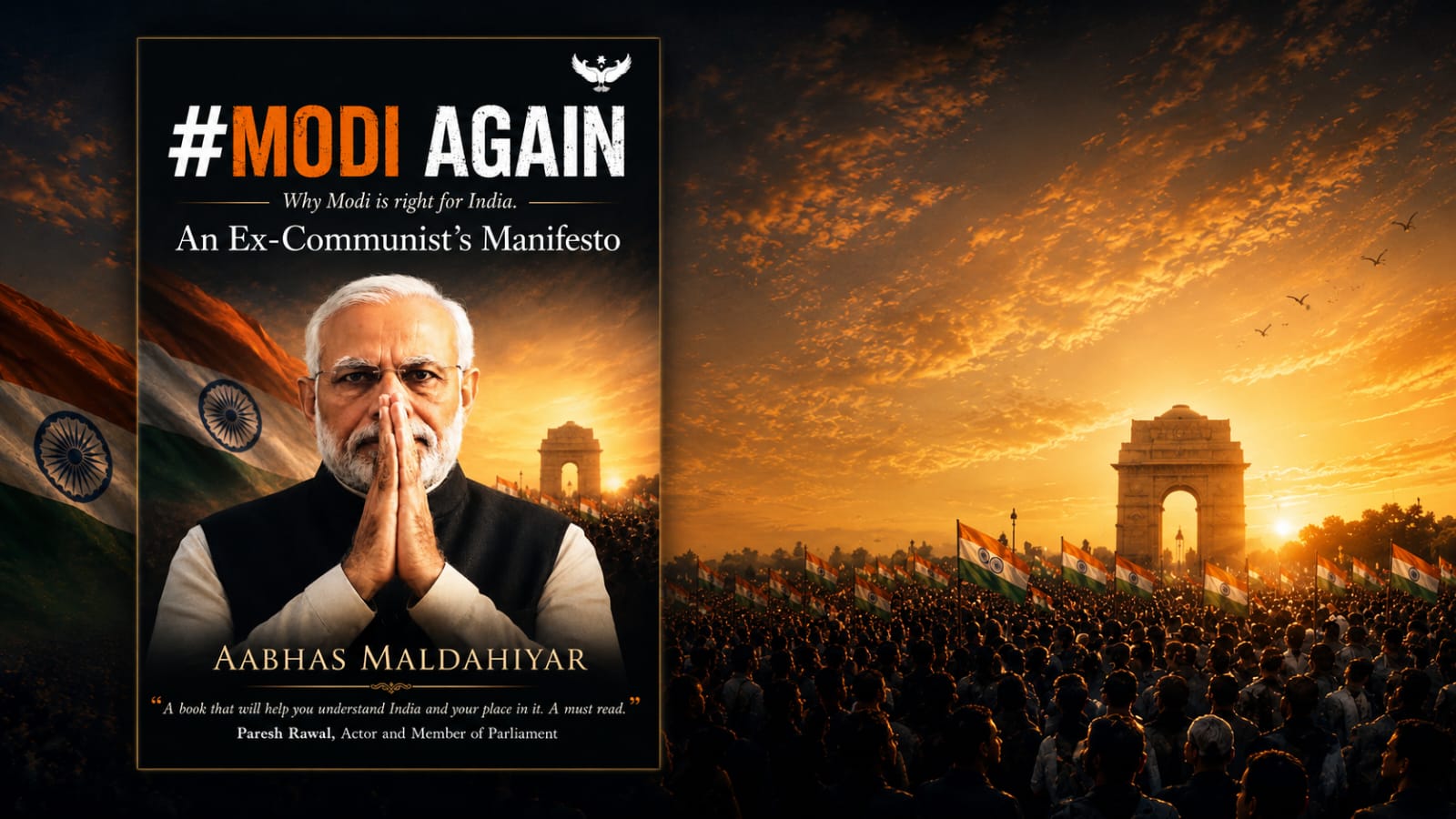
Editor’s Note: IndiaFacts seeks to hew to the limited arena of challenges to and attacks against Hindus and Hinduism. We have occasionally published essays, commentaries, and book reviews that do not strictly fit in our ambit. This review by Pradeep Krishnan and the next essay by Akshay Ranade are also exceptions, therefore. They are made in the context of the still-developing events in India about education in particular, the nature of the Indian Republic in general, and the ambit of and limits to protests in a democracy, close to the celebration of the 79th year of India’s Independence, three weeks from the date of this publication. We hope readers will therefore consider this book review and the following essay worthy of inclusion and publication on our platform.
***
There is an interesting, albeit limited, similarity between the author of the remarkable book, Modi Again: Why Modi is Right for India, An Ex-Communist’s Manifesto, and me. Aabhas Maldahiyar was once a committed Leftist who believed Marxism offered the most convincing framework for understanding society and politics. During my adolescent years, I too briefly flirted with Leftist ideas. Like many young people of my generation growing up in Kerala—a state where Communist ideology permeated campuses and public discourse—it was difficult not to be influenced, however temporarily, by its rhetoric of equality and social justice. But there the similarity ends.
Unlike Maldahiyar, I was never an ideological activist or a committed Marxist. My brief attraction to Leftist thought gradually gave way to a deeper engagement with India’s spiritual traditions, its civilizational history and its timeless philosophical heritage. Years of travelling across Bharat, interviewing saints, scholars, historians, social reformers and seekers of Sanatana Dharma transformed my understanding of the country in ways no political slogan ever could.
Reading Modi Again therefore became, for me, much more than reviewing another political book. It became an encounter with an intellectual journey that, although different in intensity and experience, echoed a familiar quest—the search for truth beyond inherited ideological narratives.
The most fascinating aspect of this book is not that it praises Narendra Modi. Numerous books have already done so. Nor is it remarkable merely because it criticizes Communism or Nehruvian socialism. Books espousing both viewpoints continue to appear every year.
What distinguishes Modi Again is that it narrates, with striking honesty and intellectual courage, the story of how a young Marxist voluntarily abandoned the ideological certainties of his youth after questioning the very foundations upon which those certainties rested. In an age when ideological positions have become increasingly rigid and polarized, the willingness to re-examine one’s convictions is itself an act of intellectual integrity.
That is why this book deserves to be read—not only by supporters of Narendra Modi or critics of the Left, but by every reader interested in understanding the changing intellectual landscape of contemporary India.
A Voice of a New Intellectual Generation
Aabhas Maldahiyar belongs to a generation of young Indian writers who refuse to inherit ideological positions unquestioningly. Emerging initially from a Left-oriented intellectual environment, he gradually evolved into one of the articulate defenders of India’s civilizational identity. Through his writings, lectures, and public interventions, he has consistently argued that modern India can be understood only when viewed through the prism of its ancient cultural continuity rather than merely through colonial or post-colonial political frameworks.
Unlike professional politicians or career ideologues, Maldahiyar writes from personal experience. His arguments are rooted in a process of self-discovery rather than political expediency. This lends authenticity to his observations.
Published by Garuda Prakashan, Modi Again: Why Modi is Right for India – An Ex-Communist’s Manifesto first appeared at a time when Indian public discourse was witnessing an unprecedented churn. Questions concerning national identity, civilizational consciousness, historical narratives, secularism, and cultural nationalism had moved from academic seminars into drawing rooms, television studios, and social media debates.
Against this backdrop, Maldahiyar’s book occupies a distinctive place. It is neither a conventional political biography nor an academic study of Narendra Modi’s government. Instead, it is the autobiography of an idea—an account of how one individual’s intellectual universe underwent a profound transformation. As the material accompanying the book notes, the author traces his journey from being a staunch Marxist who voted against the BJP in 2014 to becoming an admirer of Modi after critically re-examining communist dogma, India’s civilizational history and contemporary governance.
More Than a Political Book
Readers approaching the book expecting a partisan political tract are likely to be surprised. Politics certainly occupies a central place, but it is not the real subject of the book. The real subject is intellectual emancipation.
Maldahiyar repeatedly reminds readers that ideological indoctrination often begins long before individuals consciously enter politics. School textbooks, university classrooms, media narratives, popular cinema, and social surroundings collectively shape one’s worldview. Like millions of educated Indians, he accepted several propositions almost as articles of faith: socialism represented compassion, secularism demanded the dilution of Hindu identity, Western liberalism was the universal model for progress, and India’s ancient traditions were largely relics requiring modern reinterpretation.
What makes the narrative compelling is the author’s refusal to caricature his younger self. There is no attempt to portray his earlier beliefs as foolish or insincere. On the contrary, he explains why those beliefs appeared perfectly reasonable to a young student exposed to a particular intellectual environment. This honesty gives the book considerable persuasive power. Readers are invited not to abandon one ideology for another, but to participate in the author’s process of questioning. That distinction is important.
The Courage to Change One’s Mind
History has shown that great intellectual advances often begin with uncomfortable questions. Galileo questioned Christian cosmology. Charles Darwin questioned prevailing explanations of biological diversity. Swami Vivekananda challenged colonial assumptions about India’s spiritual traditions. Dr. B.R. Ambedkar questioned entrenched social hierarchies. Sri Aurobindo moved from revolutionary nationalism to an integral spiritual philosophy. In politics too, history remembers those who possessed the courage to revise their convictions when confronted with new evidence.
Maldahiyar’s transformation belongs to this larger tradition of intellectual re-examination. The turning point, according to the author, did not arise from political propaganda but from sustained engagement with history, archaeology, and India’s civilizational heritage. One particularly significant moment was his visit to the Ajanta Caves, where exposure to India’s artistic and spiritual legacy prompted him to question the reductionist historical frameworks through which he had previously interpreted Indian civilization. The more important lesson is methodological: truth should emerge from evidence rather than ideology. This principle runs like a golden thread throughout the book.
Rediscovering India’s Civilizational Memory
Perhaps the greatest strength of Modi Again is that it refuses to confine contemporary politics within the narrow timeframe of post-1947 India. Instead, Maldahiyar situates modern political debates within the much longer continuum of Indian civilization. To him, understanding Narendra Modi requires understanding the civilization that produced him. This is where the book rises above routine political commentary.
For decades, India’s public discourse was often dominated by analyses rooted in electoral arithmetic, caste equations, and economic indicators. Maldahiyar does not dismiss these factors, but he argues that they are insufficient to explain the profound shifts taking place in Indian society. Beneath the electoral victories and policy debates lies a deeper phenomenon—the reawakening of civilizational self-confidence among large sections of Indian society. This thesis undoubtedly provides one of the most stimulating frameworks through which contemporary Indian politics can be understood.
The true strength of Modi Again lies in the fact that it is not content with narrating the author’s personal transformation. Maldahiyar carefully takes the reader through the various milestones that shaped his ideological evolution. Each chapter represents another layer being peeled away from long-held assumptions until, by the end of the book, the reader realizes that the work is as much about questioning intellectual conformity as it is about Narendra Modi.
Unlike many contemporary political writers who begin with conclusions and then search for supporting evidence, Maldahiyar adopts the reverse approach. He starts with questions. Why did he believe what he believed? Who shaped those beliefs? Were they based on evidence or repetition? Could history have been presented selectively? These questions gradually become the backbone of the narrative. This investigative approach makes the book engaging even for readers who may not share the author’s political convictions.
From Hope to Disillusionment
One of the most absorbing sections of the book deals with the India Against Corruption (IAC) movement led by Anna Hazare. For an entire generation of young Indians, the movement represented a moral uprising against corruption. Students, professionals, homemakers, and retired citizens rallied behind Anna Hazare with unprecedented enthusiasm. Social media, then still in its infancy, amplified the movement into a nationwide phenomenon. Aabhas Maldahiyar was among those idealistic supporters.
Like countless others, he saw Arvind Kejriwal as a courageous whistle-blower prepared to challenge entrenched corruption within the political establishment. The author narrates these events not as a detached historian but as someone who lived through them. Consequently, the chapters possess an immediacy that purely academic political studies often lack.
His admiration, however, gradually gave way to disappointment. According to Maldahiyar, the anti-corruption movement slowly transformed into a conventional political project, and many of the ideals that had initially inspired thousands of volunteers appeared to recede into the background. He argues that ideological alignments replaced moral commitments and that the movement increasingly adopted the very political vocabulary it had originally sought to transcend. The narrative captures an important phase in recent Indian political history. Many young Indians who participated in those events may find echoes of their own experiences in these chapters.
The Marxist Lens and the Indian Reality
Perhaps the most intellectually stimulating portions of the book are those devoted to Marxism itself. Maldahiyar does not dismiss Marxism merely because he no longer subscribes to it. Instead, he attempts to explain why it appealed to him in the first place. Marxism offered simple explanations for complex realities. Society was viewed through the prism of class conflict. Religion was interpreted primarily as an instrument of oppression. History became a succession of economic struggles culminating in revolutionary transformation.
For an intellectually curious student, such conceptual clarity could be immensely attractive. Yet, as Maldahiyar points out, reality proved considerably more complicated. India’s civilizational continuity, its extraordinary religious diversity, its philosophical traditions, and its social evolution could not always be accommodated within classical Marxist categories. The author gradually came to believe that imported ideological frameworks often failed to explain uniquely Indian experiences.
One of his sharpest criticisms concerns what he perceives as the contradiction between Communist ideals and Communist practice. He argues that while Indian Communism frequently spoke of equality, justice, and democracy, it often displayed ideological intolerance towards viewpoints that challenged its established narratives. In his opinion, this inconsistency gradually eroded its moral credibility. Readers may disagree with the generalization, but the argument is presented with conviction and supported by the author’s personal observations.
Rethinking Indian History
The chapters dealing with Indian history are among the most provocative in the book. For decades, debates surrounding the Aryan Invasion Theory, the interpretation of medieval history, the role of ancient Indian knowledge systems, and the legacy of colonial historiography have remained deeply contested. Maldahiyar enters these debates with confidence.
Particularly noteworthy is his discussion of the Aryan Invasion Theory. This willingness to revisit accepted assumptions gives the book an intellectual vitality that extends beyond contemporary politics. The author’s larger argument is that every civilization has the right to interpret its own past through rigorous scholarship rather than inherited colonial frameworks. His arguments remain an important contribution to the ongoing debate on Indian historiography.
A Civilizational Question
Among the book’s most compelling chapters is the discussion on Ayodhya. Few issues have shaped independent India’s political discourse as profoundly as the Ram Janmabhoomi movement. For decades, it remained a symbol of competing interpretations of history, secularism, archaeology, and constitutional law. Maldahiyar approaches the subject not merely as a legal dispute but as a question of civilizational memory.
He examines historical records, archaeological findings, and political developments to explain why he believes the movement represented a larger attempt to reclaim India’s historical consciousness. Rather than relying on emotional rhetoric, he attempts to build his case through documented arguments, inviting readers to examine the evidence independently. This method distinguishes his writing from many polemical accounts. It is difficult to ignore the seriousness with which the evidence is presented.
Ambedkar Beyond Political Symbolism
Equally significant is the chapter devoted to Dr. B.R. Ambedkar. In contemporary politics, Ambedkar is frequently invoked by parties across the ideological spectrum. Maldahiyar argues that while Ambedkar’s opposition to caste discrimination is widely celebrated, several other dimensions of his political and philosophical thought receive comparatively less attention.
The author encourages readers to engage directly with Ambedkar’s writings rather than relying solely on popular political interpretations. Whether discussing constitutionalism, national unity, or social reform, he attempts to portray Ambedkar as a far more complex thinker than partisan politics often acknowledges. This chapter deserves appreciation because it promotes serious engagement with primary sources rather than ideological appropriation.
Where, then, does Modi Again stand among contemporary books on India’s civilizational resurgence? In recent years, several important works have attempted to reinterpret India’s history and political evolution from an Indic perspective. Rajiv Malhotra’s Breaking India examined the ideological forces that, in his view, sought to fragment India’s civilizational unity. J. Sai Deepak’s India That Is Bharat explored the continuing influence of colonial frameworks on India’s constitutional and intellectual discourse. Walter K. Andersen and Shridhar D. Damle’s The RSS: A View to the Inside offered an important scholarly study of one of India’s most influential socio-cultural organizations.
Unlike these authors, Maldahiyar writes neither as an academic scholar nor as a legal thinker. He writes as a representative of a generation that inherited Left-liberal assumptions, tested them against history and experience, and consciously chose another intellectual path. That makes Modi Again more personal, more accessible, and, in many ways, more relatable for younger readers who may themselves be questioning long-believed narratives.
It is this autobiographical honesty that constitutes the book’s greatest strength. If the first half of Modi Again is an account of an individual’s ideological awakening, the latter half is an attempt to explain why that awakening culminated in the author’s support for Narendra Modi. Here, Aabhas Maldahiyar moves beyond autobiography and ventures into an assessment of governance, foreign policy, economic reforms, and India’s evolving place in the world. It is in these chapters that the book justifies its title, Why Modi is Right for India.
The Modi Phenomenon
One of the refreshing aspects of the book is that Maldahiyar does not portray Narendra Modi as an infallible leader or attempt to build a personality cult around him. Instead, he asks a more fundamental question: Why has Modi succeeded in inspiring unprecedented public confidence despite relentless political opposition and sustained media criticism? His answer is rooted not in electoral arithmetic but in civilizational psychology.
According to the author, Modi’s greatest contribution has been restoring to millions of Indians a sense of pride in their own civilization. For decades after Independence, many Indians had unconsciously internalized the belief that progress required distancing themselves from their own cultural traditions. Indian history was often presented through the prism of colonial scholarship; indigenous knowledge systems were dismissed as outdated; and expressions of Hindu identity were frequently viewed with suspicion in sections of academia and the media.
Maldahiyar argues that Modi altered this intellectual climate. Whether through the celebration of yoga on the global stage, the restoration of sacred pilgrimage centres, the emphasis on India’s civilizational heritage, or the confidence with which India now articulates its national interests, the author sees the Modi era as marking a psychological shift as much as a political one. Even readers who may differ on specific policies cannot ignore the fact that India’s civilizational discourse has undergone a remarkable transformation during the last decade.
Governance Through the Eyes of a Former Leftist
Equally noteworthy is the author’s discussion of governance. Coming from someone who once viewed economic policy through a socialist lens, Maldahiyar’s assessment carries particular significance. Rather than evaluating government initiatives solely through ideological categories, he examines their practical outcomes.
He discusses programs such as the Pradhan Mantri Jan Dhan Yojana, Direct Benefit Transfer (DBT), Aadhaar-enabled welfare delivery, Swachh Bharat Mission, Goods and Services Tax (GST), Digital India, improvements in infrastructure, national security, and the government’s communication with ordinary citizens through Mann Ki Baat.
He argues that these initiatives collectively represent a transformation in the relationship between the State and the citizen. One may debate the extent of their success, but it is difficult to deny that these programs have altered the landscape of governance in contemporary India. What impressed me most was the author’s willingness to acknowledge that efficient governance need not be imprisoned within rigid ideological categories. Good public policy, he suggests, is ultimately measured not by ideological purity but by its impact on ordinary people.
India’s Voice on the Global Stage
Among the finest chapters of the book are those dealing with foreign affairs. Many writers limit themselves to describing diplomatic events. Maldahiyar goes further by explaining the strategic thinking behind India’s changing international posture. He argues that Narendra Modi inherited a nation often perceived as cautious and reactive. Over the past decade, however, India has increasingly emerged as a nation capable of engaging the world’s major powers on equal terms while preserving strategic autonomy. Students of international relations will find these chapters especially rewarding.
The book, Modi Again, succeeds because it never loses sight of the human story behind the political arguments. Maldahiyar writes in a lucid, conversational style that makes even complex subjects accessible to the general reader. He avoids academic jargon without sacrificing intellectual seriousness. His arguments are supported by references to history, political developments, and contemporary scholarship, giving the book a solid documentary foundation. The narrative also possesses emotional authenticity.
Since the book was written before many significant developments of the past few years, an expanded and updated edition would undoubtedly enhance its relevance. Issues such as the abrogation of Article 370, the construction of the Ram Mandir at Ayodhya, India’s leadership during the COVID-19 pandemic, the G20 Presidency, the rise of Digital Public Infrastructure, and India’s growing geopolitical stature deserve inclusion in a future edition. These, however, are suggestions for expansion rather than criticisms of the existing work.
Why This Book Matters
Books are often judged by the positions they advocate. Far more important, however, is whether they compel readers to think. In that respect, Modi Again succeeds admirably. One need not agree with every conclusion Aabhas Maldahiyar reaches. Healthy democracies thrive on debate, not unanimity. But one cannot deny the sincerity of his intellectual quest or the seriousness of his scholarship. It is the testimony of a young Indian who possessed the courage to examine inherited beliefs, abandon those he found untenable and embrace new convictions after sustained study and reflection. In an age increasingly characterized by ideological echo chambers, such intellectual honesty deserves admiration.

Pic: Aabhas Maldahiyar
My Assessment
As someone who has spent decades travelling the length and breadth of Bharat, meeting monks, philosophers, historians, social reformers, Sanskrit scholars, temple custodians, and ordinary devotees, I found myself repeatedly reflecting on my own journey while reading this book.
Like the author, I too discovered that India’s true strength lies not merely in its economic potential or political institutions, but in the extraordinary continuity of its civilization. The deeper I travelled into India’s sacred geography—from the Himalayas to Kanyakumari, from Kamakhya to Somnath, from Sringeri to Kashi—the more I realized that Sanatana Dharma is not merely a religion but the civilizational soul of this nation. It is this larger truth that resonates throughout Modi Again. The book is not ultimately about Narendra Modi alone.
It is about Bharat rediscovering Bharat. It is about a generation that refuses to view its own civilization through borrowed intellectual lenses. It is about the confidence to reclaim a history that was too often narrated by others. It is about recognizing that nationalism need not be an expression of hostility towards other cultures, but can instead be a celebration of one’s own civilizational inheritance.
For decades, India’s intellectual discourse was dominated by voices that often dismissed indigenous traditions as relics of a bygone age. Today, a new generation of writers is re-examining those assumptions with scholarship, confidence and intellectual openness. Aabhas Maldahiyar belongs prominently to this generation. His book is therefore significant not merely because it supports Narendra Modi, but because it symbolizes a larger intellectual awakening taking place across India.
As I closed the final chapter, ‘Yes, this has been a Journey’, I was reminded of a profound truth: the greatest revolutions are not always fought on the streets; many begin quietly in the human mind. Aabhas Maldahiyar’s revolution began when he dared to question what he had long believed. His journey culminated in the rediscovery of Bharat. And through this thoughtful, meticulously researched, and deeply personal book, he invites every reader to undertake that journey for himself.
I wholeheartedly recommend Modi Again: Why Modi is Right for India – An Ex-Communist’s Manifesto to every Indian—not because it asks us to accept the author’s conclusions unquestioningly, but because it challenges us to think independently, read widely, examine evidence honestly and reconnect with the civilizational foundations of our nation. No sincere seeker of contemporary India’s intellectual and political evolution can afford to ignore this remarkable work. It deserves a place on the bookshelf of every reader who wishes to understand not merely the rise of Narendra Modi, but the deeper awakening of Bharat itself.
