
“From Fire to Light”: A Case for Rereading the Manusmriti
‘…..Whatever opinion in short may be formed of Manu and his laws… it must be remembered, that those laws are actually revered… by many millions of Hindu subjects, whose well-directed industry would add largely to the wealth of Britain, and who ask no more in return than… the benefit of those laws, which they have been taught to believe sacred, and which alone they can possibly comprehend.’ (1)
These concluding lines from the preface to Sir William Jones’s Institutes of Hindu Law, in the 1796 edition available online, capture an important moment in the modern history of the Manusmriti. An ancient Sanskrit text belonging to the Smriti tradition was being translated not only for scholarly study, but also for practical use in colonial administration. Jones began his preface with the proposition that laws would be of little use unless they were compatible with the beliefs and established usages of the people they governed. Since Britain intended to leave Indians in possession of their own laws, at least in matters such as contracts and inheritance, Jones reasoned that those laws and customs first had to be properly understood.
Colonial Translation and Change in Authority
The British did not, of course, author the Manusmriti. What colonial rule perhaps changed was the kind of authority attached to it. The Manusmriti was a Dharmashastra text embedded within a wider tradition of Smriti commentary and interpretation. The British came to approach it as something resembling a Hindu law book. Jones himself presented the work as a comprehensive system of religious and civil duties and law, calling it “the Institutes of Hindu Law”. An ancient Smriti text thus entered a modern institutional setting, that of colonial jurisprudence and the administration of law.
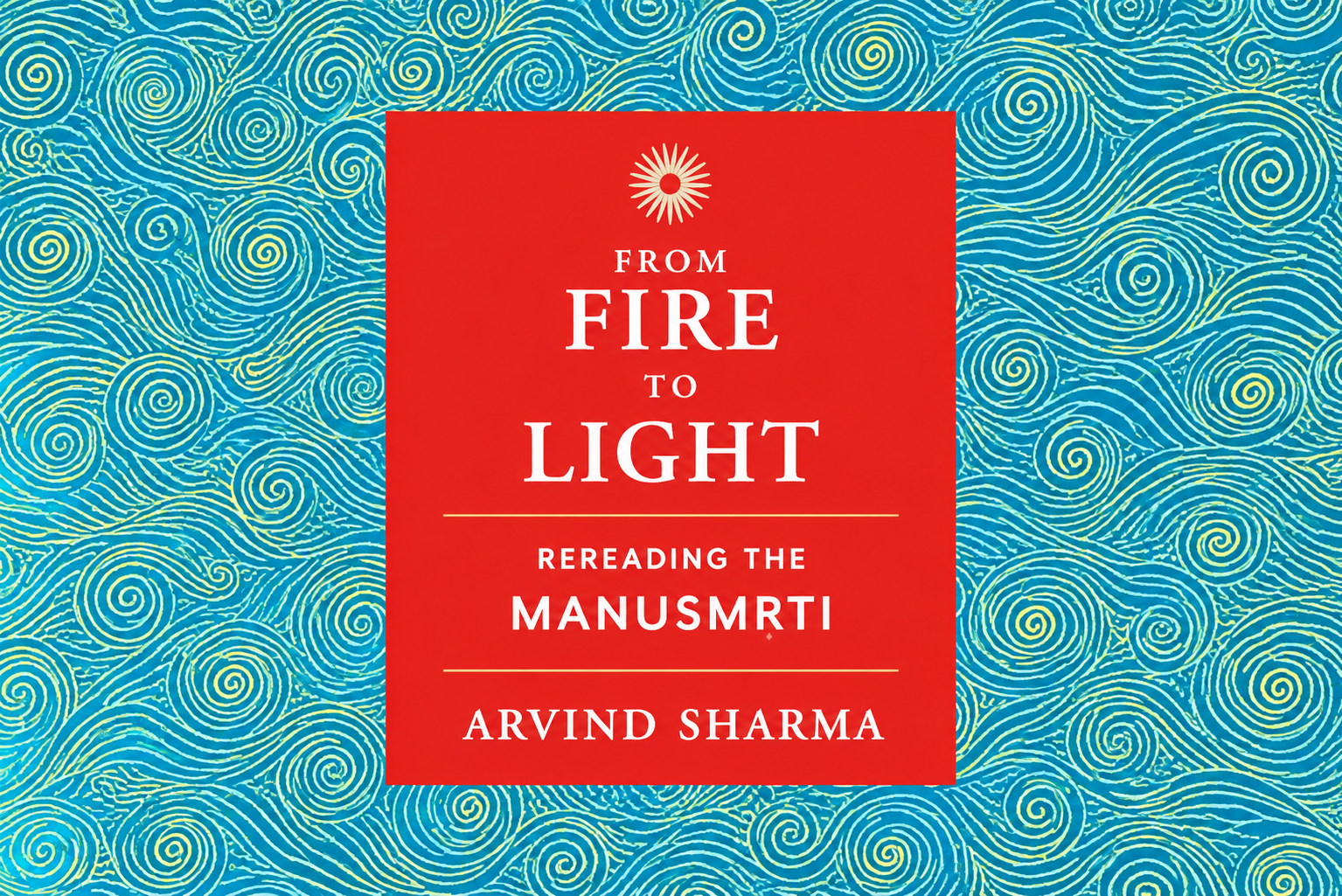
It is against this historical backdrop that Arvind Sharma revisits the Manusmriti in his recently published From Fire to Light: Rereading the Manusmriti (2). Sharma brings an unusual combination of perspectives to the subject. A former member of the Indian Administrative Service, he subsequently turned to the academic study of religion, earning a doctorate in Sanskrit and Indian Studies from Harvard, and becoming the Birks Professor of Comparative Religion at McGill University. His scholarship has focused extensively on Hinduism and comparative religion (3). In his preface, Sharma begins with a candid admission. Like many Indians, he had long known the Manusmriti largely through its most controversial passages, particularly those concerning caste and women. A closer engagement with the text, however, led him to ask a broader question. Was the Manusmriti’s meaning and historical role more complicated than either simple defence or simple condemnation allowed?
Sharma’s approach is neither to defend the work nor to place it beyond criticism. He distinguishes between the outsider, or etic, perspective and the insider, or emic, perspective, and argues that both can illuminate the text. His particular concern, however, is that the Manusmriti should also be understood from within the Hindu Dharma tradition rather than only through interpretive frameworks imposed upon it from outside.
Caste, Society, and the Historical Context
This distinction becomes important in discussions of caste. Sharma argues that modern discussions too readily treat the Manusmriti as if it created or prescribed the entire caste system as it actually developed in India. He distinguishes varna, the broad fourfold social classification discussed in Sanskrit texts, from jati, the numerous hereditary and occupational communities that constituted much of lived caste society. He further notes that caste-like social organization has existed among Indian communities outside Hinduism as well. His larger point is methodological. The relationship between a religious or legal text and actual social practice cannot simply be assumed.
Sharma also questions how historically influential the Manusmriti actually was. He notes that the text is conventionally dated to around the second century CE, but challenges the assumption that its appearance automatically translated into dominance over Indian society. He highlights India’s large share of world economic output during much of the period following its composition and asks whether the text can straightforwardly be blamed for India’s later poverty. Sharma presents this not as a definitive economic explanation, but as a reason to scrutinize simple claims of cause and effect.
Smriti, Ethics, and Intertextual Reading
A key theme in the book is the role of colonial interpretation and the quest of British administrators for texts that could serve as sources of Hindu law. Sharma contrasts the traditional Hindu understanding of Smriti literature with the idea of an immutable code. He describes Smriti as literature intended to apply enduring principles to changing circumstances.
Sharma argues that colonial writers such as James Mill contributed to what he calls a “pathological reading” of the Manusmriti, selectively emphasizing passages concerning caste, women, and social hierarchy as evidence of the supposed backwardness of Hindu civilization. He does not, however, say that problematic verses should simply be explained away. Rather, he reads them through competing interpretive frameworks. A passage concerning lying, for example, is presented as permitting falsehood in exceptional circumstances when telling the truth could cause grave harm. Sharma contrasts James Mill’s condemnation of this provision with a traditional ethical interpretation in which moral duties can conflict and therefore sometimes require exceptions.
This expands into a broader discussion of Hindu ethics, which do not necessarily assume that every moral problem can be resolved through one universally applicable rule. Different duties may sometimes conflict. The text therefore allows for exceptional conduct when ordinary rules cannot appropriately govern extraordinary circumstances. Sharma illustrates this through stories from the Mahabharata and other traditional sources.
For Sharma, one important implication is that Hindu textual tradition should be treated as historically dynamic rather than frozen. He cites Swami Vivekananda and Mahatma Gandhi to support the idea that inherited rules must be interpreted in relation to changing times. Sharma develops this argument further through what he calls “plural intertextuality”. A verse should not necessarily be read in isolation, but alongside other passages in the same work, related Hindu texts, commentaries, and the social context surrounding them. He illustrates this with the status of women. A frequently cited verse states that a woman is under her father’s guardianship in childhood, her husband’s in youth, and her sons’ in old age; she should not act independently. Read alone, it can suggest an almost complete denial of legal autonomy. Yet Sharma places beside it another verse recognizing property received by a woman after marriage as hers and providing for its inheritance by her children. Elsewhere, an apparent denial of a daughter’s inheritance sits alongside a provision recognizing inheritance from her mother. Sharma’s point is not that the troublesome verses disappear, but that one verse cannot necessarily be made to speak for an entire textual tradition.
The same method complicates accounts of varna. The familiar Purusha Sukta account describes Brahmins, Kshatriyas, Vaishyas, and Shudras as emerging from different parts of the primordial being. Yet Sharma draws attention to other passages, within the Manusmriti and elsewhere in the Vedic corpus, which offer different accounts of the origins and relationship of the varnas. Rather than forcing these into a single harmonized explanation, he suggests that they may represent different strands within the Hindu tradition. The implications extend beyond caste. Sharma argues that the Manusmriti should be read as a text within a religious tradition rather than as one standing above and directing that tradition. This is why translation matters too. Rendering dharma simply as “law,” he observes, can prompt the reader to see a legal code, whereas the original concept carries a considerably broader meaning. It is this insistence on context that Sharma carries through the book.
Sharma’s Rereading
The book moves from the historical context and sources of dharma to varna, the position of Shudras, the ashramas, and women, before turning to legal discrimination, political organization, and even foreign policy. Its later chapters examine karma and rebirth, the doctrine of the yugas, and what Sharma calls the “hermeneutics of suspicion”. This breadth matters to his argument. Sharma contends that modern discussion has often concentrated disproportionately on Manusmriti’s negative dimensions while other aspects of the work have received considerably less attention. His proposed corrective, however, is not simply to substitute an apologetic reading for a hostile one. The task, as he frames it, is to place apparently contradictory passages beside one another and ask whether their differences can be reconciled, or whether they represent genuinely different strands within the tradition.
This approach leads Sharma to revisit some of the most serious charges against the Manusmriti. On women, he accepts that they possessed less legal independence and fewer rights than men, but disputes the stronger proposition that the text accorded them no legal rights at all. On Shudras, he similarly challenges readings that rely on isolated verses while overlooking passages pointing in other directions. On caste, his conclusion is deliberately qualified. The Manusmriti is “casteist” insofar as it employs varna and jati to organize society, he says, but not if the term means that it invariably discriminates against the lower castes. Sharma makes a further distinction between hierarchy and inequality. The four varnas are ranked, but he argues that this hierarchy is not simply indexed to wealth or political power. The Brahmin placed at its summit is expected to embrace material restraint rather than worldly power. These arguments do not erase hierarchy or discrimination. They seek instead to establish more precisely what kind of social order the text actually envisages.
Sharma’s conclusion is therefore neither an acquittal of Manu nor an indictment. He explicitly says there are good reasons to criticize the Manusmriti, and his most striking criticism concerns its social vision. Faced with the possibility of rebuilding society after the collapse of the Mauryan empire, the Manusmriti gave Hindu culture a social rather than a political orientation. It saved the “society” but perhaps not its “polity”.
Contemporary Relevance
This rereading is not merely of academic interest. The Manusmriti continues to be invoked in contemporary public debate. In August, Rahul Gandhi cited the Manusmriti injunction that a woman “must never be independent”. He called these words a shame and linked them to patriarchy (4). Sharma would perhaps ask us to undertake the more difficult exercise: neither to excuse the verse nor to isolate it, but to read it within the larger textual and historical tradition to which it belongs.
References
1. Jones, William (1796). Institutes of Hindu Law, p. xvi
2. Goodreads. “From Fire to Light: Rereading the Manusmriti” — https://www.goodreads.com/en/book/show/209999811-from-fire-to-light
3. Arvindsharma. “Dr. Arvind Sharma: Biography” — https://www.arvindsharma.org/bio
4. NDTV. “Rahul Gandhi’s “Smash The Patriarchy” Call To Women Sparks Congress vs BJP”
https://www.ndtv.com/india-news/rahul-gandhis-smash-the-patriarchy-call-to-women-sparks-congress-vs-bjp-11950496
