
The Cost of Forgetting & A Return to Civilizational Roots — “Unbaptized”
A couple of years ago, while watching a thought-provoking conversation between Esther Dhanraj and Rajiv Malhotra, I encountered a voice that was at once intellectually rigorous and refreshingly honest. Unlike many public discussions on conversion and faith that are weighed down by ideological certainties, Esther spoke from lived experience. Her words carried the authority of someone who had traversed both sides of the religious divide and emerged with hard-earned insights.
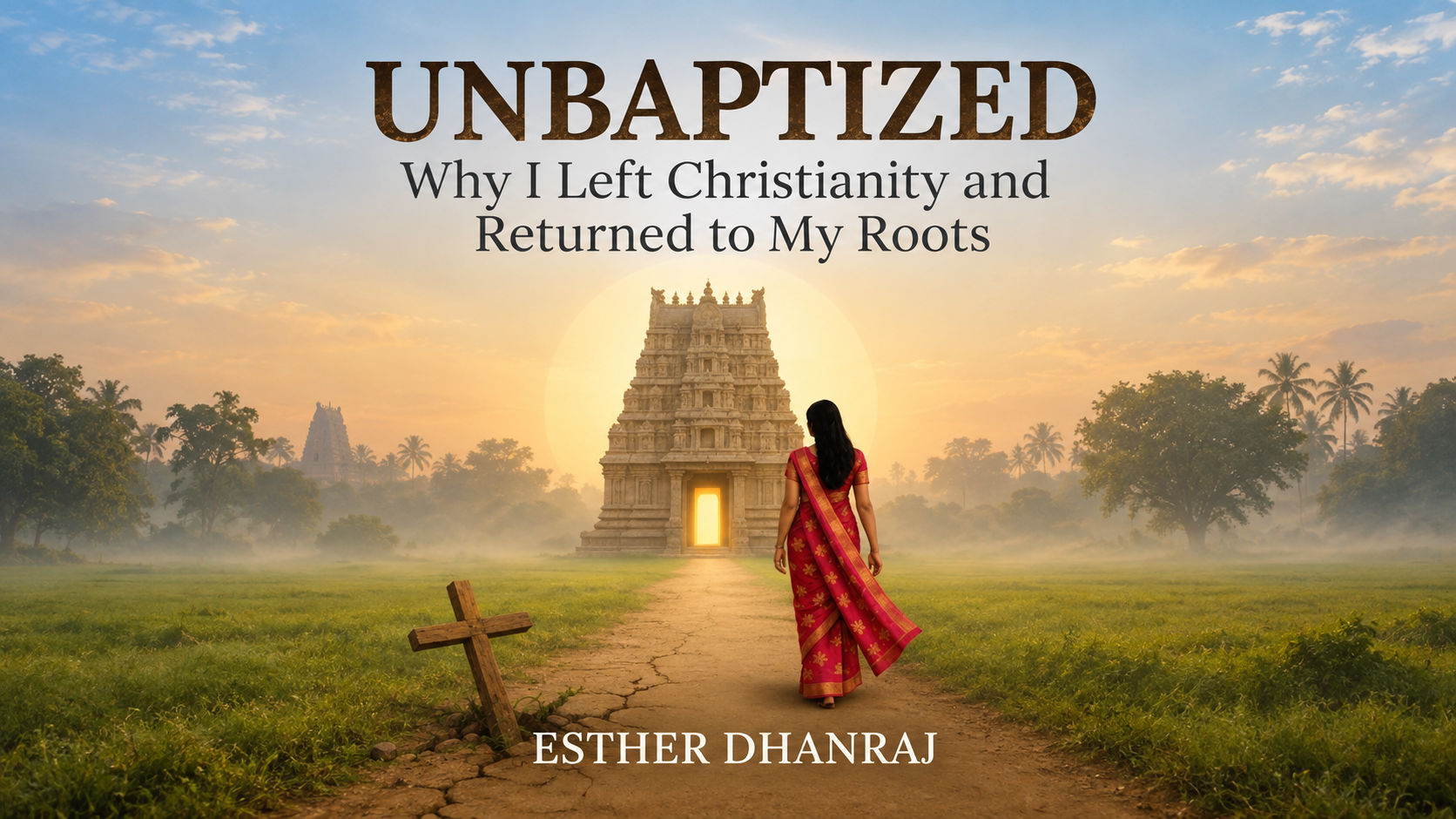
It was therefore with great anticipation that I began reading her latest book, Unbaptized: Why I Left Christianity and Returned to My Roots. What I expected was a personal memoir or testimony. What I discovered was something far more significant — a deeply reflective work that combines autobiography, theology, social commentary, and cultural critique into a single compelling narrative.
More Than a Memoir
Published by Garuda Prakashan in 2025, the 316-page volume chronicles Esther Dhanraj’s journey from a traditionally Hindu upbringing to evangelical Christianity, through years of theological study, and finally back to Sanatana Dharma after a prolonged period of intellectual and spiritual struggle. The publisher aptly describes it as a story of “faith, identity, and the courage to return home.” It is at once a personal testimony, a theological critique and a sociological study.
Yet the book is more than the story of one woman’s religious transformation. It is a meditation on faith and doubt, roots and uprootedness. At one level, Unbaptized is the story of an individual. At another, it is the story of countless Indians whose ancestral traditions were interrupted by conversion. More significantly, it is a mirror held up before contemporary Hindu society, forcing it to confront uncomfortable questions about cultural self-preservation, and the consequences of forgetting its own history. For Hindus, it is a wake-up call.
An interesting parallel may be seen in the structure of Unbaptized. Just as the Bhagavad Gita consists of eighteen chapters, Esther’s book is arranged into seventeen essays and an appendix for further reading, making a total of eighteen sections. The comparison is purely symbolic. While the Gita traces Arjuna’s journey from confusion to clarity, Unbaptized recounts Esther’s journey from her ancestral roots through religious conversion and ultimately to a rediscovery of belonging. In this sense, the book goes beyond a personal memoir and stands as a historical and cultural document.
The Missing Voice in the Conversion Debate
A major strength of Unbaptized lies in the unique perspective it offers on the discourse on religious conversion. For centuries, discussions about conversion in India have been dominated by missionaries, theologians, church institutions, social activists, politicians, and academics. What remains relatively scarce are detailed accounts from those who actually underwent conversion, lived deeply within the faith, and later left it after rigorous scrutiny. As one reviewer of the book notes, the missionary perspective has historically dwarfed the convert’s own experience, leaving important questions unanswered about their fears, motivations, doubts, and eventual disillusionment. We know much about those who convert others. We know far less about the emotional, psychological, and spiritual journeys of those who are converted.
This absence is significant. The convert has often been treated either as a trophy by missionary organizations or as a statistic in sociological debates. Rarely has the convert been allowed to speak in his or her own voice.
Esther Dhanraj changes that. She does not write as an outsider criticizing Christianity from a distance, nor as a detached academic or political activist seeking to score ideological points. She writes as someone who entered Christianity sincerely, embraced it wholeheartedly, lived within its structures, defended it intellectually at an advanced level, and eventually left it after years of rigorous examination. That gives her narrative an authenticity that cannot be manufactured. The result is a book that neither glorifies nor sensationalizes. Instead, it invites readers into a deeply personal process of inquiry.
The Story of a Family’s Conversion
Particularly compelling is the author’s honest recounting of how her family embraced Christianity. Contrary to popular stereotypes, Esther does not present her family as ignorant victims. Nor does she reduce conversion to simplistic explanations involving money or material incentives. Within some sections of Hindu society, converts are often dismissed as “rice bags” — individuals supposedly induced by material benefits. Esther challenges this caricature directly and convincingly. Her own family’s experience demonstrates the inadequacy of such stereotypes.
Instead, she paints a balanced picture of a middle-class family in Bhubaneswar/Hyderabad navigating personal tragedies, emotional vulnerabilities, social isolation, psychological needs, and existential uncertainties. Conversion, she shows, rarely fits neatly into simplistic narratives of greed or ignorance. Her family was not converted overnight. The process was gradual, unfolding against a backdrop of crises, personal loss, emotional distress, and persistent missionary engagement. Later, reflecting on this experience, Esther would observe that every conversion in her family followed a moment of distress. Into those wounds stepped evangelists offering compassion and certainty.
The conversion process emerges not as a single dramatic event but as a gradual erosion of resistance. Esther describes how repeated missionary efforts, supported by an organized ecosystem, eventually succeed where isolated Hindu resistance fails. As one commentator on the book observes, the proselytizer can fail ninety-nine times, but the hundredth attempt succeeds because it is backed by institutions, resources, and persistence. The significance of this observation cannot be ignored.
This should prompt Hindu society to ponder deeply. The question is not merely why missionaries are effective. The deeper question is why vulnerable Hindus often encounter missionary support before they encounter support from fellow Hindus. At a Hyderabad book launch, Esther reportedly posed this question precisely: How does a Christian come to help a distressed Hindu family before fellow Hindus do? That question echoes throughout the book.
For decades, public debates on conversion in India have oscillated between two extremes. One side insists that conversion is purely an exercise of individual freedom. The other portrays converts as passive victims. Esther rejects both caricatures. She shows that conversion often occurs within a complex matrix of emotional distress, social vulnerability, and psychological need — and that where there is loneliness, someone will offer companionship; where there is despair, someone will offer hope; where there is confusion, someone will offer certainty. The real question is whether Hindu society is prepared to provide those things before others do.
The book thereby challenges Hindus to examine uncomfortable questions. Why do vulnerable individuals often find support structures outside their own communities? Why are many Hindu institutions unable to provide timely emotional and social assistance to those undergoing crises? These questions lend the book an introspective dimension that distinguishes it from polemical literature.
Conversion as Civilizational and Cultural Displacement
A key breakthrough of this book is its thesis that conversion is fundamentally cultural and civilizational, rather than merely theological. The text demonstrates how the process compels converts to fundamentally dismantle their ancestral frameworks—including rituals, memories, and symbols. Ultimately, it forces individuals to not only adopt unfamiliar doctrines but to actively reclassify their own heritage as illegitimate or spiritually hazardous.
The book contains several poignant and disturbing examples. One particularly moving episode involves the death of Esther’s brother from complications related to Type 1 diabetes. Instead of serving as a moment of healing and reflection, the tragedy became an opportunity for intensified religious pressure: a pastor allegedly used the family’s grief to press for the removal of one of the last visible remnants of their Hindu heritage — the grandmother’s puja mandir and other symbols of ancestral continuity, which became targets for elimination.
Similarly disturbing is her account of the pressure placed upon her mother to abandon traditional Hindu markers such as the tilak — the tilakam, a deeply personal symbol of Hindu womanhood and identity. This was not merely a change in external appearance; it symbolized a deeper rupture with inherited identity.
These episodes illuminate an uncomfortable reality. Religious conversion, in many cases, becomes a process of civilizational reprogramming. The convert is gradually encouraged to reinterpret his or her past, distance himself or herself from ancestral practices, and identify with a new religious narrative. A person may gain a new religious identity while simultaneously losing connection with inherited cultural roots. The result can be a profound sense of alienation — not only from one’s traditions but also from one’s ancestors.
Through such incidents, Esther demonstrates that conversion often demands the rejection of inherited cultural markers, family memories, and civilizational symbols. The narrative gradually underscores that conversion is not simply a change of religious belief. It frequently entails a deeper disengagement from the culture, memory, heritage, and identity shaped over generations.
The Theology That Unmade Belief
What distinguishes Esther’s story from many other accounts is the role played by intellectual inquiry. Many conversions occur without significant engagement with theology, and Esther herself acknowledges that her family’s entry into Christianity was driven largely by emotional and practical considerations rather than doctrinal conviction.
Ironically, it was not hostility toward Christianity that led Esther away from it. It was serious engagement with it — and it was theology that eventually led her out. Far from being a casual believer, Esther immersed herself deeply in Christian theology. Driven by sincere religious commitment and a desire to defend Christianity rigorously, she pursued advanced theological education in the United States and undertook formal training in Christian apologetics — the discipline devoted to defending Christian doctrine through reasoned argument. Her intention was not to undermine Christianity but to understand and defend it more effectively.
Yet it was precisely this intellectual journey that triggered her doubts. The more she studied, the more she encountered questions that seemed resistant to satisfactory answers. Biblical contradictions, doctrinal tensions, historical uncertainties, and theological inconsistencies gradually accumulated, along with unresolved questions she found impossible to ignore.
What distinguishes Esther’s account is the integrity with which she pursued these questions. Rather than suppressing doubt, she followed it wherever it led. Rather than treating inquiry as a threat, she treated it as an obligation. This intellectual honesty forms the moral centre of the book. It is impossible not to admire the integrity with which she confronts difficult questions.
Unlike many contemporary religious narratives that celebrate certainty, Unbaptized celebrates inquiry. Her narrative illustrates a point often overlooked in religious discourse: authentic faith must be able to withstand scrutiny. The suppression of doubt does not strengthen belief; it merely postpones crisis. The book repeatedly affirms that genuine faith cannot fear scrutiny, and that religious inquiry should be encouraged rather than feared — a principle that aligns remarkably well with the spirit of Sanatana Dharma, where questioning has traditionally been regarded not as heresy but as a legitimate path to wisdom. This intellectual honesty deserves admiration.
Doubt as a Sacred Responsibility
One of the deepest and most profound themes running through the book is the legitimacy of doubt. In many religious traditions and settings, doubt is viewed as weakness, rebellion, or spiritual failure. In Esther’s narrative, doubt becomes a path to truth — an instrument of truth-seeking.
Questions that had troubled her father in his final years eventually resurfaced in her own spiritual and intellectual journey. Instead of silencing them, she confronted and pursued them directly and relentlessly.
The result was not atheism. Nor was it nihilism. Rather, it was a rediscovery of Sanatana Dharma. This distinction is important. Esther did not abandon religion, or Christianity, because she ceased seeking meaning or believing in the sacred. She left because she found herself unable to reconcile Christian claims with her intellectual conscience and reason. Her return to Hinduism was therefore not an act of rebellion but an act of recovery.
The Symbolism of the Title
The title Unbaptized is itself profoundly symbolic. In Christian theology, baptism signifies entry into the body of Christ. By calling herself “unbaptized,” Esther is questioning an entire framework of religious identity. She is describing a process of reclaiming a self that had been buried beneath layers of acquired identity.
Perhaps the most beautiful aspect of the book is that it does not end in bitterness. Esther does not describe her return to Hinduism as another conversion, but as a homecoming. This distinction is profound. Conversion implies movement from one identity to another. The metaphor suggests the recovery of something long obscured rather than the acquisition of something entirely new.
This distinction carries deep civilizational significance. Abrahamic traditions generally operate through exclusive truth claims. Sanatana Dharma, by contrast, has historically accommodated multiple paths, perspectives, and approaches to the sacred. For Esther, returning to Hinduism was not a leap into dogma but an entry into a tradition that welcomed inquiry, plurality, and exploration — one that offered intellectual openness, philosophical plurality, and cultural rootedness.
Her journey therefore culminates not in rejection but in reconciliation. She reconciles with her ancestry. She reconciles with her culture. Most importantly, she reconciles with herself. Her narrative resonates with many contemporary Indians who find themselves estranged from their cultural inheritance yet instinctively drawn back toward it.
The Emergence of the “Extian”
Perhaps one of Esther Dhanraj’s most significant social contributions to contemporary discourse is her effort to give visibility to former Christians — or “Extians” — who have left the faith.
This phenomenon deserves far greater scholarly attention than it currently receives, and remains poorly understood. For decades, public discussions have focused primarily on conversion into Christianity. Far less attention has been paid to those who subsequently leave it. Yet the number of individuals questioning inherited Christian identities appears to be growing.
Many former Christians remain silent. Some fear social ostracism. Others fear family repercussions or consequences. Still others worry about professional consequences or fear backlash from former religious communities. Esther documents the emotional cost of dissent and the backlash often faced by those who question established religious narratives. The result is a largely invisible community.
By speaking openly and publicly, Esther has helped create a space where these experiences can be discussed — an act of considerable courage. This is no small achievement. Every social transformation begins when previously isolated individuals discover that they are not alone. In that sense, Unbaptized is not merely autobiographical. It is representative and foundational. It provides language, legitimacy, and visibility to experiences that have long remained hidden, and serves as a platform for countless others whose stories remain untold.
Hindu Civilizational Amnesia
If there is one theme that elevates Unbaptized beyond the category of memoir, it is its concern with civilizational memory. Esther Dhanraj is interrogating a phenomenon that has afflicted Hindu society for generations — civilizational amnesia.
Throughout the book, and even more explicitly in her supplementary essay addressed to “Sanatanis,” Esther repeatedly returns to a central concern: Hindus have forgotten too much. The historical processes through which conversions unfolded are often poorly understood. The circumstances that enabled those transformations have faded from public awareness under which vast sections of Indian society were separated from their ancestral traditions. Even the theological and intellectual foundations of missionary activity are rarely studied today. Most importantly, they have forgotten that civilizations survive not merely through population, territory, or economic prosperity, but through memory.
Esther repeatedly raises questions that many Hindus have avoided for decades. Why do so many Hindus know so little about their own history? Why are discussions of religious aggression often considered unacceptable? Why is historical memory selectively encouraged in some contexts and discouraged in others?
For generations, many Hindus were encouraged to view their history primarily through the lens of accommodation and harmony. While these virtues undoubtedly exist within Hindu civilization, they often overshadow discussions of conflict, resistance, and survival. The result has been a peculiar form of civilizational amnesia. Many educated Indians can describe European wars in detail but remain unfamiliar with the destruction of major Hindu temples. They know the history of colonial America but not the history of missionary expansion in their own regions. They can discuss the Inquisition in Europe yet remain unaware of its manifestations in India.
This curious paradox extends further. Entire civilizations around the world preserve memories of historical suffering as part of their collective identity. Jews remember the Holocaust. Armenians remember the genocide. African-Americans remember slavery. Indigenous communities remember colonization. The Jewish people preserved memory. The Chinese preserved memory. Yet Hindus are frequently encouraged to forget.
This selective forgetting has consequences. A people who forget their struggles gradually lose the instincts necessary for cultural survival. Esther argues that this expectation is neither healthy nor sustainable. Memory is the foundation of every civilization. Without it, there can be no meaningful continuity between the past, the present, and the future.
The author’s return to Hinduism is not merely a return to a faith tradition. It is a recovery of memory. In many ways, Esther’s personal journey mirrors what she believes Hindu society itself must undertake — a journey from forgetting to remembering. A civilization that forgets its wounds cannot understand its present condition. Equally, a society that loses sight of its victories cannot draw confidence from its inheritance. When ancestral memory fades, the transmission of identity to future generations becomes difficult. Unbaptized is therefore as much about remembrance as it is about religion.
The One-Sided Burden of Tolerance
Among the most thought-provoking aspects of Esther’s writing is her critique of what may be called the asymmetry of tolerance. Modern India rightly celebrates pluralism and coexistence, and modern Hindus are frequently taught that tolerance is one of the defining virtues of their civilization. This is undoubtedly true — Hindu civilization has historically displayed an extraordinary capacity to accommodate diversity, absorb difference, and coexist with multiple philosophical traditions.
The problem, Esther argues, arises when tolerance becomes one-sided. Many Hindus have grown up internalizing the belief — the obligation — that respecting other religions is a moral duty. This is admirable. The problem arises when respect ceases to be reciprocal, when the same obligation does not operate in the other direction.
Can a tradition that regards all non-believers as spiritually lost genuinely practice pluralism in the same way as a civilization that accepts multiple paths to truth? Can a missionary enterprise dedicated to conversion coexist indefinitely with a worldview that sees all traditions as valid expressions of spiritual seeking? These questions are not asked often enough.
When a society expects only one community to endure criticism of its traditions, repeated reinterpretations of its history, and organized efforts to convert its members, while insulating others from comparable scrutiny, tolerance ceases to be a reciprocal virtue and becomes an unequal obligation. Esther argues that this burden has fallen disproportionately upon Hindus, who are often expected to demonstrate restraint and accommodation even when their beliefs are dismissed as false, pagan, or spiritually deficient within certain theological frameworks. Yet when concerns are raised about these dynamics, the response is frequently to label such objections as intolerance. This imbalance, she suggests, deserves serious examination if genuine pluralism is to flourish.
Esther challenges this double standard. Her argument is not against tolerance. It is against the selective application of tolerance. A virtue ceases to be a virtue when it becomes a unilateral obligation. This imbalance deserves serious examination — pluralism cannot survive if it is demanded from only one side.
Secularism and the Problem of Asymmetry
Closely related to the question of tolerance is the issue of secularism. For decades, Indian public discourse has celebrated secularism as a foundational value, and India’s version of secularism promises equal treatment in theory. Yet the practical meaning of secularism has often remained contested, and many critics argue that it frequently imposes greater obligations on the majority than on minority communities.
Esther’s reflections suggest that Indian secularism has frequently operated through unequal expectations. The majority community is expected to dilute its identity in the name of secularism, while minority communities are encouraged to preserve theirs. Expressions of Hindu identity are often subjected to intense scrutiny and viewed with suspicion, while equally assertive expressions from other communities are treated as legitimate exercises of religious freedom or accepted as legitimate forms of self-expression.
The result is a paradoxical situation. The Hindu is encouraged to celebrate diversity but discouraged from defending his own traditions. He is expected to respect other faiths but may be criticized for expressing pride in his own.
It reflects a perception that has become increasingly widespread and deserves attention. The issue is not whether secularism is desirable. The issue is whether it can survive if applied unevenly. A genuinely secular, genuinely pluralistic framework cannot operate through unequal standards — it should create equal obligations and equal freedoms. If one community is constantly asked to apologize for its traditions while others are encouraged to celebrate theirs, resentment becomes inevitable. Esther’s observations force readers to confront these uncomfortable realities.
The Question of Religious Expansion
Central to Esther’s civilizational critique is her insistence on historical consciousness, highlighting a pervasive trend in modern Indian discourse—the refusal to engage objectively with history.
Historical events involving religious conflict, temple destruction, forced conversions, colonial interventions, iconoclasm, and missionary expansion are often minimized or avoided altogether. The rationale is usually well-intentioned: many fear that discussing such topics may inflame contemporary tensions. Yet Esther raises a crucial question: what are the consequences of suppressing historical memory?
Civilizations do not survive merely through economic prosperity or population. They survive through memory. A society that refuses to study its past becomes vulnerable to misunderstanding its present — and to repeating it. Historical awareness does not require hostility. Remembering is not the same as seeking revenge; it is simply refusing to surrender truth. Understanding historical processes does not imply animosity toward contemporary individuals.
Yet many Hindus have been conditioned to view discussions of civilizational trauma as somehow illegitimate. The cumulative effect of centuries of invasions, iconoclasm, forced conversions, colonial interventions, and missionary campaigns is frequently minimized or ignored. Esther argues that this forgetting, and this expectation to forget, is neither healthy nor sustainable, and has come at a cost.
The Psychology of Cultural Displacement
The book is particularly insightful in examining conversion as a psychological process. Religious conversion is often discussed in abstract theological terms; Esther brings the discussion back to human experience.
Her narrative demonstrates that conversion frequently involves a gradual restructuring of identity. The convert begins to reinterpret childhood memories through a new framework. Family traditions acquire different meanings. Ancestral practices come to be viewed with suspicion. Symbols once associated with belonging become associated with error. Over time, an entirely new narrative replaces the old one. The convert is encouraged to see himself not as the inheritor of an ancient civilization but as someone rescued from it.
This process creates profound tensions. For many converts, the question is no longer merely theological. It becomes existential. Who am I? Where do I belong? What is my relationship with my ancestors? What does it mean to reject traditions that shaped generations before me? These questions lie at the heart of Esther’s journey. Her eventual return to Hinduism emerges not as a rejection of Christianity alone but as an attempt to heal a deeper rupture.
Resistance to Proselytization
A controversial question in contemporary discourse concerns resistance to proselytization and the distinction between hostility and self-defence. Modern discourse often treats resistance to proselytization, or religious conversion, as inherently intolerant. Critics often portray such resistance as intolerance or bigotry. Esther challenges this assumption and offers a different perspective.
Every civilization possesses mechanisms of self-preservation. Languages are protected and preserved. Indigenous cultures, traditions, monuments, and heritage sites are preserved and protected. Traditional knowledge systems are documented and defended. Why then should concerns about religious conversion be treated differently, or automatically be dismissed as bigotry?
The question is not whether individuals possess freedom of conscience. They certainly do. The question is whether large-scale, organized, institutionally funded efforts to transform the religious composition of communities should be exempt from scrutiny, or viewed purely as exercises of individual freedom.
Esther’s own account demonstrates the extent to which conversion frequently operates through organized networks and complex institutional structures rather than isolated individual encounters. Recognizing, and ignoring, this reality does not constitute intolerance, nor does it promote tolerance — it merely obscures reality, or constitutes awareness. Cultural self-defence is not hatred. It is the instinct by which civilizations survive.
A Challenge to Hindus
While Christians will find much in the book to reflect upon, Unbaptized is equally, and perhaps even more sharply, addressed to Hindus.
Esther argues that many conversions succeed because genuine human needs remain unaddressed. Emotional support, community engagement, educational assistance, and social solidarity are often provided more effectively by missionary networks than by local Hindu institutions. This diagnosis deserves serious attention.
If Hindus wish to counter conversion, legal measures alone will not suffice. A civilizational response must include compassion, community-building, and social responsibility. In this sense, Esther’s work is constructive rather than merely critical. She calls not for hostility but for renewal.
A Call to Wakefulness
The broader civilizational concerns that animate Esther’s thinking become especially evident in the call to “Sanatanis” in the book. It is among the most powerful pieces of writing associated with Unbaptized — passionate, provocative, and unapologetically civilizational, even uncomfortable.
At its heart lies a simple but urgent appeal: wake up. Esther argues that Hindus have spent too long assuming that goodwill alone can guarantee survival. They have trusted narratives that discourage self-assertion. They have confused passivity with virtue. They have mistaken historical forgetfulness for moral superiority.
It is not a call for hostility. It is a call for awareness. There she reflects on historical memory, cultural confidence, religious aggression, and Hindu responses to centuries of proselytization and conquest. Its central message is that civilizations survive only when they understand themselves. Without self-knowledge, tolerance degenerates into self-erasure. Without memory, pluralism becomes vulnerability. Without confidence, coexistence becomes capitulation.
Her words compel reflection and reveal the deeper concerns underlying Unbaptized. At its core lies a question that increasingly confronts modern India: can a civilization survive if it loses confidence in its own traditions? Esther’s answer is unequivocal — a civilization that forgets its roots risks losing itself. Her return to Hinduism is therefore not merely personal; it symbolizes a larger quest for civilizational continuity in an age of cultural fragmentation.
Why Every Hindu and Every Christian Should Read This Book
One remarkable feature of Unbaptized is that it speaks to multiple audiences at once.
It asks difficult questions about social responsibility, community support, historical awareness, and cultural continuity. For Christians, it invites introspection, offering an opportunity to understand why some sincere believers eventually leave the faith despite years of commitment and theological study. For scholars, it is a valuable primary source — first-person accounts of conversion and de-conversion remain relatively rare in the Indian context. For policymakers, it highlights dimensions of conversion that are often ignored in legal and political debates. Most importantly, for ordinary readers, it is a deeply human story.
Books occasionally appear at moments when civilizations, or societies, are reassessing or re-examining themselves and foundational assumptions. Unbaptized is one such book. India today is witnessing renewed debates about religious freedom, conversion, identity, decolonization, and civilizational self-understanding. Much of that debate is dominated either by ideological slogans or institutional narratives.
Esther Dhanraj introduces something far more valuable: lived experience. The testimony of someone who traversed both worlds and emerged with insights that neither side can easily dismiss. Her story reminds us that religious choices are rarely abstract. They affect families, memories, relationships, and entire systems of meaning. Most importantly, the book restores agency to the convert. Instead of speaking about converts, Esther speaks as one. That distinction makes all the difference.
What Distinguished Readers Have Said
The impressive list of endorsements accompanying the book reflects its growing importance within contemporary discourse.
Rajiv Malhotra recognizes the book as an important intervention in discussions surrounding conversion and identity. Stephen Knapp highlights its value as a firsthand account of religious transformation. Other distinguished scholars, writers, and public intellectuals — including Koenraad Elst, Anand Ranganathan, J. Sai Deepak, Maria Wirth, Neeraj Atri, Sanjay Dixit, Pandit Satish Sharma, and several others — have welcomed the work as an important contribution to understanding the lived realities of conversion and de-conversion.
What unites these endorsements is the recognition that Esther’s voice fills a longstanding gap in public discourse.
Literary Merit
Apart from its intellectual and civilizational significance, Unbaptized is also a remarkably readable book. Esther writes with clarity, sincerity, and emotional restraint. She avoids sensationalism. She does not indulge in bitterness. Even when describing painful experiences, her tone remains measured and reflective.
This literary discipline enhances the credibility of her account. The narrative flows smoothly between personal recollections, theological discussions, historical observations, and broader cultural reflections. The result is a book that appeals simultaneously to scholars, activists, religious practitioners, and general readers.
A Journey Home and a Civilization’s Mirror
Unbaptized: Why I Left Christianity and Returned to My Roots is one of the most important books published in recent years on religion, identity, and historical consciousness in India. It is honest without being bitter or vindictive. Critical without being hateful. Personal without becoming self-indulgent.
Esther Dhanraj’s journey — from Hindu roots to Christianity, from Christian apologetics to theological doubt, and ultimately from alienation to cultural reintegration — offers insights that transcend the boundaries of autobiography. Her story is both compelling and instructive, and deserves to be read not only because it is unique, but because it illuminates a larger phenomenon that has shaped Indian society for centuries. Her story compels readers to ask larger questions. What happens when a civilization loses confidence in itself? What happens when historical memory is replaced by selective forgetting? What happens when tolerance becomes unilateral? What happens when cultural self-preservation is mistaken for intolerance? Can a civilization survive if it forgets itself?
The answers are not always comfortable. Yet Unbaptized insists that they must be confronted. The answer implicit throughout the book is clear: no civilization can endure indefinitely without memory. No culture can survive if it loses confidence in its own traditions. No people can preserve their future if they sever themselves from their past.
For Hindus, the book is a summons to self-examination. For Christians, it is an invitation to introspection. For scholars, it is a valuable primary source. For India, it is an important contribution to the ongoing recovery of civilizational memory. And for anyone seeking to understand the human consequences of conversion — not through missionary reports or ideological rhetoric, but through the eyes of one who lived it — Unbaptized is indispensable reading.
At its deepest level, this is not a book about leaving Christianity. It is a book about rediscovering belonging. It is about recovering memory. It is about reconnecting with ancestry. It is about understanding that roots matter. And in an age increasingly marked by cultural fragmentation and civilizational uncertainty, that message could not be more timely.
For that reason alone, Unbaptized deserves a wide readership. It is not merely the story of Esther Dhanraj’s return. In that sense, her memoir evolves into a broader reflection on continuity of tradition and cultural memory to her roots — it is a reminder, and a call, that civilizations, like individuals, can find their way home only when they remember who they are.
