
“India: The Mother” – Rediscovering the Soul of Bharat Through the Mother’s Vision
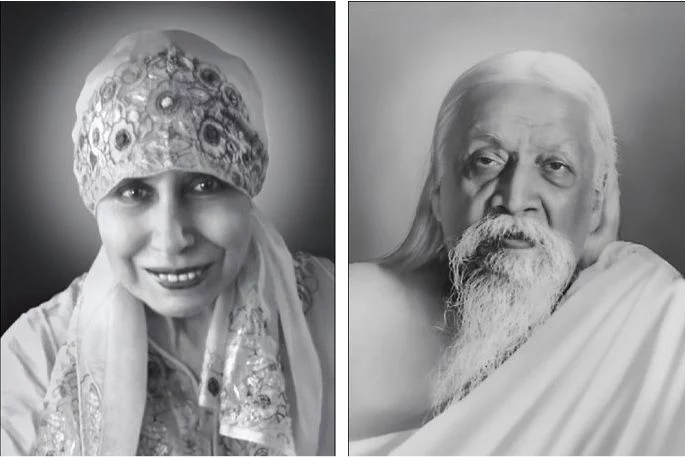
Picture Courtesy: La Grace Center
Editor’s Note: This review is published on the occasion of and in celebration of India’s 79th anniversary of Independence, August 15, 2026.
***
Till my late teens and early twenties, I knew very little about Sri Aurobindo and the Mother. The person who first opened that door for me was the late P. Parameswaran (1927-2020), veteran RSS Pracharak, profound thinker, and founder-director of Bharatheeya Vichara Kendra, Thiruvananthapuram, Kerala.
Every visit to Parameswar ji was an education in itself. His modest room was a treasure-house of ideas. Books on Indian culture, spirituality, history, philosophy, and civilizational thought lined the shelves. He possessed the rare gift of introducing young minds to books that could transform their lives. Whenever I visited him, he would invariably recommend a new work on Indian culture, spirituality, or national thought.
One evening, my eyes rested upon a framed photograph hanging on the wall. It depicted a bearded yogi and a European lady. Curious, I asked him who they were, particularly the Western woman. With characteristic simplicity, Parameswar ji introduced me to Sri Aurobindo and the Mother.
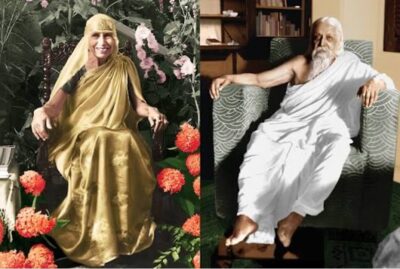
The Mother and Sri Aurobindo
He then gave me a brief but memorable introduction to Sri Aurobindo and the Mother. He spoke about Sri Aurobindo’s pivotal role in India’s freedom movement, his withdrawal from active politics following his profound spiritual realization, and the Mother’s extraordinary contribution in nurturing and carrying forward his vision after his passing. Before I left, Parameswar ji strongly urged me to read Sri Aurobindo’s works, particularly The Foundations of Indian Culture, which he considered essential reading for anyone seeking to understand India’s civilizational spirit.
I eagerly took his advice and began reading Sri Aurobindo. The experience, however, was both humbling and frustrating. Each time I opened one of his books, I found myself struggling to comprehend even a few pages. His writings possessed an intellectual depth and spiritual intensity that seemed far beyond my capacity to grasp. Every sentence appeared layered with meanings that unfolded into further meanings, leaving me overwhelmed and often bewildered. After several unsuccessful attempts, I candidly confessed my difficulty to Parameswar ji.
He smiled, as though he had heard the same admission many times before. “Read again,” he said gently. “And then read again. Continue reading. One day, the meaning will begin to reveal itself.” He also advised me to begin with the Mother’s writings, which, he felt, were more accessible and could serve as a gateway to understanding Sri Aurobindo’s thought. That simple suggestion proved invaluable. It marked the beginning of a journey that has continued for decades and continues even today.
Years later, inspired by the writings of Sri Aurobindo and the Mother—though I still readily admit that much of Sri Aurobindo’s vast and luminous vision remains beyond my complete comprehension—I expressed to Parameswar ji my desire to visit the Sri Aurobindo Ashram in Pondicherry. His response was immediate and encouraging.
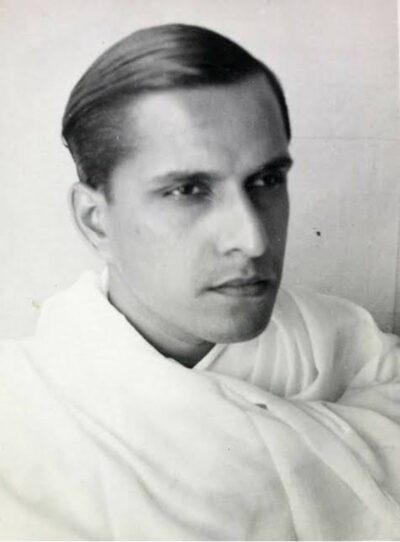
Sri Madhav Pundalika Pandit
He handed me a letter of introduction addressed to Sri M. P. Pandit (1918–1993), one of the foremost exponents of Sri Aurobindo’s philosophy and a close associate of the Mother, who had served as her secretary for more than three decades. Armed with that letter, I undertook my first journey to Pondicherry. It was far more than a visit; it was a pilgrimage.
The serene atmosphere surrounding the Samadhi of Sri Aurobindo and the Mother, the pervasive silence, the discipline of Ashram life and the unmistakable spiritual presence that seemed to permeate the surroundings left a lasting impression on my mind. What began as a single pilgrimage soon became a cherished annual practice. Since 1989, visits to the Sri Aurobindo Ashram have remained an integral part of my spiritual life. Each pilgrimage has deepened my appreciation of Sri Aurobindo’s vision, strengthened my faith in India’s spiritual destiny and renewed my reverence for the Mother and her work.
As the birth anniversary of Sri Aurobindo on 15 August approaches, I offer this humble introduction to India: The Mother as a token of gratitude and reverence—to Sri Aurobindo, whose vision continues to illuminate seekers across the world; to the Mother, who translated that vision into a living force; and to the late Sri P. Parameswar ji, whose guidance first opened the doors of that remarkable spiritual universe to me.
A Book Unlike Any Other
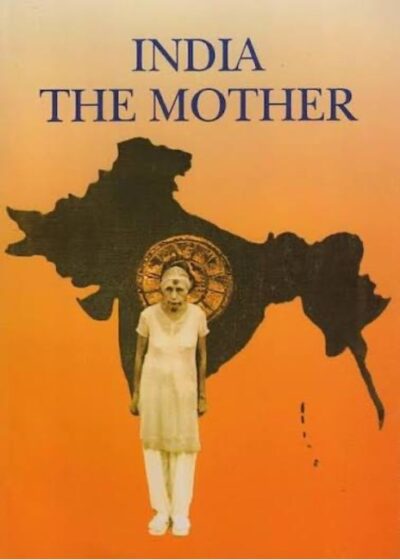
India: The Mother is not a conventional book. It is neither a biography nor a systematic philosophical treatise. Rather, it is a carefully compiled collection of the Mother’s writings, letters, messages, interviews and conversations spanning almost six decades—from 1916 to 1973. The editors describe it as a companion volume to India’s Rebirth, which brought together Sri Aurobindo’s writings on India and her future.
The greater part of the volume is drawn from Mother’s Agenda, the remarkable record of the Mother’s conversations with Satprem over nearly twenty years. What emerges from these pages is not merely a collection of observations on contemporary events but a profound spiritual interpretation of India’s past, present and future. The central premise of the book is simple yet revolutionary.
For the Mother, India is not merely a geographical territory, a political state or an economic unit. India is a living spiritual reality—a manifestation of the Divine Shakti working through history. She is, in the Mother’s words, the Ancient Mother who continues to mould civilizations, guide nations and shape humanity’s future. This idea forms the foundation of the entire volume.
India: More Than a Nation
One of the most striking themes running through the book is the Mother’s insistence that India is far more than a modern nation-state. To her, India is a civilizational force. While many countries derive their identity from race, language, territory or political institutions, India’s uniqueness lies in her spiritual aspiration. Throughout history, India has sought answers to the deepest questions of human existence. The quest for Truth, rather than the pursuit of power, has been the distinguishing feature of Indian civilization. The Mother repeatedly returns to this theme.
She sees India as a repository of spiritual knowledge accumulated through millennia of experimentation by rishis, yogis and seekers. The future of humanity, she suggests, depends not merely upon technological progress or political arrangements but upon the recovery of this deeper wisdom. The dormant strengths of Indian civilization, she says, are destined to help shape humanity’s future and provide the vision that a materially driven civilization has failed to offer.
The Mother and India’s Destiny
The book reveals that the Mother’s concern for India was not sentimental but deeply spiritual. She did not regard patriotism as mere emotional attachment. Rather, she viewed India as an instrument chosen for a particular mission in the evolution of human consciousness. Again and again, she reminds her listeners that India must discover her true self.
Political independence, in the Mother’s view, was only the beginning of India’s journey, not its culmination. Neither economic prosperity nor military power, she argued, could by themselves secure the nation’s true greatness. India’s unique role lay in its ability to harmonize the material and the spiritual, to bring together action and contemplation, progress and inner growth, worldly achievement and higher consciousness. The Mother repeatedly cautioned against the uncritical imitation of materialistic models of development, warning that India risked losing its civilizational identity if it abandoned its spiritual foundations. The challenge before the nation, therefore, was not to reject modernity but to infuse it with the values and wisdom of its enduring spiritual heritage.
A Remarkable Historical Commentary
One of the great strengths of India: The Mother is that it is also a historical document. The Mother comments on many of the defining events of twentieth-century India and the world.
Her observations are often startling in their clarity and directness. The book records her reflections on India’s freedom, Partition, national leadership, foreign policy, wars, education, social change, and international affairs.
Unlike politicians or journalists, however, she examines these events from a deeper perspective. She is concerned not merely with what happened but with the forces operating behind events. This gives the volume a unique character. It becomes both a spiritual document and an alternative history of modern India.
Partition and the Dream of Reunion
Among the most significant themes in the book is the question of the Partition of India in 1947 into an Islamic Republic of Pakistan and a “secular” Republic of India. The Mother regarded the division of India as an unnatural and temporary arrangement. The volume reproduces Sri Aurobindo’s famous statement of August 15, 1947, in which he expressed the hope that the division between India and Pakistan would not become permanent and insisted that India’s unity was essential for her future greatness.
The Mother repeatedly returns to this subject in her conversations. She recalls Sri Aurobindo’s conviction that the division could not endure indefinitely and that unity would eventually be restored in one form or another. It demonstrates the extraordinarily long-term perspective from which she viewed history. For the Mother, political arrangements were temporary; civilizational realities were permanent.
China, National Security, and Leadership
The sections dealing with the Chinese invasion of India in 1962 are among the most compelling in the volume. The Mother watched developments with deep concern. Her conversations reveal anxiety about India’s preparedness, criticism of political complacency, and concern regarding Chinese ambitions in Asia.
Equally striking are her observations on leadership. She expresses astonishment that, for decades, so few voices challenged prevailing assumptions about national security and foreign policy. She speaks candidly about the limitations of contemporary political leadership and the dangers of intellectual conformity. Readers cannot fail to be impressed by the courage and independence with which she expressed them.
Education: The Key to India’s Future
The Mother accords education a central place in the making of a new India. Throughout the book, she argues that the purpose of education extends far beyond preparing students for careers or equipping them with vocational skills. True education, in her view, must foster the integral development of the individual, nurturing character, discipline, self-awareness, creativity and spiritual consciousness. This approach reflects the broader philosophy of Sri Aurobindo’s Integral Yoga, which seeks the harmonious development and transformation of the entire human personality rather than the cultivation of isolated intellectual abilities. At a time when educational systems are increasingly driven by examinations, credentials, and career-oriented competition, the Mother’s vision offers a compelling alternative—one that places human growth, inner awakening, and holistic development at the heart of the learning process.
Beyond Religion
One of the most striking features of the Mother’s thought is her clear distinction between spirituality and organized religion. While firmly rooted in India’s ancient spiritual heritage, she consistently transcends sectarian boundaries and dogmatic limitations. For the Mother, spirituality is not a matter of ritual observance, institutional affiliation, or theological conformity; it is a living, transformative experience of the Divine. She regards India’s civilizational strength as stemming from its unique ability to embrace diverse paths to truth and accommodate a wide spectrum of spiritual quests. This inclusive and universal outlook lends the book a timeless relevance, making its message resonate far beyond the cultural and geographical boundaries of India.
Towards Human Unity
Perhaps the most compelling aspect of India: The Mother is its forward-looking vision of humanity’s future. The Mother repeatedly argues that nationalism, while important in its proper context, cannot by itself address the deeper challenges confronting the world. Lasting solutions, she maintains, require an expansion of human consciousness beyond narrow divisions and competing national interests. In her view, India’s historic role is not to exercise power over other nations but to offer a spiritual and civilizational vision that can help humanity move towards a higher mode of existence. She envisages a future in which nations retain their distinct identities while cooperating within a larger framework of unity and mutual understanding. This aspiration towards human unity and collective progress found practical expression in initiatives such as Auroville and remains central to the broader vision of Sri Aurobindo and the Mother.
Listening to the Soul of India
Some books inform, others inspire, and a rare few transform the way we perceive the world and our place within it. India: The Mother belongs unmistakably to this latter category. More than a collection of reflections, messages, and conversations, it presents a profound vision of India that rises above the confines of politics, ideology, and the shifting currents of history. Through its pages, the Mother invites readers to look beyond the immediacies of public life—beyond elections and governments, victories and setbacks, hopes and disappointments—and to engage with the deeper reality that underlies the Indian civilisation.
For the Mother, India is not merely a nation-state defined by geography or political institutions; she is a living spiritual presence, a civilisation shaped by millennia of seeking, striving and self-discovery. The book challenges readers to rediscover this deeper dimension of India and to reflect upon her larger role in the future evolution of humanity.
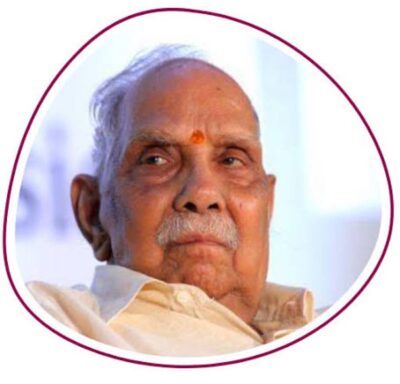
Padma Vibhushan P Parameswaran
As I look back on my own journey—from the humble room of Parameswar ji, where I first encountered the photographs of Sri Aurobindo and the Mother, to the serene surroundings of the Sri Aurobindo Ashram in Pondicherry—I realize how profoundly those early encounters influenced my understanding of India and her destiny. Parameswar ji opened the door to a world of ideas and spiritual inquiry; Sri Aurobindo and the Mother revealed the vast horizons that lay beyond.
On the sacred occasion of Sri Aurobindo’s birth anniversary, I offer my humble pranams to Sri Aurobindo, the Mother, and Parameswar ji, whose guidance first led me to their transformative vision. I warmly commend India: The Mother to every reader who seeks to understand not only the history and culture of India, but also the deeper forces that have shaped her civilization and continue to guide her future. For within these pages resonates a timeless message: that India is more than a country, more than a political entity, and more than a chapter in world history. She is a civilization with a unique spiritual mission, a continuing journey of consciousness, and, in the Mother’s luminous vision, the eternal Mother herself.
A Spiritual History of Modern India
One of the distinctive strengths of India: The Mother is its structure. The editors have arranged the Mother’s observations chronologically, enabling readers to witness not only the unfolding of modern Indian history but also the evolution of the Mother’s responses to it. The book spans nearly six decades—from 1916 to 1973—and is divided into three broad periods. The first period covers the years leading up to Indian independence and includes the Mother’s reflections on India’s spiritual mission, her collaboration with Sri Aurobindo, and her early perceptions of the forces shaping the nation’s destiny.
The second period encompasses the crucial years immediately following independence. Here the Mother grapples with the consequences of the partition of India, the challenges confronting the newly independent nation, and the opportunities opened by freedom.
The third and most extensive section records her conversations and observations during the turbulent decades from 1958 to 1973. These pages provide a fascinating commentary on Indian politics, international developments, education, culture, national security, world unity, and humanity’s future evolution.
Read consecutively, the book becomes far more than a collection of sayings. It emerges as a spiritual chronicle of modern India seen through the eyes of one of the twentieth century’s most extraordinary spiritual personalities.
Sri Aurobindo’s Five Dreams, and the Future of India
No introduction to this volume can ignore Sri Aurobindo’s historic message of August 15, 1947, delivered on the occasion of India’s independence and his seventy-fifth birthday.
The Mother repeatedly refers to the vision embodied in that message. Sri Aurobindo did not regard independence merely as a political event. He viewed it as the first step in a much larger process involving the reunification of India, the liberation of Asia, the emergence of a world union, the spiritual gift of India to humanity, and the evolution of a higher consciousness.
The book reminds readers that Sri Aurobindo’s vision was never confined to national politics. India’s freedom was important because it would enable the nation to fulfil a larger mission in the world. The Mother repeatedly returns to this theme. She saw India not as an end in itself but as an instrument for a greater transformation of humanity. India’s destiny, in her understanding, was inseparable from the destiny of the world itself.
The recurring emphasis on India’s future mission distinguishes this volume from ordinary books on nationalism. Here nationalism is transformed into a spiritual responsibility.
Independence and the Tragedy of Partition
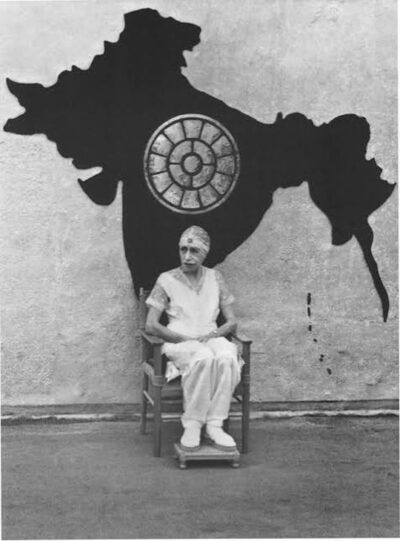
The Mother in front of a painting of Undivided India
Few events affected Sri Aurobindo and the Mother more deeply than the Partition of India. The book records their conviction that the division of the country was contrary to the deeper truth of Indian civilization. Sri Aurobindo’s famous message on Independence Day explicitly expressed the hope that the partition would not become permanent and that the unity of India would eventually be restored. He warned that a divided India would remain weakened and vulnerable. The Mother shared this perspective.
Throughout the volume, she returns to the idea that the partition represented a temporary distortion rather than a permanent reality. Political boundaries may divide territories, but they cannot erase centuries of cultural, historical, and spiritual unity.
What is remarkable is that the Mother discusses this issue not in terms of resentment or hostility but in terms of a larger historical process. She consistently looks beyond immediate conflicts and asks what deeper forces are seeking expression through events. Readers may differ regarding the practical implications of such a vision, but they cannot fail to recognize the extraordinary breadth of perspective from which she viewed history.
A Frank Assessment of Leadership
One of the more intriguing aspects of India: The Mother is the Mother’s readiness to engage with contemporary political developments and national affairs. Unlike many spiritual leaders who remained detached from public issues, she followed both Indian and international events with keen interest and remarkable attentiveness. Her observations reveal not only a deep concern for India’s destiny but also a perceptive understanding of the political and strategic challenges confronting the nation.
Particularly noteworthy are her comments surrounding the events leading up to and following the Chinese invasion of 1962. The Mother repeatedly expresses concern over India’s inadequate preparedness and what she perceived as a failure among sections of the political leadership to recognize the gravity of the emerging threat. In several conversations, she reflects on the absence of strategic foresight in national decision-making, and voices surprise that the implications of China’s actions were not more widely understood or anticipated.
The significance of these observations lies less in their political content than in what they reveal about the Mother’s broader worldview. For her, spirituality was never synonymous with disengagement from worldly affairs. Rather, she believed that a higher consciousness should inform every sphere of human endeavor, including governance, public policy, and national leadership. Consequently, these passages offer readers a rare glimpse of a spiritual thinker applying her insights to the practical challenges of statecraft, national security, and the future direction of the country.
The Chinese Challenge and National Vigilance
The chapters dealing with China rank among the most compelling and politically significant sections of the book. The Mother’s observations reveal a growing concern over developments in Tibet and the changing strategic situation along India’s northern borders. Her conversations demonstrate a keen awareness of the geopolitical implications of Chinese expansionism and the potential challenges it posed to India’s security and sovereignty. She repeatedly draws attention to the dangers confronting the nation and expresses deep anxiety over India’s vulnerability during the 1962 Sino-Indian conflict.
What lends these reflections particular weight is the fact that they were recorded contemporaneously, at a time when the full dimensions of the crisis had yet to be fully understood by many observers. Far from viewing the Chinese challenge solely through a military lens, the Mother interpreted it as a test of India’s preparedness, national resolve, and clarity of vision. These passages offer not only a historical perspective on a critical period in India’s post-independence history but also insights that continue to resonate in contemporary discussions on national security, strategic policy, and regional stability.
India’s Spiritual Mission in the Modern World
Perhaps the most enduring theme that runs through India: The Mother is the conviction that India has a distinctive and indispensable role to play in the future evolution of humanity. The Mother repeatedly argues that India’s greatest contribution to the world will not be measured in terms of political influence, military power, or economic strength. Rather, she sees India’s true significance in the realm of consciousness and spiritual knowledge.
According to the Mother, India has preserved through millennia a profound understanding of the inner dimensions of human existence—an inheritance that has become increasingly relevant in a world grappling with conflict, alienation, environmental crises and a growing sense of spiritual emptiness. While acknowledging the extraordinary achievements of modern science and technology, she cautions that material progress alone cannot provide lasting solutions to humanity’s deeper problems.
The answer, in her view, lies not in rejecting modernity but in complementing it with a higher spiritual awareness. India’s civilizational heritage, she believes, offers precisely such a possibility. Consequently, the book calls upon Indians to rediscover confidence in their cultural and spiritual inheritance and to recognise its contemporary relevance. The Mother does not advocate a retreat into the past or a nostalgic revivalism. Instead, she envisions a creative synthesis in which the wisdom of India’s ancient traditions is harmoniously integrated with the achievements of the modern age for the benefit of humanity as a whole.
At its core, this vision transcends the false choice between materialism and world-denying spirituality. The future, the Mother suggests, belongs to an integral approach that unites inner growth with outward progress and seeks the transformation of both the individual and society.
The Foundation of National Regeneration
Among the many themes explored in India: The Mother, education emerges as one of the subjects closest to the Mother’s heart. She views education not merely as a system for imparting knowledge or preparing young people for careers, but as a transformative process central to the development of both the individual and society. At the core of her educational philosophy lies the belief that every human being possesses latent capacities and higher possibilities that must be consciously nurtured and brought to fruition.
For the Mother, the true purpose of education extends far beyond intellectual training. It must foster the harmonious growth of the entire personality—physical, emotional, mental, moral and spiritual. Education should enable individuals to discover their inner potential, cultivate self-awareness and develop the qualities necessary for a meaningful and purposeful life. This holistic approach later found practical expression in the educational initiatives associated with the Sri Aurobindo Ashram and the Sri Aurobindo International Centre of Education, where learning was conceived as an integral process of self-development rather than a mere preparation for employment.
The relevance of this vision is perhaps even greater today than when it was first articulated. At a time when educational systems are increasingly driven by examinations, professional credentials, and career-oriented competition, the Mother raises fundamental questions about the broader purpose of learning. She challenges educators and policymakers to move beyond a narrow focus on academic achievement and employability and to give equal importance to character formation, creativity, self-discipline, inner growth, and wisdom. In a society where education is often measured primarily by economic outcomes, her call for a more holistic and human-centred approach remains both compelling and urgently relevant.
The Living Soul of a Civilization
The Mother’s reflections on culture constitute one of the most insightful and enduring aspects of India: The Mother. She views culture not merely as a repository of artistic achievements, social customs, or historical traditions, but as the outward expression of a civilization’s inner consciousness. In her understanding, a nation’s literature, music, philosophy, art, architecture and social institutions are reflections of its deeper spiritual and psychological life. When this inner consciousness remains vibrant and creative, culture flourishes; when it declines, cultural forms risk becoming lifeless, mechanical and disconnected from their original purpose.
Throughout the book, the Mother urges Indians to look beyond the external forms of tradition and reconnect with the living spirit that gave rise to them. While expressing deep admiration for India’s rich cultural heritage, she cautions against a nostalgic attachment to the past or the uncritical preservation of inherited practices. Tradition, she argues, should serve as a source of inspiration and continuity, providing the foundations upon which future growth and renewal can be built.
This balanced approach—respecting the past while remaining open to innovation—is a recurring feature of the Mother’s thought. She rejects both the tendency to romanticise history and the impulse towards rootless modernisation that severs a society from its cultural foundations. Instead, she advocates a creative regeneration of Indian culture rooted in enduring spiritual values yet responsive to the needs and challenges of the contemporary world.
In an era when debates over identity, heritage, and modernity often become sharply polarized, the Mother’s perspective offers a thoughtful alternative. She envisions a cultural renaissance that combines fidelity to India’s spiritual core with a willingness to embrace new ideas, thereby ensuring that tradition remains a dynamic force for growth rather than a barrier to progress.
An Experiment for Humanity
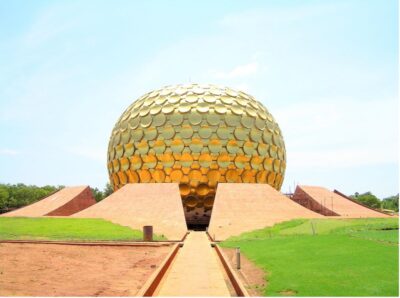
The Matrumandir, Auroville
No examination of the later sections of India: The Mother would be complete without considering the significance of Auroville, one of the most visionary initiatives associated with the Mother. Conceived not simply as a township but as an experiment in human unity, Auroville was envisaged as a place where individuals from diverse nations, cultures, religions and social backgrounds could live and work together in a spirit of harmony, cooperation and shared purpose.
For the Mother, Auroville represented far more than a physical settlement. It was intended as a living laboratory for the future—a practical experiment in creating a new way of life founded on higher values rather than divisions of race, nationality, ideology or religion. Many of the ideals that recur throughout India: The Mother—human unity, spiritual growth, international understanding, collective progress, and the evolution of consciousness—found concrete expression in this ambitious undertaking.
What makes Auroville particularly noteworthy is that it sought to move beyond philosophical discourse and translate spiritual principles into lived reality. The Mother was not content merely to advocate the ideal of human unity; she endeavoured to create an environment in which such unity could be explored, experienced and progressively realised. In this sense, Auroville stands as one of the most innovative social and spiritual experiments of the twentieth century.
Whether regarded as a visionary community, a socio-cultural experiment, or a pioneering model for future human development, Auroville remains a remarkable testament to the Mother’s faith in humanity’s capacity for growth and transformation. Within the broader framework of India: The Mother, it emerges as a natural and practical expression of her conviction that India’s spiritual heritage has a universal relevance and that the nation’s deeper mission is ultimately directed towards the welfare and evolution of all humanity.
Religion, Spirituality and the Future Evolution of Humanity
One of the enduring reasons for the global appeal of the Mother’s writings is her nuanced distinction between religion and spirituality. Throughout India: The Mother, she emphasizes that spirituality cannot be equated with adherence to a particular creed, doctrine or religious institution. While acknowledging the valuable role that religions can play in providing ethical guidance, inspiration and a sense of community, she maintains that genuine spirituality is rooted in direct inner experience and personal realisation rather than external forms of belief.
This perspective enables the Mother to transcend sectarian boundaries and address readers across cultures, faiths, and nationalities. Her vision is at once deeply spiritual and profoundly universal, drawing upon the wisdom of the world’s religious traditions without being confined by any single one of them. She recognizes the contributions of different faiths to humanity’s moral and spiritual development, yet argues that the future evolution of human consciousness requires moving beyond dogmatism, exclusivism, and the divisions that have often accompanied organized religion.
Central to the Mother’s thought is the idea that human evolution is not complete. Echoing the core insights of Sri Aurobindo’s philosophy, she presents consciousness itself as an evolving reality. Just as life emerged from seemingly inert matter, and mind evolved from life, she envisages the emergence of a higher form of consciousness that transcends the limitations of the present human condition. This evolutionary vision permeates the entire volume and provides the framework within which she interprets both individual growth and collective human progress.
Within this larger perspective, India assumes a special significance. The Mother repeatedly suggests that India’s ancient spiritual heritage and long tradition of inner exploration uniquely position it to contribute to humanity’s next stage of development. In her view, India’s deeper mission is not merely national but civilizational—to help humanity discover higher possibilities of consciousness and participate in a more harmonious and spiritually awakened future.
Why India: The Mother Matters Today
More than two decades after its publication, India: The Mother continues to resonate with striking relevance in contemporary India. The country has undergone profound transformations, marked by rapid economic growth, technological advancement, and an expanding global presence. Yet many of the fundamental questions that shape India’s civilizational journey remain unresolved. What is India’s true identity? What larger role is it destined to play in the world? Can development be sustained without a strong moral, cultural and spiritual foundation? Is material progress alone sufficient to secure national greatness?
These are the questions that lie at the heart of the Mother’s reflections. What distinguishes her approach is that she looks beyond immediate political debates, policy concerns and electoral calculations to examine the deeper forces and civilizational currents that shape the destiny of nations. Her concern is not merely with what India does, but with what India fundamentally is. She repeatedly invites readers to reflect on the essence of Indian civilisation, its historic mission, and the unique contribution it can make to humanity’s future.
The book addresses many of the issues that continue to dominate India’s public discourse—identity, education, culture, national security, social harmony, development, and the country’s place in an increasingly interconnected world. Yet the Mother approaches these subjects from a perspective rarely encountered in contemporary discussions. Rather than viewing history through the lens of ideology, political competition, or economic interests alone, she encourages readers to think in terms of civilization, consciousness, and long-term human evolution.
At a time when public debate is often consumed by short-term controversies and immediate concerns, India: The Mother offers a broader and more enduring vision. It challenges readers to view India not merely as a modern nation-state but as a civilization with a deeper purpose and responsibility. Whether or not one agrees with all of the Mother’s conclusions, the intellectual seriousness, spiritual depth, and civilizational perspective that inform her reflections make this a work of lasting significance. More than a historical document, it remains a thought-provoking and rewarding guide for anyone seeking to understand India’s past, present, and future in a larger and more meaningful context.
A Book for Every Indian
India: The Mother defies easy categorization. It is at once a spiritual testament, a commentary on modern Indian history, a reflection on national and international affairs, a civilizational discourse, and a compelling record of the Mother’s deep engagement with India’s destiny and humanity’s future. Few books succeed in bringing together such diverse dimensions within a single volume while maintaining a coherent and unifying vision.
For students of Indian history, the book offers a distinctive perspective on many of the defining events of the twentieth century, viewed not merely through political or historical lenses but through a broader civilizational and spiritual framework. Admirers and students of Sri Aurobindo will find valuable insights into how the Mother interpreted, extended, and applied his vision to the evolving challenges of the modern world. Those interested in India’s cultural and spiritual heritage will encounter a powerful affirmation of the nation’s larger mission, while spiritual seekers will discover reflections capable of enriching their own inner quest.
At the same time, the book remains accessible to the general reader. The Mother’s observations are marked by clarity of thought, intellectual independence, and a profound concern for humanity’s future. Her reflections invite readers to look beyond surface events and engage with the deeper questions of consciousness, culture and civilisation.
This is not a book that yields all its riches at a single reading. It rewards careful study, reflection and repeated engagement. Much like the writings of Sri Aurobindo himself, its deeper meanings often unfold gradually, revealing new insights with each return to its pages. For that reason, India: The Mother is best approached not merely as a book to be read and set aside, but as a work to be revisited, contemplated upon, and absorbed over time.
The Mother and the Soul of Bharat
As I bring this introduction to a close, my thoughts inevitably return to that modest room of Parameswar ji where I first noticed the photographs of Sri Aurobindo and the Mother and asked a simple, almost casual question: “Who are they?” Looking back, it is remarkable how that brief exchange set in motion a spiritual and intellectual journey that has continued for decades. At the time, I could scarcely have imagined that my early struggles to comprehend even a single page of Sri Aurobindo’s writings would eventually lead me to the Sri Aurobindo Ashram in Pondicherry, to countless pilgrimages, and to a lifelong engagement with one of the most profound spiritual visions of modern India.
Within that journey, India: The Mother occupies a special and cherished place. More than a collection of conversations, messages, and reflections, it is a penetrating exploration of India’s civilizational identity and spiritual destiny. Throughout the volume, the Mother reminds readers that India is far more than a modern nation-state. She is a living civilization, shaped and sustained by millennia of spiritual quest, cultural creativity, and philosophical inquiry. Her true stature, the Mother suggests, cannot be measured solely through economic indicators, military capabilities, or political achievements. Rather, it lies in her capacity to preserve and transmit a deeper understanding of life, consciousness, and human fulfilment.
The Mother viewed India not as a civilization burdened by its past, but as one uniquely equipped to contribute to humanity’s future. She believed that the next stage of human progress would depend upon the successful integration of material advancement with spiritual wisdom, scientific achievement with inner growth, and external development with the evolution of consciousness. In that larger endeavor, she saw India as having a vital and historic role. The spiritual resources accumulated through centuries of seeking, she believed, would enable India to offer humanity a path towards a more harmonious, enlightened, and integrated future.
Whether approached as a work of history, a reflection on national destiny, a spiritual document, or a civilizational discourse, India: The Mother leaves a lasting impression upon the thoughtful reader. It challenges, inspires, and, above all, invites deeper reflection on the meaning of India and her place in the world.
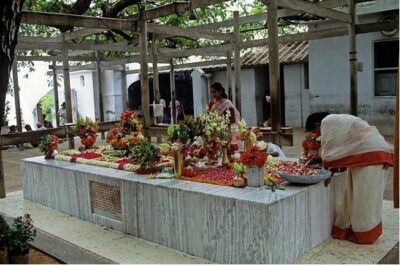
Samadhi of Sri Aurobindo and The Mother, Pondicherry
For those who seek to understand the deeper currents shaping India’s past, present and future, India: The Mother is far more than a book to be read once and placed on a shelf. It is a work to be reflected upon, revisited, and absorbed over time. For within its pages resonates not merely the voice of the Mother, but the enduring spirit of a civilization that continues to inspire humanity’s search for truth, harmony, and higher consciousness. In that sense, this volume is not simply about India—it is an invitation to encounter the very soul of Bharat.
