
From Colonial Prohibition to National Honor: Why Did Vande Mataram Take 79 Years to Reach the Red Fort?
Image courtesy: Vishwa Samvada Kendra
Begin with the gap, not the anthem. On 15 August 2026, as Narendra Modi reached the Red Fort ramparts for his thirteenth Independence Day address, an Army band did something no government had arranged in seventy-nine years of the ceremony: it played Vande Mataram before the flag rose and before Jana Gana Mana sounded (Government of India, Ministry of Defence, 2026; Business Today, 2026). Nothing about the song was new: the British jailed schoolchildren for chanting it in 1905, freedom fighters carried it to the gallows as a slogan, and the Constituent Assembly opened its Assumption of Power ceremony with it on the eve of independence. What was new in 2026 was letting the song stand where Tagore’s Jana Gana Mana alone had always stood — at the ceremony’s centre. This is less a story of forgetting and remembering than of how a plural republic decided, and re-decided, what a shared song is permitted to mean.
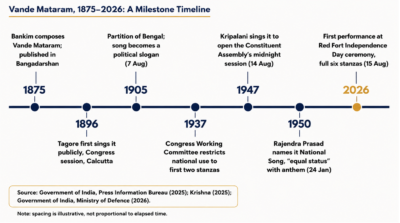
Bankim Chandra Chattopadhyay wrote Vande Mataram in 1875 and published it in Bangadarshan, his own journal, before folding it into Anandamath, his 1882 novel (Government of India, 2025). The song imagines the nation as mother — rivers, harvests, moonlit nights — and only in later verses does that mother acquire a goddess’s iconography. Tagore, who set the words to his own tune, first sang it publicly at the 1896 Congress session in Calcutta (Now Kolkata). Political charge came fast: on 7 August 1905, students marched on Calcutta’s town hall against Curzon’s partition of Bengal, chanting the phrase, turning a literary refrain into a slogan almost overnight (Government of India, 2025). The colonial state answered with bans on chanting in Barisal, fines on Rangpur schoolchildren, and lathi charges in Belgaum — repression that only sharpened its currency (Government of India, 2025). By 1907, Bhikaji Cama had stitched the words onto a tricolour and raised it over Stuttgart, the first Indian flag on foreign soil.
Here the story gets complicated. The song’s later stanzas, largely absent from the marching-song version of the Swadeshi years, invoke the motherland as Durga and Lakshmi — a Shakta idiom that some Muslim leaders, and by the 1930s the Muslim League formally, found hard to reconcile with a shared national ritual. This was not simple communal friction, whatever the shorthand suggests. Nehru’s correspondence with Subhas Chandra Bose, ahead of the Congress Working Committee’s 1937 deliberations, shows a leadership sorting manufactured outrage from real discomfort: he judged the agitation stoked “to a large extent” by communalists, yet conceded real substance underneath, and insisted Congress answer genuine grievance rather than merely placate noise (Krishna, 2025). Tagore, consulted directly, recommended confining the national use of the anthem to the first two stanzas; his letter, according to historian Sabyasachi Bhattacharya, shaped the resolution almost entirely (Bhattacharya, 2003; Krishna, 2025). The Committee also noted something easy to miss: Vande Mataram had never been formally adopted as anyone’s anthem. It was already a symbol without fixed office; the compromise left its status as ambiguous, and as revered, as before.
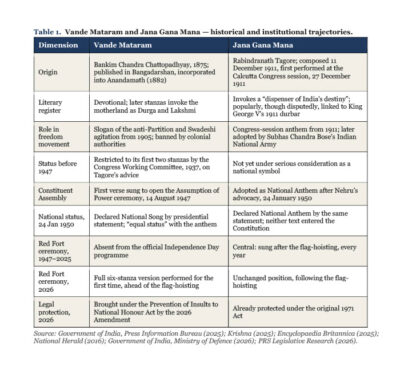
That ambiguity travelled into the Republic. On the night of 14 August 1947, Sucheta Kripalani opened the Constituent Assembly’s Assumption of Power ceremony singing the song’s first verse (Krishna, 2025), and yet the choice of national anthem stayed unresolved for two more years, debated by members who found Jana Gana Mana too Bengali in idiom, or — less noted — uncomfortably close to a 1911 tribute timed to King George V’s Delhi durbar (Encyclopaedia Britannica, 2025; Krishna, 2025). Nehru pushed for Jana Gana Mana on practical grounds: its tune, he told the Assembly, had impressed foreign orchestras and military bands, whereas Vande Mataram was judged less exportable in instrumental form (National Herald, 2016). On 24 January 1950, Rajendra Prasad settled the matter by presidential statement, not vote: Jana Gana Mana would be the anthem, Vande Mataram would hold “equal status” with it, honoring its role in the freedom struggle (Government of India, 2025). Neither text entered the Constitution; both rest on convention, not law — precisely why one could occupy the Red Fort for seventy-nine years while the other waited outside. Post-apartheid South Africa faced a similar dilemma and chose fusion, splicing its two rival anthems into one 1997 hybrid (South African Government, n.d.); India chose separation instead, leaving both symbols standing, unranked.
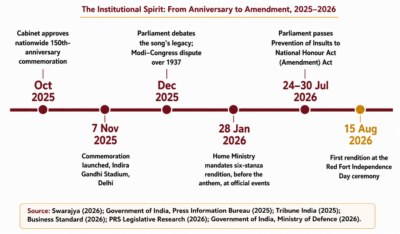
The Red Fort moment did not spring from nowhere; it was the final act of a deliberate, year-long sequence, not a spontaneous gesture of remembrance. Cabinet approval in October 2025 financed a nationwide commemoration of the song’s 150th year, launched at Delhi’s Indira Gandhi Stadium on 7 November with a commemorative stamp and coin (Swarajya, 2026; Government of India, 2025). A Lok Sabha debate followed in December, in which Prime Minister Modi asserted the 1937 abridgement had “sown the seeds of Partition” — a claim Congress rejected within hours, citing Tagore’s own letter as proof the decision was collective and principled, not appeasing (Tribune India, 2025; Krishna, 2025). The disagreement hardened into policy. A Home Ministry order of 28 January 2026 mandated the full six-stanza version at official functions nationwide, the song preceding the anthem wherever both appear (Business Standard, 2026). By July, Parliament had passed the Prevention of Insults to National Honour (Amendment) Act, 2026, extending to Vande Mataram the protection already given the anthem, with penalties of up to three years for intentional disruption (PRS Legislative Research, 2026). The DMK’s Kanimozhi called the compulsion majoritarian and warned it betrayed the pluralist spirit of 1937; the government’s reply, via Minister of State Nityananda Rai, was that the song had waited long enough for its due (Telangana Today, 2026). Both claims, read narrowly, are defensible. Neither is the whole truth.
Is the 2026 restoration a reinterpretation or political assertion dressed as an anniversary celebration? These are not competing explanations so much as layers of one event. Institutionally, the change is real and traceable, not merely rhetorical. Historically, the claim that the 1937 events caused the Partition of India strains against the record: Bhattacharya’s study and the Working Committee’s own minutes describe a leadership negotiating, not capitulating (Bhattacharya, 2003). Politically, the timing — a milestone anniversary, an election cycle, a government keen to fuse cultural nationalism with its “Viksit Bharat” development narrative — is not incidental. What a purely celebratory account would miss is this: the 1937 and 1950 settlements were not oversights but considered accommodations, and they held for three-quarters of a century without formal revision. That the state has now chosen, by law, to resolve an ambiguity earlier generations left deliberately open is itself the story — not proof that those generations failed to notice the song, but evidence this one has decided ambiguity is no longer the price worth paying for consensus.
So, why wait for seventy-nine years? Because the distance between the Red Fort and Vande Mataram was never a gap in memory. It was the architecture of a compromise built to let a devotional, explicitly religious hymn and a constitutionally secular republic share one country without either having to yield entirely. What changed in 2026 is not what India remembers of its freedom struggle, but how insistently, and how legally, it has now chosen to say so aloud.
References
- Bhattacharya, Sabyasachi. 2003. Vande Mataram: The Biography of a Song. New Delhi: Penguin Books India.
- Business Standard. 2026. “Govt Mandates 6-Stanza Version of Vande Mataram at Official Events.” Business Standard, February 11, 2026. https://www.business-standard.com/india-news/vande-mataram-national-anthem-national-song-events-126021100222_1.html.
- Business Today. 2026. “Independence Day Celebrations 2026: ‘Vande Mataram’ Played for First Time at Red Fort. Here’s Why It Matters.” Business Today, August 15, 2026. https://www.businesstoday.in/india/story/independence-day-celebrations-2026-vande-mataram-played-for-first-time-at-red-fort-heres-why-it-matters-549361-2026-08-15.
- Encyclopaedia Britannica. 2025. “Jana Gana Mana.” Encyclopaedia Britannica Online. Accessed August 16, 2026. https://www.britannica.com/topic/Jana-Gana-Mana.
- Government of India, Press Information Bureau. 2025. “150 Years of Vande Mataram: A Melody That Became a Movement.” PIB Backgrounder, November 6, 2025. https://www.pib.gov.in/PressNoteDetails.aspx?NoteId=155910&ModuleId=3®=48&lang=2.
- Government of India, Ministry of Defence. 2026. “Independence Day Celebrations 2026 to Honour ‘150 Years of Vande Mataram’ & ‘Yuva Shakti for Viksit Bharat@2047.’” Press Information Bureau, August 10, 2026. https://www.pib.gov.in/PressReleasePage.aspx?PRID=2297232®=48&lang=2.
- Krishna, Vineeth. 2025. “Between Reverence and Controversy: Vande Mataram in India’s Constitutional History.” Centre for Law and Policy Research (blog), December 17, 2025. https://clpr.org.in/blog/blog-between-reverence-and-controversy-vande-mataram-in-indias-constitutional-history/.
- National Herald. 2016. “Nehru and the National Anthem.” National Herald, November 17, 2016. https://www.nationalheraldindia.com/time-prism/nehru-and-the-national-anthem.
- PRS Legislative Research. 2026. “The Prevention of Insults to National Honour (Amendment) Bill, 2026.” Bill Track. Accessed August 16, 2026. https://prsindia.org/billtrack/the-prevention-of-insults-to-national-honour-amendment-bill-2026.
- South African Government. n.d. “National Anthem.” Accessed August 16, 2026. https://www.gov.za/about-sa/national-anthem-0.
- Swarajya. 2026. “New Protocol Elevates Vande Mataram with Six-Stanza Requirement at Government Ceremonies.” Swarajya. https://swarajyamag.com/news-brief/new-protocol-elevates-vande-mataram-with-six-stanza-requirement-at-government-ceremonies.
- Telangana Today. 2026. “Parliament Passes Bill Making Insult to Vande Mataram a Punishable Offence.” Telangana Today, July 30, 2026. https://telanganatoday.com/parliament-passes-bill-making-insult-to-vande-mataram-a-punishable-offence.
- Tribune India. 2025. “Key Vande Mataram Stanzas Dropped in 1937, Says Modi.” The Tribune, November 7, 2025. https://www.tribuneindia.com/news/india/key-vande-mataram-stanzas-dropped-in-1937-says-modi.
