
Artha Before Moksha: Why India Cannot Skip the Rung of Prosperity
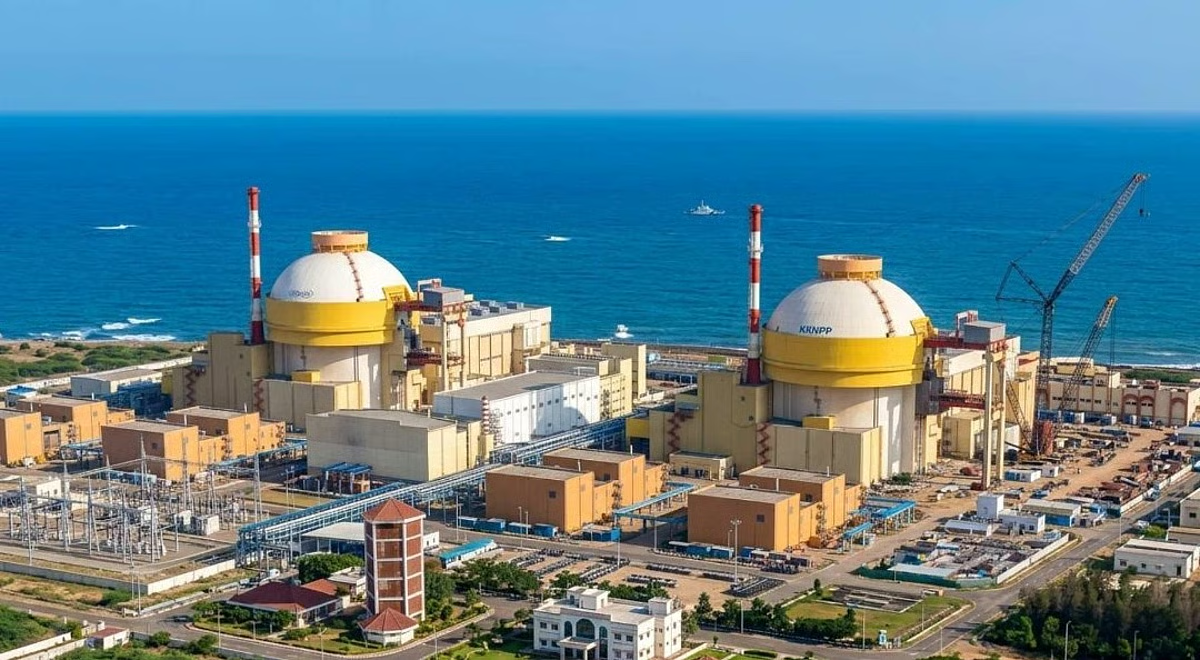
Image Courtesy: NewsGram
Editor’s note: This article was originally published by The Khyat Institute and is reprinted here (with minimal edits) with their permission.
From Chanakya to Vivekananda, the tradition put wealth beneath dharma, not in place of it. We turned the ladder upside down.
Abstract
Indian tradition placed prosperity beneath dharma, not in its place. The Chanakya Sutra roots dharma in artha; the Hitopadesha puts wealth between worthiness and dharma; the ashrama system sequenced renunciation after the householder’s debts were paid; Vivekananda held that restraint is a virtue only in those strong enough to choose otherwise. This brief argues that India after independence inverted that order, renaming poverty as simplicity, and that the inversion hardened into an industry of obstruction, as Kudankulam and Sardar Sarovar show. It also takes up the strongest objection, that the same principle forbids engineering away the climb to Kedarnath, and offers a tentative answer.
In May 1780, John Adams was in Paris, surrounded by the gardens of Versailles, and he refused to write to his wife about them. He had no time for statuary, he told Abigail. His duty was the science of government. Then he wrote the most quoted lines of his career: he must study politics and war so that his sons could study mathematics, philosophy, navigation, commerce and agriculture, so that their children would have the right to study painting, poetry, music and architecture.[1]
A detail rarely mentioned is that Adams first wrote that his sons would study “Painting and Poetry,” then struck it out and pushed the arts down by one more generation.[2] Even in a private letter, he corrected himself. The arts do not come one generation after security. They come two.
That small correction contains the argument of this essay. Prosperity is not the final goal of a civilization. It is the rung you cannot skip. Culture, civility, aesthetics, and even renunciation sit above it, and every attempt to reach them without first standing on it has failed, in India more expensively than almost anywhere.
The Ladder we Already Built
Indians do not need an American founder to teach them this. The sequence is written into our oldest texts on statecraft.
The Chanakya Sutra opens with a chain: the root of happiness is dharma, the root of dharma is artha, the root of artha is the state, and the root of the state is mastery of the senses.[3] Sukhasya mūlaṃ dharmaḥ, dharmasya mūlam arthaḥ. Dharma does not float free of material conditions. It grows from them.
The Hitopadesha, the book Indian children were taught to read from for centuries, makes the same point in its opening verses: learning gives humility, humility gives worthiness, worthiness brings wealth, from wealth comes dharma, and from dharma, happiness.[4] Dhanād dharmaṃ tataḥ sukham. Wealth sits in the middle of the chain. It is not the top. It is also not optional.
There is a subtlety here that the slogan “want less” usually misses. In Chanakya’s chain, sense-control (indriyajaya) is not what replaces wealth. It is the foundation of wealth, because it is what makes a state possible. Restraint is how a society produces prosperity, not a substitute for having any. A civilization that preaches wanting less instead of building more has misread its own manual.
The same logic governed the individual life. The ashrama system did not ban renunciation. It sequenced it. The Manusmriti is blunt: only after paying the three debts should a man turn his mind toward liberation, and one who seeks liberation without paying them goes downward.[5] Sannyasa was the last stage of life, not a way out of the second.
The Bhagavata Purana tells this as a story. When the sage Narada persuades Prajapati Daksha’s sons to renounce the world before they have taken up their household duties, Daksha curses him. His complaint is not that renunciation is false. It is that his sons were taken to it before they had earned it.[6] The tradition understood that a society of premature ascetics produces neither good ascetics nor a functioning society.
The Modern Restatement
Swami Vivekananda, the most important Hindu voice of the modern era, came back to this sequence again and again.
At the Parliament of Religions in Chicago in 1893, he scolded the missionaries in the audience for building churches in India while millions starved. The crying need of the East, he said, was not religion, of which it had plenty, but bread. “It is an insult to a starving people to offer them religion; it is an insult to a starving man to teach him metaphysics.”[7]
In Karma-Yoga he goes further, and his argument is the exact structure of this essay. Non-resistance, he grants, is the highest ideal. But a man who does not resist because he is weak commits a sin. Only the man who could strike, and chooses not to, practises a virtue. “Then only, when he has gained the power to resist, will non-resistance be a virtue.”[8]
Replace “non-resistance” with “simplicity,” “frugality” or “harmony with nature,” and the principle holds. Restraint is a virtue only when it is chosen by someone who could do otherwise. When poverty is renamed simplicity, it is not a virtue. It is a misfortune given a nicer name.
Nietzsche, from a very different starting point, put it more harshly: the good is whatever heightens the feeling of power in man, and the bad is whatever comes from weakness.[9] One does not have to accept the rest of his philosophy to see the point. A morality that turns weakness into a virtue will, in time, produce more weakness.
How We Inverted It
Somewhere between independence and liberalization, India turned the ladder upside down.
Poverty was romanticized as authenticity. Self-sufficiency was preached to villages that had no surplus to be self-sufficient with. “Small is beautiful” became an article of faith for a country that had not yet built anything big. Too many of our intellectual elites, comfortable themselves, came to see the poor man’s aspiration for a pucca house, a motorcycle, electricity, and a job in a factory as a kind of cultural corruption.
This inversion was not only an idea. It became an industry.
Kudankulam
In February 2012, Prime Minister Manmohan Singh, an economist and a Congress prime minister, not a nationalist firebrand, told Science magazine that the protests stalling the Kudankulam nuclear plant were driven by NGOs, “often funded from the United States and the Scandinavian countries.”[10] His office went further in the days after: the Minister of State in the PMO said foreign-funded NGOs had sent money to groups near the plant.[11]
The state acted on it. Home Minister P. Chidambaram announced cases against four NGOs for prima facie diverting foreign funds from their declared purpose, two of them referred to the CBI.[12] A German national on a tourist visa was deported for activities the government said were inconsistent with that visa.[13]
Some of this was contested. The protest leaders sent the Prime Minister a legal notice,[14] and the deported German’s role was later disputed in the press.[15] The Institute does not claim every allegation was proven. Our claim is narrower and harder to dismiss: a sitting Congress Prime Minister, briefed by his own Home Ministry, concluded that foreign-funded networks were obstructing India’s energy security, and his government acted on that conclusion.
Kudankulam Unit 1 went into commercial operation at the end of 2014, years behind schedule, and now supplies the southern grid.[16] Every year of delay was a year of coal burned, diesel generators run, and factories not built in Tamil Nadu.
The Pattern
Two years later, in June 2014, an Intelligence Bureau report to the Prime Minister’s Office alleged that a significant number of Indian NGOs, funded by donors in the US, UK, Germany, the Netherlands and Scandinavia, were using people-centric issues to stall projects across seven sectors, from nuclear and coal power to mining and farm biotechnology.[17] It put the cost at 2–3% of GDP a year.
That number should be treated with caution. The report never explained how it was calculated, and economists said so at the time.[18] But the pattern it described, in which foreign money funds local organizations whose field reports are then used to raise the issue in international forums, is consistent with what the previous government had found at Kudankulam on its own. Two governments of opposite parties reached the same diagnosis.
Narmada
The Sardar Sarovar dam is the clearest before-and-after case in Indian development.
For three decades, the Narmada Bachao Andolan fought the dam. It brought in international pressure, and in 1993, after an independent review it had pushed for, the World Bank withdrew.[19] Construction stalled for years while the case went through the Supreme Court. In October 2000, the Court allowed construction to continue under the Tribunal award, provided rehabilitation kept pace with dam height.[20]
Look at what the dam then did. In 2019, during one of Gujarat’s worst droughts, the state was supplying Narmada water to 8,911 villages, 165 towns and six cities through the canal network. Most other reservoirs in the state had almost run dry.[21] The Kutch Branch Canal, completed in 2022, brought Narmada water to a district that had depended on tankers and trains to drink.[22]
The Institute accepts that the displacement was real, that rehabilitation was often late and sometimes unjust, and that the courts were right to insist on it. Critics have also documented, with justification, that canal completion lagged for years and that industry sometimes received water before farmers did.[23] These are arguments for building better. They are not arguments for not building at all. The Andolan’s goal was not a better dam. It was no dam.
This is the distinction that matters. There are villagers with real grievances about land, compensation, and resettlement. And there are professional activist networks, some foreign-funded, that take over those grievances and redirect them toward a goal the villagers never chose: stopping the project entirely. The first deserve a hearing and a fair deal. The second deserve scrutiny.
Sanskriti and Adhunikta
None of this is an argument for abandoning culture in favor of concrete. It is an argument about order.
Sanskriti and adhunikta, culture and modernity, are not opponents. The temple towns of the Cholas were built by a state that collected revenue, ran irrigation works and sent navies across the Bay of Bengal. The aesthetics followed the prosperity. They always have.
Development will cost something. Some trees will be cut. Some rivers will be redirected. Some valleys will fill with concrete that is not beautiful. A serious country says this openly instead of pretending growth can be painless. Adams did not pretend that studying war was as pleasant as studying porcelain. He simply knew which had to come first.
Civility, too, follows prosperity. Patience in queues, care for public spaces, the luxury of caring about the aesthetics of a building rather than whether it has a roof: these are the habits of people who are no longer anxious about tomorrow’s meal. Lecturing a poor society on civility while denying it the means of prosperity is like Adams’s grandchildren demanding porcelain before anyone had won the war.
The counterargument
The Strongest Objection: Material Spiritualism
Here the Institute must argue against itself, and the objection is serious.
Consider Kedarnath. The traditional pilgrimage is a hard trek of roughly 16 km uphill from Gaurikund, made on foot, on ponies or in palanquins.[24] For centuries, its difficulty was not an inconvenience waiting to be engineered away. It was the point. The yatra was a test. Only the committed reached the Jyotirlinga, and arriving meant something because the climb had cost something.
Today you can fly there by helicopter. In March 2025, the Union Cabinet approved a ropeway from Sonprayag that will cut the one-way journey from eight or nine hours to about 36 minutes, with capacity for 18,000 passengers a day.[24] Compare that with the daily limit of 5,000 pilgrims recommended by a Supreme Court-appointed committee after the 2013 floods,[25] which killed more than 6,000 people in a valley already under strain from unregulated construction.[26] In June 2025, a helicopter returning from the shrine crashed in poor visibility and killed all seven people on board, the fifth helicopter accident on the Char Dham route that season.[27] The widening of the Char Dham highways went all the way to the Supreme Court, which allowed it in 2021 largely on defence grounds, over serious warnings about landslides.[28]
The ecological case is real, but the deeper objection is about meaning. Taking a helicopter to Kedarnath is like being flown to the summit of Everest and then writing your name next to Tenzing Norgay’s. You have been to the place. You have not made the journey. Call this material spiritualism: consuming the sacred as a destination while skipping the discipline that made it sacred.
Notice what this objection does. It does not come from outside our argument. It comes from inside it. This essay has argued that you cannot skip the rung: artha before dharma, grihastha before sannyasa, strength before restraint. A helicopter to the dham is skipping the rung. The same principle that demands dams and reactors in the plains seems to forbid ropeways at the summit.
There is also a counter to the objection, and it should be stated honestly. The yatra was never purely a test of personal strength. The elderly, the sick and the wealthy have been carried up in palkis and dandis by local porters for as long as there have been pilgrims, and the porters’ families lived off that trade. Development at the dhams feeds local people now, as the pilgrim economy always did. So the real question is not whether anyone should be helped up the mountain. It is at what point help hollows out the meaning of arriving.
The Hitopadesha, the same text that told us wealth comes before dharma, also asks where the greedy, running here and there after wealth, could find the happiness of the calm mind sated with the nectar of contentment.[29] The tradition held both ideas at once. It did not think them contradictory, because it put them in sequence and in place.
The Institute’s tentative answer is the same principle applied to geography rather than to a life. Build the road to the valley. Build the dam, the reactor, the canal, and the factory in the plains, without apology. But leave the last ascent to the feet. Some places should stay hard to reach, not because the people cannot afford to build there, but because a prosperous people can finally afford to choose not to. That, too, is restraint chosen from strength, Vivekananda’s non-resistance applied to a mountain.
We are not certain this answer is right. We are certain the question deserves better than either the activist who opposes every road or the planner who thinks every summit needs a gondola.
The Rung We Keep Skipping
Adams studied war so his grandchildren could study porcelain. Chanakya placed artha beneath dharma. Manu put the householder before the renunciant. Vivekananda told a hall full of missionaries that India needed bread before sermons.
The lesson does not change across these sources. Prosperity is not the highest goal. It is the rung everything higher stands on. A civilization that tries to jump straight to renunciation, to ecological purity, to cultural refinement, without first building a broad, durable prosperity, will not get those higher things. It will stay where it started, poor, and lecturing itself about virtue.
India has spent too long admiring the top of the ladder from the bottom. It is time to climb.
Notes
- John Adams to Abigail Adams, post 12 May 1780. Text via New England Historical Society: https://newenglandhistoricalsociety.com/john-adams-writes-to-abigail-i-must-study-politicks-and-war ; catalogue entry, Massachusetts Historical Society: https://masshist.org/adams-resources/slipfile/single_slip_viewer.php?id=022863
- On the struck-out “Painting and Poetry”: Michael Molinsky, “Quotations in Context: Adams,” MAA Convergence: https://old.maa.org/press/periodicals/convergence/quotations-in-context-adams
- Chanakya Sutra 1.1–1.4. Sanskrit and Hindi gloss via Veer Narmad South Gujarat University, Dept. of Economics newsletter: https://vnsgu.ac.in/uploads/assetlinks/47020f45-5dc7-48e0-a8e5-099884bca74c.pdf; English rendering of the opening sutras: https://www.ahymsin.org/2017/02/
- Hitopadesha, Prastavika (introduction), verse 6, vidyā dadāti vinayaṃ…: https://de.wisdomlib.org/hinduism/book/hitopadesha-sanskrit/d/doc276459.html
- Manusmriti 6.35, ṛṇāni trīṇyapākṛtya mano mokṣe niveśayet: https://enjoylearningsanskrit.com/scriptures/manu-smriti/chapter-6/verse-35
- Bhagavata Purana 6.5.37 (Daksha’s complaint against Narada): https://vedabase.io/en/library/sb/6/5/37/
- Swami Vivekananda, “Religion not the crying need of India,” Parliament of Religions, Chicago, 20 September 1893: https://vivekananda.net/booksbyswami-completeworks-4-religionnotcryingneed; background: https://en.wikipedia.org/wiki/Religion_not_the_crying_need_of_India
- Swami Vivekananda, Karma-Yoga, ch. II, “Each is great in his own place,” Complete Works vol. 1: https://en.wikisource.org/wiki/The_Complete_Works_of_Swami_Vivekananda/Volume_1/Karma-Yoga/Each_is_great_in_his_own_place
- Friedrich Nietzsche, The Antichrist, §2 (Mencken trans.): https://monadnock.net/nietzsche/antichrist-2.html
- World Nuclear News, “Singh: Foreign groups behind anti-nuclear protest,” Feb 2012: https://world-nuclear-news.org/Articles/Singh-Foreign-groups-behind-anti-nuclear-protest
- The Tribune, 25 Feb 2012: https://www.tribuneindia.com/2012/20120225/main2.htm
- Deccan Herald, “German’s activities were inconsistent with tourist visa”: https://www.deccanherald.com/content/230942/germans-activities-were-inconsistent-tourist.html
- Deccan Herald / IANS, 28 Feb 2012: https://www.deccanherald.com/amp/story/india%2Fgerman-deported-anti-kudankulam-activist-2316249; UCA News: https://www.ucanews.com/news/officials-deport-german-as-ngos-charged/43845
- Eco-Business, “Kudankulam nuke plant: Protesters send notice to Manmohan Singh”: https://eco-business.com/news/kudankulam-nuke-plant-protesters-send-notice-to-manmohan-singh
- Tehelka, 29 Feb 2012, archived at South Asia Citizens Wire: https://www.sacw.net/article2566.html
- CAG Report No. 38 of 2017, Performance Audit on KKNPP Units I and II, ch. 1: https://www.cag.gov.in/uploads/download_audit_report/2017/Chapter_1_Introduction_of_Report_No.38_of_2017_-_Performance_Audit_on_Kudankulam_Nuclear_Power_Project,_Units_I_and_II_Department_of_Atomic_Energy.pdf ; World Nuclear News: https://wnn.world-nuclear.org/articles/india-and-russia-celebrate-commissioning-of-kudank
- Original report: “NGO activism against development projects in India — a review,” Intelligence Bureau / MHA, June 2014, full PDF archived at NYU Libraries: https://archive.nyu.edu/handle/2451/40704; first reported by Amitav Ranjan, Indian Express, 7 June 2014, “Foreign-aided NGOs are actively stalling development, IB tells PMO in a report”: https://indianexpress.com/article/india/india-others/foreign-aided-ngos-are-actively-stalling-development-ib-tells-pmo-in-a-report/; summary of contents: https://www.thenewsminute.com/news/intelligence-bureau-report-ngos-and-what-it-says-21256
- Outlook, “War And Green Peace,” 30 June 2014: https://www.outlookindia.com/national/war-and-green-peace-news-291130; AP via WTOP: https://new.wtop.com/?p=105343
- Bretton Woods Project, 2017: https://www.brettonwoodsproject.org/2017/10/controversial-sardar-sarovar-project-dam-set-to-displace-thousands/ ; Swarthmore Global Nonviolent Action Database: https://nvdatabase.swarthmore.edu/index.php/node/2820
- Narmada Bachao Andolan v. Union of India, (2000) 10 SCC 664, as summarised in the 2005 judgment: https://www.legitquest.com/case/narmada-bachao-andolan-v-union-of-india/67d; IELRC copy: https://ielrc.org/content/c0503.pdf; archival note on the 1994–99 stay: https://catalogue.archives.ncbs.res.in/repositories/2/archival_objects/11129
- The Quint, Gujarat Dy CM Nitin Patel on Narmada supply, 2019: https://www.thequint.com/amp/story/news/india/gujarat-govt-assures-water-available-in-sardar-sarovar-till-july-end; India Environment Portal: https://indiaenvironmentportal.org.in/news-clippings/gujarat-facing-massive-water-crisis
- Kutch Branch Canal explainer (summarising Indian Express): https://iasgyan.in/daily-current-affairs/kutch-branch-canal; original: https://indianexpress.com/article/explained/kutch-branch-canal-pm-modi-inaugurate-8115418/; historical context on water trains to Saurashtra: https://ielrc.org/content/c9101.pdf
- The Quint, “Drought-hit Gujarat has water for factories but not for farmers”: https://www.thequint.com/news/environment/drought-hit-gujarat-has-water-for-factories-but-not-for-farmers; on CAG drinking-water coverage findings: https://countercurrents.org/upadhyaya071007.htm
- The Tribune / ANI, 5 Mar 2025: https://www.tribuneindia.com/news/business/cabinet-clears-kedarnath-ropeway-to-cut-travel-time-from-8-9-hours-to-36-minutes; Deccan Herald: https://www.deccanherald.com/india/uttarakhand/centre-approves-kedarnath-and-hemkund-sahib-ji-ropeway-projects-worth-rs-6811-crore-3433183
- Scroll / Dialogue Earth, “A decade after the devastating Kedarnath floods, is the fragile region any safer?”: https://scroll.in/article/1054308/a-decade-after-the-devastating-kedarnath-floods-is-the-fragile-region-any-safer
- Dialogue Earth: https://dialogue.earth/en/climate/a-decade-after-the-floods-is-kedarnath-safer/
- PTI via The Week, 15 June 2025: https://www.theweek.in/wire-updates/national/2025/06/15/del55-ukd-5thld-crash.html; The Tribune: https://www.tribuneindia.com/news/uttarakhand/helicopter-crashes-near-kedarnath-shrine-in-uttarakhand-all-7-on-board-killed
- BOOM Live, 14 Dec 2021: https://www.boomlive.in/law/supreme-court-char-dham-environment-16016 ; Deccan Herald editorial: https://www.deccanherald.com/amp/story/opinion%2Feditorial%2Fconcerns-remain-over-fragile-ecosystem-1065273.html ; Down To Earth critique: https://www.downtoearth.org.in/environment/when-the-himalayas-lose-assessing-char-dham-pariyojana-judgment-80755
- Hitopadesha 1.137, santoṣāmṛta-tṛptānāṃ…: https://de.wisdomlib.org/hinduism/book/hitopadesha-sanskrit/d/doc276636.html
