
Hanuman Ansh has Something Malhotra’s “Ravanya” Does not Have: A Soul
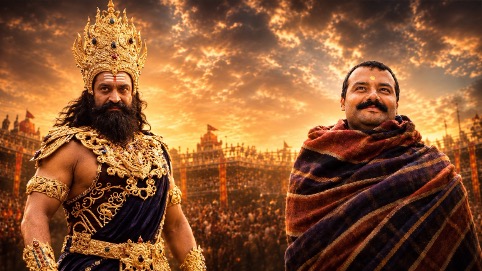
AI images courtesy of the author
The Ramayana is close not only to my heart but to the hearts of millions. There are numerous interpretations and adaptations of the Ramayana across Asia, with around 300 known versions and adaptations.
To me, the most special Ramayana will always be the one a mother tells her child. That is the first Ramayana a child comes to know. Through that story, a mother introduces the child to her own moral system, her worldview, her prejudices, and her virtues.
As the child grows up, it encounters the Ramayana in school textbooks, in books written by different authors, on television, and in temples. In some versions, there is an element of Bhakti; in others, an element of politics is attached, while some offer an exploration of human psychology.
Yet, the essence of the Ramayana remains the same.
That is why I believe the concept of a thali (plate of food) is such a beautiful analogy. In India, we have different variations of food, different preparations and different flavours, yet all of them are made with love.
That is why, no matter the structure, the language, or the medium, whether it is songs, bhajans, movies, television serials, or books, if the intention is pure and the essence is preserved, the Ramayana being told will always touch the heart.

Hari Anant, Hari Katha Anant
With this in mind, let us consider Namit Malhotra’s Ramayana. Or, as I like to call it, Ravanya. There are many faults with this Ramayana, but the biggest mistake, from which almost everything else stems, is its wrong intention and distorted essence.
This film is not made for the Indian audience. Its intention seems to be to seek external validation from the “gori chamdi” (“white-skinned”) in the West. And from this impure intention stems the title “Ravanya” and a doomsday-like depiction of the Ramayana, where Gods are no longer Gods but superheroes, and Ravana is portrayed as a Doomsday-level villain. A villain who, ironically, is not really a villain but a misunderstood hero.
If this attempt to humanise Ravana were not enough, even the basic principles of human consent and the right to self-defense are not respected. The film takes such a bizarre creative liberty that we might actually come away feeling that Surpanakha was the victim at the hands of Lakshmana.
Let’s consider intention first.
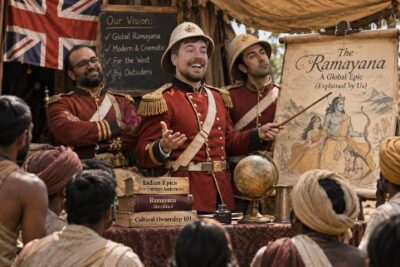
In the film’s marketing campaign, producer Namit Malhotra seems more interested in promoting the film in the United States than in India. On 26 September, Namit Malhotra brought MrBeast, a YouTuber whose audience primarily consists of Western teenagers and adolescent boys, into the film’s promotional campaign. As an audience member, you might wonder: out of all the people in the world, what does MrBeast have to do with the Indian epic Ramayana?
But what we are missing is the most basic fact: this movie is not made for the Indian audience. It is made for the Western audience. Hence, brown-skinned people should shut up and let the “gori chamdi” teach you what the Ramayana really means.
This is not what I think. This is what Namit Malhotra’s actions make me believe.
The entire marketing and promotional campaign of the film seems to have been concentrated in the West. Apart from one appearance on Kaun Banega Crorepati (KBC), there has been almost complete silence when it comes to connecting with the Indian audience. Therefore, a film made with the intention of seeking external validation from the West can never truly be pure in its approach.
With this intention, Namit Malhotra transforms the entire epic into a doomsday-style Avengers movie. He distorts the epic and exercises creative liberty to such an extent that, when you watch this film, you might genuinely start believing that Ravana and Shurpanakha were actually the victims. Malhotra has essentially offered a Marxist interpretation in which Ravana and Shurpanakha are presented as victims.
In this version, Ravana becomes a social reformer fighting for his oppressed Asura clan.
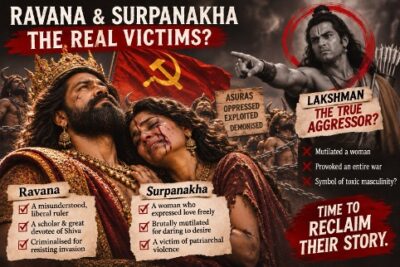
The first major distortion is the depiction of Ravana as someone who fought for Lanka, which is not true.
Ravana received Lanka on a platter from Kubera. The story of Ravana acquiring Lanka from Kubera was not a story of social reform or a struggle for his people. It was a consequence of his arrogance, an arrogance built and fuelled by his mother’s jealousy of Kubera. This arrogance grew to such an extent that Ravana began troubling priests and poor people, forcing them to worship him. And when Kubera confronted Ravana and asked him to stop this cruelty, Ravana, driven by his arrogance, fought against him as well.
The entire aspect of Ravana’s lust and his desire to capture Sita because of her beauty is also completely missed. Instead, we are presented with a narrative in which Ravana abducts Sita to avenge Shurpanakha.
Even if we ignore all of this, the lowest point of the movie, in my opinion, is when Sita scolds Lakshman for cutting off Shurpanakha’s nose. If we read the original epic, we see that Shurpanakha is overcome by lust upon seeing Rama and Lakshmana. She approaches Rama and asks him to marry her. When he refuses, she approaches Lakshmana, who refuses her as well. She then decides to attack Sita, after which Lakshmana, in self-defense and to teach her a lesson, cuts off her nose.
The entire essence of this episode is that both the brother and sister, despite being knowledgeable and powerful, fail to understand the concept of consent. They believe in taking things by force. They believe in the rule of the jungle, the rule of the strongest. But Dharma is not that. Dharma is the responsibility of the strong to protect the weak, to respect boundaries, and to uphold what is right.
Rama is the very embodiment of that Dharma.
Yet, in the movie, we see Sita scolding Lakshmana, creating an impression that the entire responsibility for all the terrible things that will unfold in the epic lies with Lakshmana’s supposed rage. This distortion of the entire epic is nothing but a Marxist interpretation.
There are many other faults one can find in Malhotra’s version of the story. Some of them can be ignored as creative liberty. But the glorification of Ravana is something that cannot be forgiven. Perhaps this is what you get when you hire a research consultant who has accused Lord Vishnu of rape.
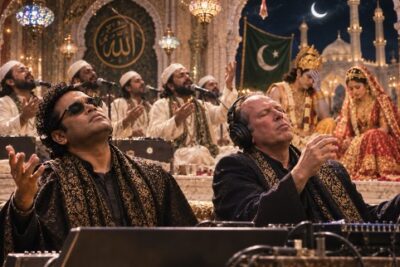
As to the musical score in the film, the songs in the Ramayana fail to impress. Surely, what else can one expect when Malhotra announces a collaboration between Hans Zimmer and A. R. Rahman for the film’s music?
For the music direction/production of an epic like the Ramayana, the director had an incredible opportunity to showcase India’s musical talent. Yet, he chose these two musicians who, in my opinion, have failed to understand the essence of Indian devotional music. A. R. Rahman has, quite literally, used what sounds like a Sufi-Islamic musical style for a Diwali sequence. The wedding of Rama and Sita, too, has a musical quality eerily reminiscent of Kun Faya Kun.
Casting Ranbir Kapoor as Rama was another wrong choice. Kapoor simply does not possess the innocence that Arun Govil’s portrayal of Rama had. Well, what else can we expect from an actor who has appeared in films like Animal, Sanju, and Rockstar, and who claimed to have given up non-vegetarian food for the duration of the production of the film, only to be caught eating chicken?
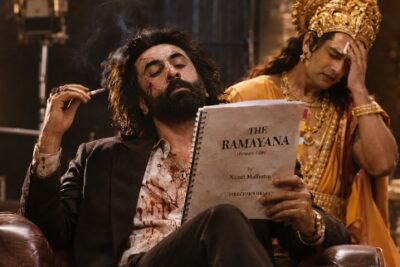
Sai Pallavi as Sita is average at best. There is hardly any chemistry between her and Ranbir. Yash, as Ravana, is good, primarily because the entire film seems to be centered around him. But nothing in this world makes me sadder than watching YouTube clips of public reviews in which children say that they watched this film because of Ravana.
In the Ramayana, Rama was known for maryada, Sita for swabhimaan, and Hanuman for bhakti. Alas, we get none of them in this film.
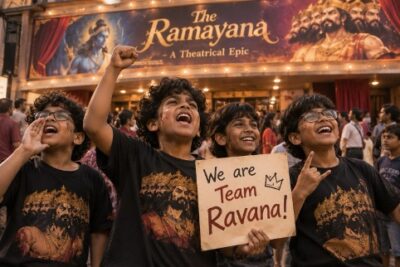
Almost every Bollywood interpretation of the Ramayana has been disappointing, whether it is Adipurush or this film now.
Is everything really this dark? Is there no way left for us to experience the beauty, power, and greatness of our epics? Well, there is.
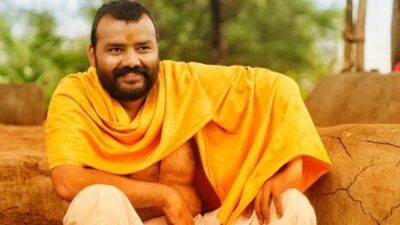
Hanuman Ansh, which was filmed on a budget of ₹2 crore, initially grossed ₹90 lakh in the first week, while the second week was even quieter, earning around ₹40 lakh. However, the film’s fortunes changed dramatically in its third week. It has now become the 17th highest-grossing Hindi film domestically. The film has reportedly generated almost ₹440 crore, with an ROI of approximately 400%. This is nothing short of a miracle.
What does a film made on a budget of about ₹2 crore have to offer? A soul.
The film is based on the book Divine Detour and revolves around the life of Neem Karoli Baba, the spiritual master, whom men and women from near and far came to revere.
While the film is slow to unfold and lacks cinematic spectacle, it is one of the best films I have watched.
It takes you on a spiritual journey and allows you to experience seva, compassion, and devotion. It touches your heart in a way you might never have imagined. And that is because it understands the assignment, which is intention and essence. The intention of the film is pure, and its essence is bhakti.
The entire making of the film was approached in a deeply spiritual manner. No non-vegetarian food was served while making the film; the Hanuman Chalisa was recited in the morning; and there were no unnecessary loud commands on the sets. The entire journey of making this film was spiritual.
The cast does not consist of any big Bollywood names. In fact, the main lead himself was an accidental choice. Yet, his presence in the film is so remarkable that it is genuinely outstanding. He has had his own spiritual journey in life, and the experience of that devotion reflects beautifully in his performance.
But the biggest highlight of the film is its music. The bhajans are not sung by famous Bollywood singers but by local folk singers, preserving their rustic quality and authenticity. The music does not rely on autotune or other artificial enhancements. Instead, it focuses purely on vocals, and that is what makes it so mesmerizing. It grounds your emotions and connects you with the devotion behind every word.
The song Parvati beautifully describes Parvati’s unwavering love for Lord Shiva. The world may see Shiva as a strange ascetic surrounded by snakes, but Parvati sees the supreme consciousness, the innocence and the divinity within him.
Then there is the bhajan Main Tere Hi Bharose Hanuman, sung by Suneel Lodhi, who is blind. The song conveys a beautiful idea: when you surrender the fear of the outcome to Hanuman, you begin to discover courage within yourself. It is through that surrender that fear loses its hold over you.
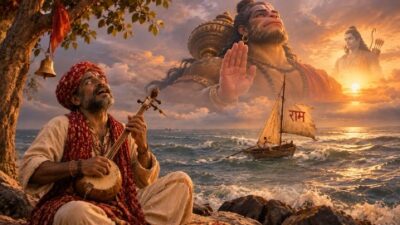
This is not merely a film. It is an experience. For every Ramayana, there is Hanuman Bhakti.
For every Adipurush, there is Mahavatar Narsimha. And through all of this, the light of devotion continues to persist. Hari Anant, Hari Katha Anant.
