
On Asuras, Rākṣasas, and Other Supernatural Beings
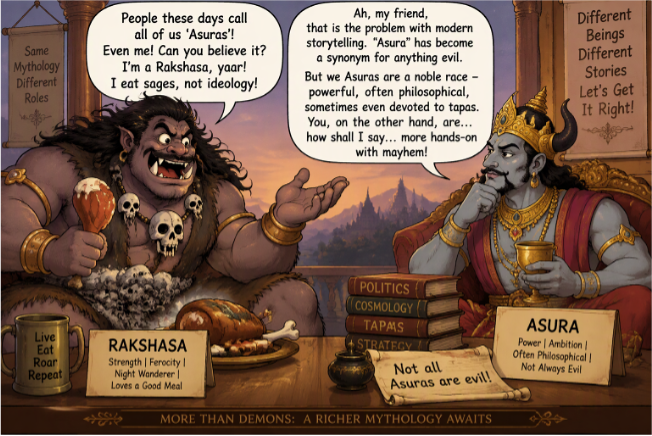
Image: An Asura meeting a Rākṣasa in AI’s imagination
Recently, we watched the new 3D movie Ramayana (the Hindi version) at a Cineplex theatre here in the eastern nook of Canada. It was visually grand and action-packed. But it turned out to be disappointing for me. Not because it told only half the story, leaving the rest for future productions. Its deviation from the traditional narrative failed to produce any good vibes. But the main reason was that I watched two epic TV serials in the prime of my youth – Ramanand Sagar’s Ramayana (1987) and B. R. Chopra’s Mahabharata (1988). These TV epics established a benchmark that is difficult to surpass. Any new visual retelling inevitably invites comparison with those landmark productions, and unless it matches their depth, authenticity, and emotional resonance, disappointment is almost unavoidable.
This article is not about the movie; it deals with another interesting matter. In the movie, I heard the terms “asura” and “rākṣasa” being used interchangeably. This is very common in modern Indian literature. Not only these two, but many other equally colorful supernatural beings – like the Daityas, Dānavas, Yakṣas, Gandharvas, and Kinnaras – are brought under one catchall term “asura,” which has become an umbrella term for any “bad guy”. In the ancient lore and in the regional legends, these different classes of supernatural beings had distinct personalities, quite different from each other.
Classes of Supernatural Beings
Interestingly, Amarakośa, the ancient Sanskrit lexicon composed by Amarasimha in the 5th century CE, lists the following categories of supernatural beings:
Vidyādharo’psaro-yakṣa-rakṣo-gandharva-kinnarāḥ ।
Piśāco guhyakaḥ siddho bhūto’mī devayonayaḥ ।।
विद्याधरोऽप्सरो-यक्ष-रक्षो-गन्धर्व-किंनराः।
पिशाचो गुह्यकः सिद्धो भूतोऽमी देवयोनयः ।।
This shloka mentions ten beings, namely the Vidyādhara, Apsara, Yakṣa, Rākṣasa, Gandharva, Kinnara, Piśāca, Guhyaka, Siddha, and Bhūta. All these, including even the rākṣasa, piśāca, and bhūta, are mentioned as devayonayaḥ, from the womb of the gods. It means they are all treated as divine beings. In our fascinating legends, we come across not only these ten but many more equally charismatic supernaturals. Let us now meet some of these ten and a few others.
Asuras and Rākṣasas
As said earlier, the Ramayana movie treats the terms Asura and Rākṣasa as interchangeable, although they belong to very different classes of beings in our ancient legends. The Asuras are of noble lineage on par with the devas (gods). They are descendants of the same father but of different mothers. In the itihāsas and the purāṇas, the sage Kaśyapa married several daughters of Dakṣa Prajāpati. His wife Aditi gave birth to the Ādityas (devas), and her sisters gave birth to the various clans collectively called Asuras. Daityas descend from wife Diti, Dānavas from wife Danu, Kālakeyas from wife Kālakā, and Paulomas from wife Pulomā.
The Samudra Manthana, or the churning of the “milky ocean,” was a joint project of the Asuras and the Devas. Despite the constant cosmic wars between them, marriages across the two clans were quite common in our colorful legends. Śaci (Shachi) was the wife of Indra, the king of the Devas, and thus she was their chief queen. But she belonged to the Asura clan, the Danava. Rati Devi, the wife of Kāma Deva (God of Love), was an Asurī (female of the Asura clan). In the romantic legend of Kaca and Devayānī, Kacha was a sage from among the Devas, while Devayani was a pretty Asura damsel. Being the daughter of Shukracharya, who was a Brahmin, she was only half-Asurī. In the love story of Usha and Aniruddha, Usha was a lovely Asurī, the daughter of the Asura king Bāṇa, and the dashing Aniruddha was human and as handsome as his grandfather Shri Krishna. Many Asuras were ardent devotees of Vishnu and Shiva. The famous Prahlāda, son of Hiranyakaśipu, and Mahābali, renowned for his generosity, were Asuras and great devotees of Vishnu.
In ancient Persia, the Ahura was the cognate cousin of the Asura. The Ahuras were heavenly beings. Ahura also meant lord. Zarathustra elevated one of the Ahuras as Ahura Mazda, the supreme monotheistic God. Ahura Mazda, or the Sanskrit cognate Asura Medha, means Supreme Intellect.
In contrast to the Asuras, the Rākṣasa were beings of tamas (darkness). They were malevolent, shapeshifting creatures inhabiting forest lands. They found pleasure in causing trouble to human beings, especially to sages performing yāgas. But Rākṣasas are also sometimes portrayed in the ancient lore as handsome men and pretty women, well-versed in the Vedas, and speaking impeccable Sanskrit. Rākṣasas also entered into military and matrimonial alliances with the Asuras, Devas, and humans. Ravaṇa, the villain of the Ramayana, was the son of Kaikasi, a Rākṣasi (a female Rākṣasa), and a Brahmin sage Viśhravas. Ravaṇa’s wife Mandodari was the daughter of Mayāsura, the legendary Asura architect and king of the Dānava. The Rākṣasa king Sukeśa, a maternal ancestor of Ravaṇa, had as his wife the daughter of the Gandharva king Grāmaṇī. The Pāndava prince Bhima had a son, Ghaṭotkaca, with Hiḍimbi, a Rākṣasi from the heavily forested plains bordered by the foothills of the Himalayas.
Ancient texts make a clear distinction between Asura and Rākṣasa: असुषु रमन्ते इति असुराः, those who revel in sense enjoyments are Asura; and परहिंसाप्रधाना राक्षसाः, those who mainly cause pain to others are Rākṣasa.
Vidyādharas
Unlike the primal Rākṣasas or the cosmic Asuras, Vidyādharas are overwhelmingly considered benign, cultured, and deeply benevolent. They are essentially the mystical scholars, aerial wizards, and romance heroes of ancient Indian literature. They prominently figure in the Jātaka tales of the Buddhists, the Jaina legends, the Kathāsaritsāgara, the itihasas, and the puraṇas. King Vikramaditya (hero of the Vikramaditya and Vetāla stories) was a Vidyādhara in his pūrva janma (previous birth). So was the famous Udayana of Kathasaritsāgara, a romance-loving king of Kaushambi.
Vidyādharīs, the female counterparts of Vidyādharas, appear in Kathasaritsāgara as major romantic heroines. The two famous queens of Naravāhanadatta (who eventually becomes the emperor of the Vidyādharas), Madanamañcukā and Vegavatī, are Vidyādharīs possessing powers of flight and shapeshifting.
Vidyādhara was a popular masculine name in India at one time. You could find many Vidyādharas in North India and Vidyādharans in South India. Sir Vidiadhar Surajprasad Naipaul (the Nobel Laureate V.S. Naipaul) of Trinidad and Tobago carries the Vidyādhara name.
Yaksha and Yakshi
The Yaksha and his female counterpart, Yakshi or Yakshini, were beautiful beings with an artistic nature. Yakshis often ended up as Sālabhañjikas, the enticingly voluptuous sculptures of maidens who act as parts of load-bearing pillars or columns in temples. A Yaksha in Kalidasa’s Meghadūta, banished to the forests of Central India, asks a dark rain cloud to convey his earnest longings for his dear wife living far away in the north in her Himalayan abode. The lofty Himalayan ranges were the abode of the Yaksha – Kinnara – Gandharva. When the Yakshi reached Kerala, she was still enticingly pretty, but only to seduce gullible men who finally end up being devoured by her atop the tall, black, and intimidating palm tree (karimpana).
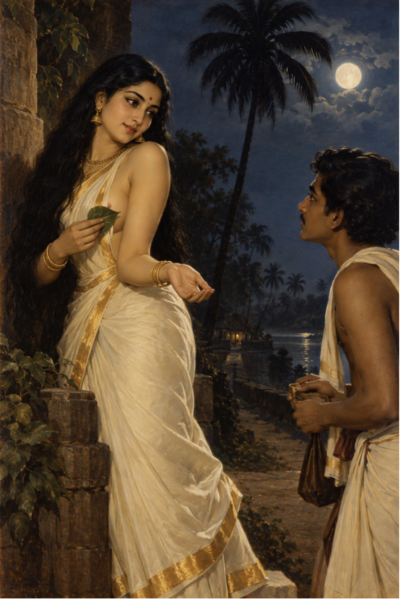
A Yakshi seducing a young man, in the imagination of AI (Artificial Intelligence)
Sage Vishravas, Ravaṇa’s father, was also the father of Kubera. Kubera’s mother was a Yakshini. Kubera became Yaksharāja, king of the Yakshas, and through penance, he also became a Deva, the God of Wealth. Thus, Yaksharāja Kubera is the older stepbrother of Rākshasarāja (king of Rākshasas), Ravaṇa.
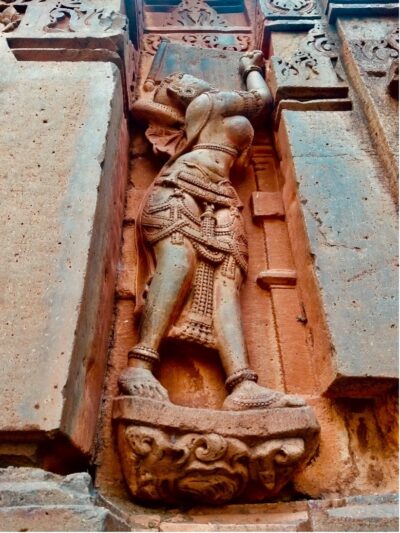
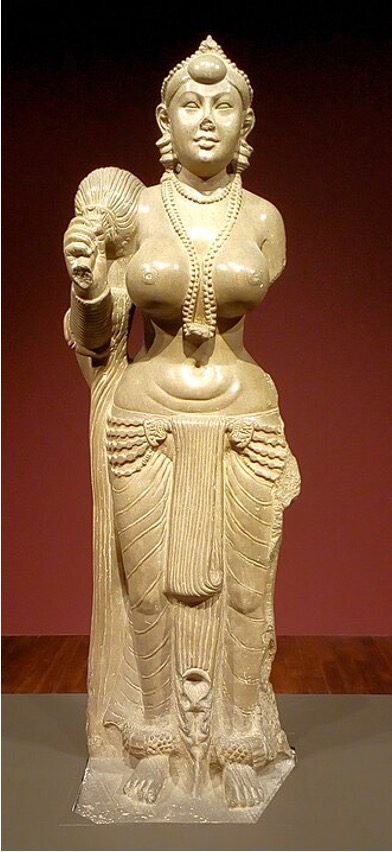
Hoysala Salabhanjika of circa 1100 CE and Deedarganj Yakshi of circa 200 BCE. Pictures from Wikipedia
Gandharvas and Apsaras
The Gandharvas are majestic, highly powerful celestial spirits who serve as the overarching masters of music (Gandharva Veda). They excel primarily at instrumental orchestration (such as the stringed lute or veena) and composition. They are closely tied to the cosmic court of Indra in the Deva Loka (the heavenly realms). The term “Gandharva” is often seen to be associated with the names of modern singers, as in “Gāna Gandharva” XYZ. Gandharvas are portrayed as benevolent, but in Kerala lore, these handsome supernaturals can have a darker side, a tendency to cohabit invisibly with human women (with or without their consent). This is somewhat like the Hebrew “Sons of God” of the Elohim class finding the “Daughters of Men” attractive and having progeny with them. The Gandharvas, however, did not leave any progeny with their human partners of Kerala.
Apsaras, the female counterparts of Gandharvas, are celestial dancers. Although they are placed in the Gandharva category, they have an origin different from that of the Gandharvas. The mainstream Apsaras have a water connection – apsaras literally means “moving in the waters” (ap = water, saras = moving). They were born during Samudra Manthana, the churning of the milky ocean. Some apsaras have a different origin. For example, Urvaśī was created from the thigh (ūru) of sage Nārāyaṇa to humble the pride of Indra’s court dancers.
Urvashi, Menaka, Rambha, and Tilottama are famous Apsaras of the heavenly court of Indra. Illustrious personalities like the valiant king Purūravas or the venerable sage Viśvāmitra could not resist the charm of the heavenly Apsaras.
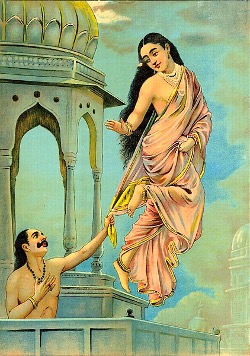
King Pururavas and Urvashi; Copy of a Raja Ravi Varma painting from Wikipedia
Kinnara
The Kinnaras and their female counterparts, Kinnaris, are traditionally depicted as gentler, more peaceful mountain and forest spirits dwelling in Kinnara Desha in the rugged trans Himalayan ranges. Modern Kinnaur in Haryana is thought to be mythologically connected to this ancient Kinnara Desha. The Kinnaras are portrayed primarily as vocalists and devotional melodists. The word “Kinnara” underwent a nuance change in modern times. Now, they are considered people of Tritiya-Prakriti (third nature or third gender), meaning transgender and intersex communities. “Kinnari” was once a popular female name, especially in North India. The masculine “Kinnar” is rarely found nowadays, presumably because of its modern association with the third gender. The Malayalam word “kinnāram” originated from the word kinnara. It started as kinnaram, denoting the sweet musical notes from the stringed instrument of the same name associated with the Kinnaras, and over time underwent a semantic change and an elongation of the vowel to mean playful flirting or sweet nothings.
Siddha, Guhyaka, and Cāraṇa
Alongside the Vidyādharas, ancient epics frequently describe two other sky-dwelling clans who hover over great battles, showering flowers and singing praises: the Siddhas and the Cāraṇas.
The Siddhas are human ascetics and yogis who attained supernatural powers (siddhis) through their intense sādhana (spiritual practice) and tapasya (penance).
Cāraṇas are divine wanderers, minstrels, and chroniclers who roam the cosmos singing the praises of gods and heroes. They are inherently semi-divine like the Gandharvas and did not need any penance to attain this status. The Cāraṇas have a living earthly counterpart in western India (especially Gujarat and Rajasthan), where the Charan (चारण) caste has historically served as revered royal bards, poets, and historians for centuries.
The Guhyakas are secretive mountain spirits who serve alongside Yakshas as attendants to Kubera.
Bhūta – Preta – Piśāca
Ah, now we come to the haunting grounds of the ghostly apparitions of our ancient stories – Bhūta, Preta, and Piśāca.
In everyday conversation across India, these three are often lumped together as generic “ghosts.” However, in classical Sanskrit texts, the Puraṇas, and traditional funeral rites (Garuda Puraṇa), they represent very distinct states of existence and different types of beings.
Not all Bhutas are ghosts. Some are semi-divine, like those of the Bhūtagaṇa of Shiva. The non-divine Bhutas are indeed ghosts. The word Bhuta literally translates to “that which has been“ (the past). If a person dies in an unnatural, violent manner, or dies prematurely (such as in an accident or by suicide), or dies with extreme, unresolved earthly desires, their soul fails to cross over into the ancestral realm (the pitṛ loka). Instead of moving on, they remain stuck in the subtle earthly plane as a Bhuta—a wandering, restless spirit tied to their past life, often haunting the places or people they were attached to.
Preta literally means “one who has gone forth“. A Preta is the immediate state of a soul right after physical death. Before the proper funeral rites (Śrāddha and Sapiṇḍīkaraṇa) are completed—usually a 10-to-13-day process—the soul is trapped in a liminal, disembodied state. It is driven by intense hunger, thirst, and attachment to its old body and family. If the rites are completed properly, the Preta transitions peacefully into the realm of the ancestors (pitṛ loka). Because of past misdeeds and bad karma, a soul can linger indefinitely in the Preta state without passing on to the pitṛ loka.
Piśācas are demonic and malevolent shapeshifters that are often found in cremation grounds. They can assume any form, may become invisible, and feed on human energy. They are also portrayed as eaters of raw flesh. Human beings can be born as Piśācas in the next birth on account of the load of bad karma.
In short, a Preta is a soul in transit, a Bhuta is a soul stuck in the past, and a Piśāca is a dark entity—either by primordial birth or as a grim karmic punishment for a wicked human life.
Below is an AI-generated image of a meeting between the Bhuta-Preta–Piśāca team and the Ghost-Goblin-Ghoul team. It moved Ghoul, the Semitic demon from the deserts of Arabia, to the dark background, yet closer to the side of the Bhuta-Preta–Piśāca team.
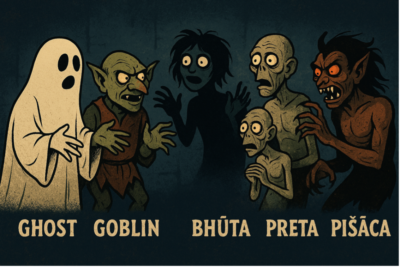
Meeting of Bhuta-Preta–Piśāca with Ghost-Goblin-Ghoul in AI’s imagination
Law of Karma and Saṃsāra
Every single one of the supernatural beings — Devas, Asuras, Gandharvas, Yakshas, Kinnaras, Vidyādharas, Preta-Bhuta–Piśāca, and all others—is strictly bound by the law of karma and saṃsāra.
In Indian philosophy, heaven (svarga) or semi-divine status is merely a temporary luxury hotel paid for by immense good karma (puṇya). Once that kārmic bank balance runs out, or if they commit an error, even a celestial being must fall back down into the cycle of birth and rebirth (saṃsāra). Only by realizing the Ultimate Reality (Brahman or Nirvāṇa) does a soul permanently cross the ocean of Saṃsāra and achieve liberation (moksha). This is the absolute bedrock of Indian philosophy and cosmology.
